_2,_2011_June.jpg)
Sundøy Bridge
A mountain range can function as a border. When the Helgeland Bridge opened in 1991 and finally tied the island of Alsta to the Norwegian mainland, the residents of Sundøya watched the celebration from the far side of seven peaks — connected on the map, cut off in practice, because no road crosses the Seven Sisters and none ever will. They kept their ferry. They also kept an argument, and they made it patiently for twelve years: if the island got a bridge, then the part of the island the bridge did not reach was owed one too. On 9 August 2003, they won it.
The Wrong Side of the Ridge
Alsta is not a large island, but it is an awkward one. The Seven Sisters run down its spine — Botnkrona at 1,072 metres, Skjerdingen, Grytfoten and the rest — a wall of rock steep enough that the road network on one shore has no relationship at all to the road network on the other. Sandnessjøen, the island's town, sits southwest of the range. Sundøya is a village on the eastern side, facing the mainland across a narrow reach of the Leirfjorden. When the Helgeland Bridge landed on Alsta, it landed on the wrong side for them. Going anywhere still meant waiting at a ferry slip while the rest of the island drove. That is a specific kind of frustration, and it does not fade.
A Bridge Worth Arguing About
Sundøya had fewer than 150 inhabitants. The bridge cost well over 150 million kroner. Nobody pretended those numbers made obvious sense together, and the decision was genuinely disputed in Norwegian public debate — the kind of project that invites a certain sort of newspaper column about money spent on the sparse north. The counter-argument was not economic. It was about fairness. A community had been passed over once by an accident of topography, and the country had already decided, when it built the 1991 crossing, that Alsta deserved a fixed link to the mainland. Sundøya simply asked that the decision be applied to all of Alsta rather than to the convenient half of it. That argument won.
No Cables, No Towers
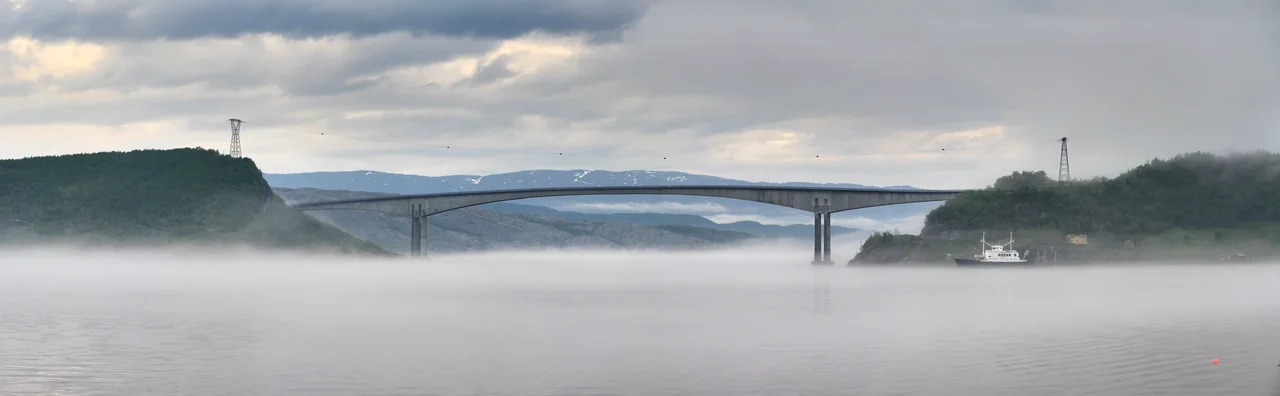
Anyone expecting a smaller cousin of the Helgeland Bridge is in for a surprise, because the two structures share a fjord and almost nothing else. The Sundøy Bridge carries no stay cables and has no towers. It is a free-cantilever concrete box girder: 538 metres in three spans, with a main span of 298 metres and 43.5 metres of clearance to the water. Its weight is its own problem to solve, so the designers reduced it. The main span uses high-strength lightweight aggregate concrete — a mix called LC60 — while the side spans are cast in normal-density C65. Lighter concrete in the middle means less dead load for the cantilever to carry as it reaches out from the piers, which is how a span this long stands up without a single cable. When it opened, 298 metres put it among the longest concrete cantilever spans in the world; only Stolma, elsewhere in Norway, had reached further, at 301 metres.
August 2003
Jan-Eirik Nilsskog designed it, and the bridge opened to traffic on 9 August 2003. The old ferry landing is still there on the mainland shore, a slab of concrete sloping into the water in the foreground of nearly every photograph anyone takes of the span above it. That juxtaposition is the story in a single frame: the thing that used to govern your day, and the thing that replaced it. For 150-odd people, the change was total and mundane at the same time. No timetable. No last boat. Just a road, running out over the fjord and back onto the mainland, available at three in the morning to anyone who needs it.
From the Air
The Sundøy Bridge spans the Leirfjorden at 66.021°N, 12.933°E, roughly 10 km east of the Helgeland Bridge and on the opposite side of the Seven Sisters ridge. Fly it at 1,000 to 3,000 feet AGL. Unlike its cable-stayed neighbour it has no towers, so look instead for a low, pale three-span concrete arc with a pronounced hump over the centre and the remains of the old ferry slip on the mainland shore. Sandnessjøen Airport, Stokka (ENST) is the nearest field, on the far side of the mountains; Mosjøen Airport, Kjærstad (ENMS) lies southeast. The Seven Sisters generate significant mechanical turbulence and rotor in westerly flow — give the ridge line room, and expect rapid visibility changes in this maritime air.
Nearby Stories
- Lukttinden 8.5 km away
- Grane Church 18 km away
- Lomsdal–Visten National Park 19 km away
- Vega 22 km away
- Træna Lighthouse 23 km away
- Bremstein Lighthouse 65 km away
- Operation Musketoon 65 km away
- Dunderland Valley Bus Crash 90 km away