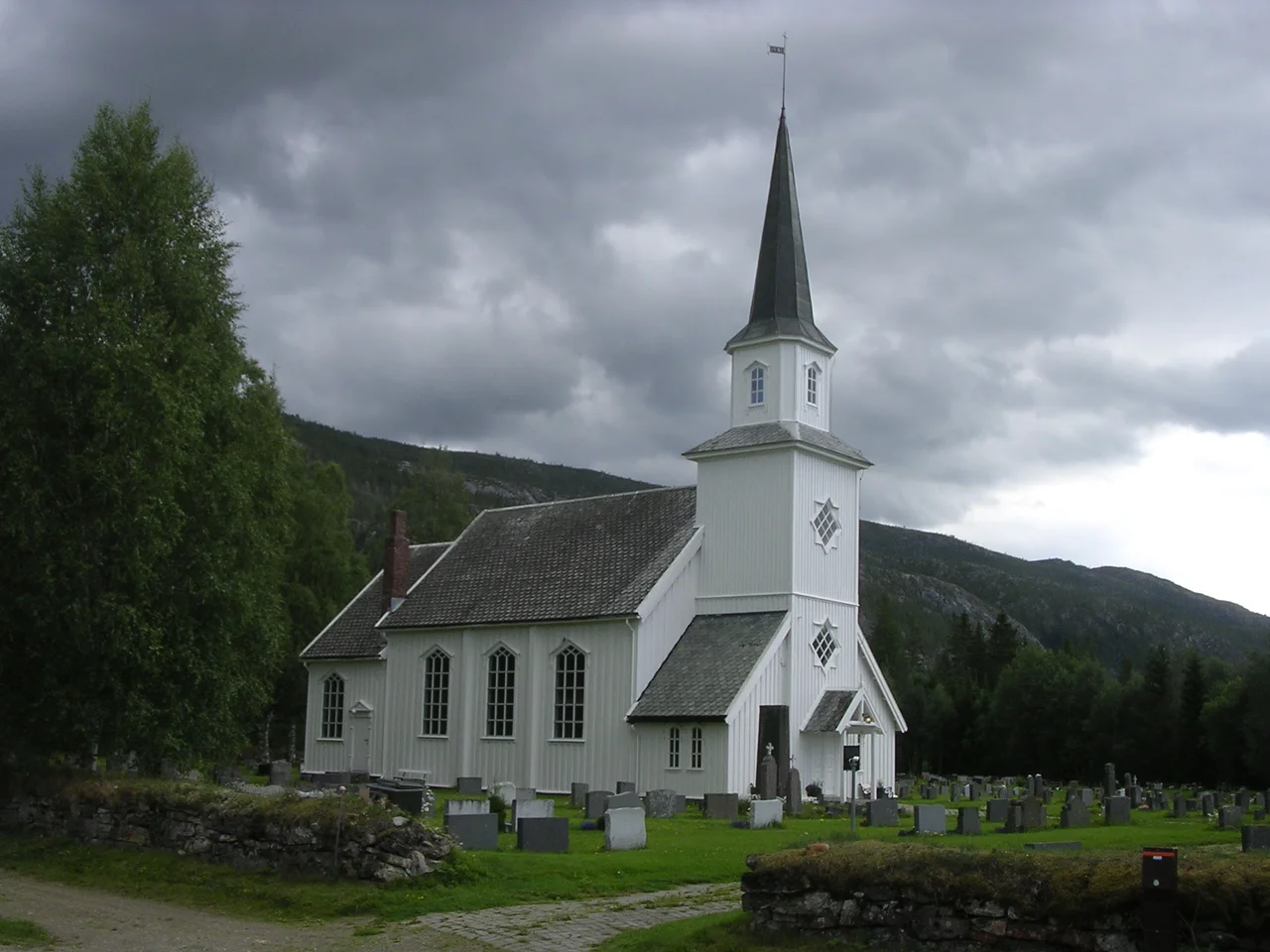

Grane Church
A model sailing ship hangs inside Grane Church, and Grane Church is nowhere near the sea. The vessel is called Brit. Votive ships are a long-standing fixture of Norwegian churches — offerings of thanks for a safe passage, or of hope for someone still out on the water — and they are usually found in the coastal parishes where the risk was daily and literal. Here the fjord at Mosjøen lies well to the north, with the Atlantic beyond it, and the nearest water is the Vefsna running past 250 metres away. On the coast such a ship is a prayer about the sea. Inland, hung above a farming and forestry congregation, it becomes something more like a memory of where these families came from.
Older Than the Room It Stands In
The altarpiece at the east end predates the church around it by roughly two centuries. It dates from the 1600s and it was not made for this building; it came from Dolstad Church in Mosjøen, downriver at the fjord. Norwegian parishes have passed furnishings along like this for generations — when one congregation rebuilds or refits, the older fittings travel upstream to a newer, poorer church that needs them. What Grane received was a piece of seventeenth-century work that had already served another Helgeland congregation for two hundred years before it was set up here.
The result is a building where nothing quite matches in age. The timber walls went up in 1860. The altarpiece was old when the first tree was felled for them. The ship in the nave, the churchyard outside, and the 1999 service building beside it that houses the parish offices each belong to a different century entirely.
White Timber Beside the E6
The church was built in 1860 to plans by Andreas Grendestad and Andreas Nilsskog, and consecrated on 22 July that year. Its form is the Norwegian standard: a long church, white-painted timber, a rectangular nave running into a narrower chancel on one axis, with room for about 230 people. That is a generous number for this valley. Rural congregations here built for confirmations, funerals and Christmas Eve rather than for a wet Sunday in October.
It has been worked on twice since — restored in 1890, and again in 1988 — and it stands directly beside the E6, which means most people who have ever seen it saw it through a car window at speed. There is one more oddity in its position. Grane Church sits at almost exactly the latitude of Luleå Cathedral — go due east from this churchyard, across the width of Sweden, and after some four hundred kilometres you reach it at the head of the Gulf of Bothnia.
The Church That Named a Municipality
This is the building that gave a district its name. The first Grane Church was raised in 1860 on the old Grane farm, a holding recorded under that spelling as far back as 1661, and the parish took the farm's name from the church that stood on it. When the parish was separated from the sprawling Vefsn Municipality on 1 July 1927 to become a municipality of its own, with 1,746 residents, it carried the same name again. The boundaries drawn then have never changed.
So an entire administrative unit, two thousand square kilometres of forest, lake and mountain reaching south to the Trøndelag border, is named after a farm, which supplied its name to a church, which supplied it back with interest. Today the Church of Norway maintains a single parish across the whole municipality, part of the Indre Helgeland deanery in the Diocese of Sør-Hålogaland, and Grane Church is its principal building. Services are held roughly twenty times a year.
The Place That Stayed Put
Everything else moved. The administrative centre of the municipality is Trofors, a few kilometres south, where the roads and the railway converge and where nearly three in five of Grane's residents now live. The church did not follow. It stayed at the old farm, on the riverbank, in a village that gave its name to a municipality and then quietly handed the working life of that municipality to somewhere else.
What that leaves is a building doing the slow, unglamorous work rural churches do: a churchyard filling by degrees, a set of offices added in 1999 in a plain new building next door, and a model ship named Brit hanging in the nave above all of it, still sailing nowhere.
From the Air
Grane Church stands at 65.5831°N, 13.3967°E, on the east side of the Vefsna valley in inland Helgeland, about 250 m from the river and immediately alongside the E6 highway. Best viewed from 1,500–3,000 ft AGL: white timber walls and a churchyard make a sharp geometric contrast against dark spruce forest, and the contrast is strongest under snow, when the roofline is one of the few straight edges in the landscape. Follow the E6 and the Nordlandsbanen railway north from Trofors — the church lies a few kilometres up the valley on that line, with Laksforsen waterfall further downstream to the north. Terrain rises quickly east and west of the valley floor; 8,000 ft clears everything in the municipality, including Kvigtinden at 1,699 m (5,574 ft). Nearest airports: Mosjøen Airport, Kjærstad (ENMS) to the north, Mo i Rana (ENRA) beyond it, and Namsos (ENNM) to the south. Valley fog and low stratus are common; midwinter daylight is limited to a few hours around noon.
Nearby Stories
- Lukttinden 8.1 km away
- Okstindbreen 8.6 km away
- Sundøy Bridge 12 km away
- Hattfjelldal Municipality 12 km away
- Lomsdal–Visten National Park 13 km away
- Majavatn 26 km away
- Ranseren 28 km away
- Namsskogan Municipality 58 km away