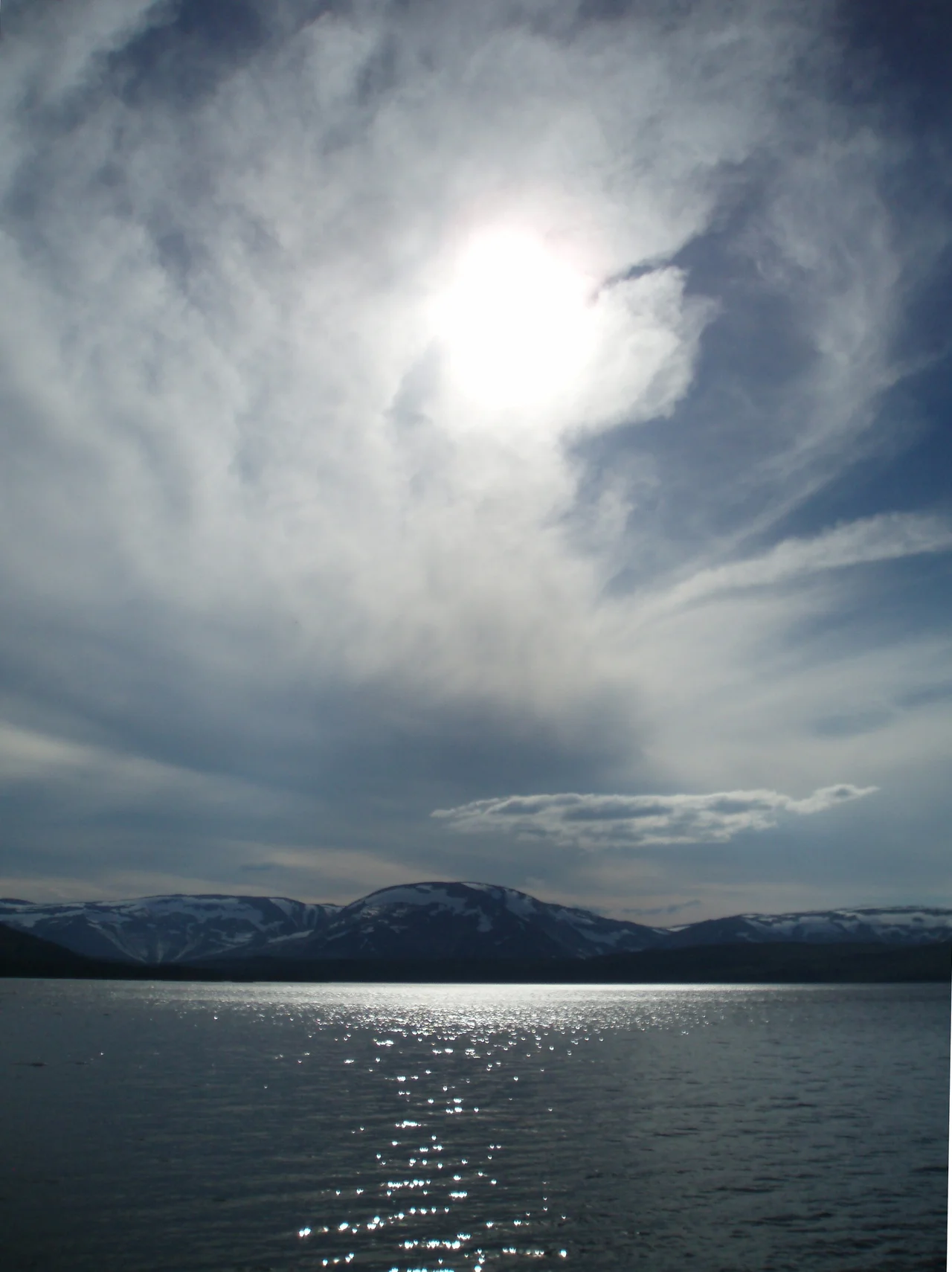

Majavatn
Read the list of the twenty-four men shot at Falstad in October 1942 and it is not the number that stops you. It is the addresses. Aursletta, Aursletta, Aursletta. Holmen, Holmen, Holmen. Stavassdalen, Stavassdalen, Stavassdalen. Majavatn seven times over. Two Øygårds from the same small place, two Holmens from the same small place, two Liens from the same small place. Grane is a thinly settled municipality in interior Nordland — farms strung along a valley, a church, a railway halt — and over two mornings it lost twenty-four of its men. Whatever else the Majavatn affair was, it was first of all something that happened to a handful of neighbouring households who all knew each other.
A Stop on the Line
Majavatn today is a village on the eastern shore of Majavatnet, sitting at 320 metres above sea level just west of the boundary of Børgefjell National Park. Two arteries pass straight through it: the E6, Norway's spinal highway, and the Nordland Line. Majavatn Station stands 321.74 kilometres north of Trondheim Central. Majavatn Church serves the southern end of the municipality. The village of Leiren lies about 30 kilometres northeast, the municipal centre of Trofors about 45 kilometres north. Southern Sami herders still move reindeer through this country, as they have for centuries. It is, in every visible respect, a place you would drive past. That was exactly its value in 1942 — a rail line, a road, empty mountains behind it, and a border with neutral Sweden close enough to reach on foot.
Weapons Over the Fells
Resistance groups across Helgeland worked with supply operations run out of Britain, tied to the Shetland Bus boat traffic and to the plans gathered under the name Operation Jupiter. Captain Birger E. Sjøberg, who used the alias Nils Berdahl, organised expeditions into the region to make contact with local groups and to bring in weapons and equipment. The material was carried inland across the mountains into the districts of Grane and Vefsn — hard country, hauled by people who knew it. At Tangen farm in Majavatn, resistance members stored what came through. Farms make good caches. They also make terrible ones, because a farm cannot be moved and everybody in a valley knows whose it is.
What Happened at Tangen
In 1942 the Gestapo unravelled part of the Helgeland network. The arrest of a telegraph operator gave them the thread, and it led to Tangen farm. The men there learned that German forces were coming. There was fighting at the farm that autumn; several escaped into the mountains behind it and some of those eventually reached Sweden. On 6 September, two German police officers were shot at Majavatn. Arrests followed across Grane, Vefsn, Vevelstad and the Trondheim area. In the ordinary run of the occupation this might have ended in prison sentences. It did not, because the killing of the two policemen reached Josef Terboven, the German Reichskommissar for Norway, and Terboven governed by making examples.
Terboven's Week
He arrived in Trondheim by train on 5 October. The next morning, red notices declaring civilian martial law went up across the city, covering Trondheim and its neighbours, the whole of Nord-Trøndelag county, and — pointedly — Grane Municipality, hundreds of kilometres north. Curfew from eight at night until five in the morning. No long-distance travel. No assembly. Newspapers stopped. Nearly thirteen thousand police, Hird members and soldiers were mobilised to enforce it. That evening Terboven announced over loudspeakers in Trondheim's main square that ten prominent local men had already been shot at Falstadskogen as what he called atonement sacrifices; eight of them were being held a block away and heard their own deaths announced before they were driven out to the forest. The same week's decrees were used as a pretext to arrest every Jewish man in the area — a step on the road that would take most of Norway's Jews to Auschwitz within months.
Two Mornings in the Forest
On 7 October a tribunal convened at Falstad under Gerhard Flesch. Its proceedings were summary. It condemned fifteen men from Grane, and they were shot the following morning. Nine more were condemned on 8 October and shot on 9 October. Thirty-four Norwegians were killed extrajudicially during that one week of martial law, which was lifted on 12 October once the occupation authorities decided order had been restored. The twenty-four from Grane were Peder Stor-Tjønnli, Johan Audun, Johan Øygård, Einar Øygård, Ole Sæter, Olaf Svebakk, Alf Stormo, Oddvar Olsen, Magnus Lien, Edvard Sæter, Peter Lund, Arne Holmen, Mikael Holmen, Aksel Johansen, Ingvald Melingen, Tormod Tverland, Leif Sjøfors, Bjarne Lien, Nils Møllersen, Arne Moen, Agnar Blåfjellmo, Emil Øylund, Peder Forbergskog and Rasmus Skerpe. They are worth reading slowly. Falstadskogen holds more than two hundred dead from 1942 and 1943 — forty-three Norwegians, seventy-four Yugoslavs, over a hundred Soviet citizens. Of the forty-three Norwegians, thirty-four were killed in that single week.
The Trains Still Pass
Terboven's calculation was that terror would break the resistance. It did the opposite: over the remaining two and a half years of occupation the Norwegian underground grew better organised, better connected, and harder. That is cold consolation in Grane, where the loss was concentrated in a way no national outcome balances. Stand at Majavatn now and you get lake, birch, the church, the railway, the fells of Børgefjell rising to the east, and a northbound train that does not stop for long. The place gave the affair its name. The men it took were mostly farmers.
From the Air
Majavatn lies at 65.166°N, 13.369°E, at roughly 320 m elevation on the eastern shore of Majavatnet in Grane Municipality, interior Nordland. From the air, the village sits at the meeting of two unmistakable linear features — the E6 highway and the Nordland Line railway — running north–south through an otherwise empty valley, with the dark granite highlands of Børgefjell National Park rising immediately to the east. The lake itself is the local visual anchor. Recommended viewing altitude 3,000–6,000 ft AGL to keep the road, rail line and lake in one frame; terrain to the east demands considerably more. Nearest airfields are Mosjøen Airport, Kjærstad (ENMS) to the north-northwest, Mo i Rana Airport, Røssvoll (ENRA) further north, and Namsos Airport, Høknesøra (ENNM) to the southwest. This is a classic valley-weather corridor: low cloud and reduced visibility are common, and daylight is short from November through February.
Nearby Stories
- Grane Municipality 1.6 km away
- Stora Blåsjön 3.1 km away
- Jetnamsklumpen 6 km away
- Limingen 9.2 km away
- Unkervatnet 13 km away
- Namsskogan Familiepark 15 km away
- Lomsdal–Visten National Park 23 km away
- Namsskogan Municipality 28 km away