
Sunnylands
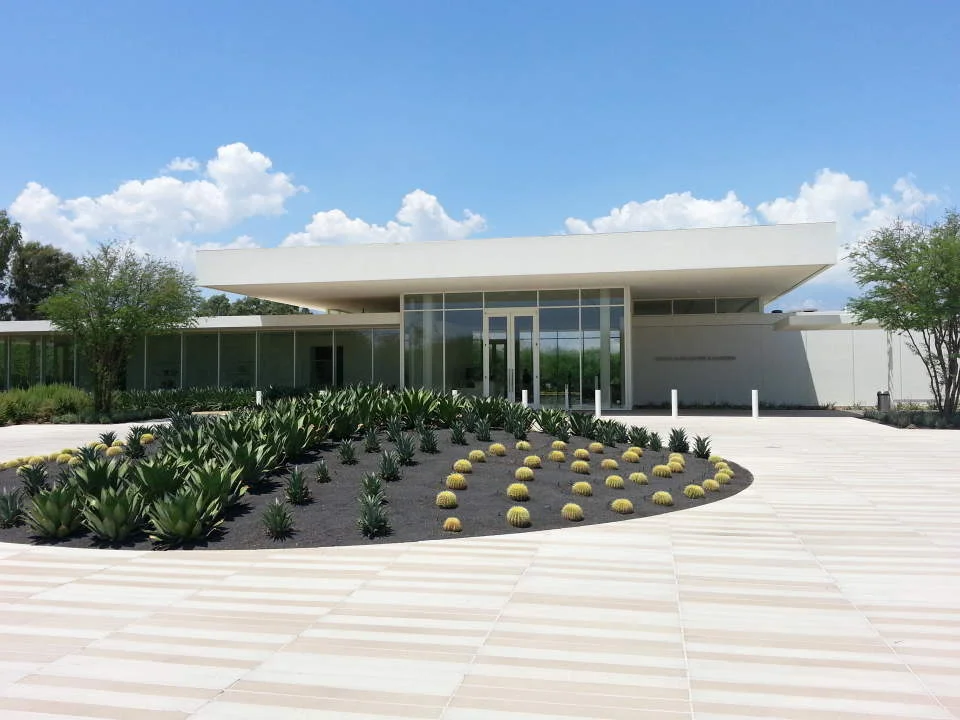
The pink roof was not a subtle choice. When architect A. Quincy Jones completed the Annenberg estate in Rancho Mirage in 1966, the compound's distinctive pink color was visible for considerable distances across the Coachella Valley flatlands, a deliberate signal that something significant occupied these 200 acres. Walter Annenberg, who had built a publishing empire that included TV Guide and the Philadelphia Inquirer, did not build things quietly. He built Sunnylands to the scale of his ambitions and filled it with the art those ambitions could afford: Picasso, Van Gogh, Monet, Wyeth — a collection that would eventually be donated to the Metropolitan Museum of Art.
A Compound Built for History
At the time of its completion, Sunnylands was the largest private residence in Riverside County. The Jones design spread across the site in a series of low horizontal pavilions connected by covered walkways, the low profile emphasizing the vast scale of the property rather than the height of any single structure. The compound included not only the main house but guest cottages, service buildings, a nine-hole golf course, a pool, and the gardens that visitors today encounter as one of the estate's primary draws. Jones, who had built a significant practice in Southern California modernism, created for the Annenbergs a building that embodied the post-war California dream at its most expansive.
Camp David of the West
The Annenbergs used Sunnylands as a center of social and political gravity from its earliest years. Frank Sinatra was married at the estate. Every US president from Nixon to Obama either visited or used the compound for significant diplomatic purposes. President George H.W. Bush hosted Japanese Prime Minister Toshiki Kaifu there in 1990. President Barack Obama met Chinese President Xi Jinping at Sunnylands in 2013 — a bilateral summit that generated significant diplomatic attention. In 2016 the estate hosted an ASEAN summit. The nickname 'Camp David of the West' captured something real: this was a place where the informal became formal, where the social relationships cultivated over decades of hosting yielded meetings of genuine consequence.
The Art That Moved to New York
The Annenberg Impressionist collection was one of the significant private collections assembled in the twentieth century United States. Works by Picasso, Van Gogh, Monet, and Andrew Wyeth hung in the rooms where presidents and prime ministers relaxed over dinner, creating an atmosphere of casual engagement with some of the most valuable objects in American private hands. In 1991, Walter Annenberg pledged the entire collection — ultimately appraised at over a billion dollars — to the Metropolitan Museum of Art. The works transferred to New York after Leonore Annenberg's death, leaving the house itself and the gardens as the estate's primary cultural artifacts. The collection's departure was a kind of dispersal: the art that had defined the house's interior character now belongs to a public institution.
A Property That Outlasted Its Owners
Walter Annenberg died in 2002; Leonore Annenberg died in 2009. Both are interred on the Sunnylands property, a choice that expresses the depth of their attachment to a place they had built as the culmination of a lifetime of acquisition. After Leonore's death, Sunnylands opened to the public through the Annenberg Foundation Trust, which manages the estate as a center for study and reflection — a mission that formalized what the compound had always been informally: a place set apart from ordinary time, where the business of the world was conducted in an atmosphere of unusual deliberateness. The gardens, designed with drought-tolerant desert plantings, are open to visitors; the house tours operate by reservation.
From the Air
Located at 33.78°N, 116.41°W in Rancho Mirage, California, east of central Palm Springs. The 200-acre estate with its distinctive pink-roofed structures and surrounding grounds is visible from cruising altitude. Palm Springs International Airport (ICAO: KPSP) is approximately 8 miles to the northwest.
Nearby Stories
- Pioneertown, California 7.2 km away
- North Shore, California 11 km away
- Wonder Valley, California 11 km away
- Cholla Cactus Garden 12 km away
- Toro Peak 12 km away
- Tenaja Fire 20 km away
- San Bernardino Train Disaster 26 km away
- Bell Canyon 42 km away