.jpg)
Sussex
We wunt be druv. The motto is Sussex dialect for we will not be pushed around, and the county has been demonstrating it for fifteen centuries. The South Saxons, the Sūþseaxe, gave Sussex its name in the fifth century. They were a Germanic tribe who crossed from the North German Plain and settled the strip of coast between the Weald and the Channel. The Anglo-Saxon Chronicle puts the founding moment in AD 477, when a man named Ælle landed with three sons and won a battle on the banks of the Mearcredesburna. Whatever the truth of that legend, Sussex has been a recognisable place ever since, and its people have spent most of those centuries refusing to be told what to do.
The Wealden Iron
The South Downs roll east and west across the county like a chalk spine, and the High Weald rises behind them in a tangle of woodland and hidden valleys. The Romans called the local tribe the Regni and built a vast palace at Fishbourne whose mosaics still survive. The Saxons settled the coast. The Normans changed everything. In 1066, William of Normandy landed at Pevensey, threw up a wooden castle at Hastings, and a few weeks later defeated Harold Godwinson on the ridge above the town. Harold's chief seat was probably at Bosham; the men of Sussex fought beside him and died beside him. William built Battle Abbey on the spot, and Sussex's wealth dropped by forty per cent in the next two decades. The Weald, once the great forested barrier across the south, became England's iron foundry. Flemish workers brought the first blast furnace to Sussex in 1496. By the seventeenth century, the Sussex Weald was making cannon for the navy, gunpowder for war, and stripping its own forests to do it.
Radicals on the Coast
The Sussex coast has always faced trouble outward. During the Hundred Years' War, French raiders burned Hastings, Rye, and Winchelsea. During the Second World War, the same coast became Britain's front line and the assembly ground for D-Day's landing craft and Mulberry harbours. Inland, Sussex bred radicals. Thomas Paine developed his ideas in Lewes before sailing to America and writing Common Sense. Charles Lennox, the third Duke of Richmond, supported parliamentary reform and the American colonists. Percy Bysshe Shelley was born at Field Place near Horsham. Richard Cobden, the great free-trade campaigner, came out of the West Sussex hills. The eccentric Wealden character extended to small acts of defiance. Smuggling was treated locally as a legitimate trade. Lewes still burns effigies of the Pope every November 5, a bonfire tradition older than memory and louder than any other in England.
Two Counties, One Place
Sussex was split for administrative convenience by Tudor times, with the western three rapes and the eastern three keeping separate quarter sessions from 1504. In 1889 it became two administrative counties; in 1974 it became two ceremonial counties, East Sussex and West Sussex, and the single lord lieutenant was abolished. Sussex people did not approve. Sussex Day was created in 2007 to celebrate what is still felt as a single place. The patron saint, Richard of Chichester, has his feast day on 16 June. The county flag, six gold martlets on blue, comes from the heraldic shield of Sir John de Radynden, a fourteenth-century knight. The unofficial anthem is Sussex by the Sea, composed by William Ward-Higgs in 1907 from Kipling's poem, and still sung at Brighton and Hove Albion matches and at Lewes Bonfire. In February 2025, the UK Government approved devolution proposals that would unite East Sussex, West Sussex, and Brighton and Hove under a single elected mayor. Sussex might, after seven hundred years of division, become officially Sussex again.
Cricket and Bloomsbury
Cricket may have been invented here. The earliest reference to men playing the game comes from Sussex in 1611, the first to women in 1677, the first to a cricket bat in 1622. Sussex County Cricket Club, founded in 1839, is England's oldest county cricket club and the oldest professional sports club in the world. The Brighton Festival is the largest arts festival in England, and Brighton Pride one of the largest and oldest in the country. The county has drawn writers and artists for as long as the trains have run. Vanessa Bell and Duncan Grant kept their Bloomsbury household at Charleston Farmhouse near Firle, painting every wall and door. At Farley Farm House near Chiddingly, Roland Penrose and Lee Miller hosted Picasso, Man Ray, Henry Moore, and Max Ernst. Rudyard Kipling lived at Burwash and at Rottingdean. A.A. Milne set the Hundred Acre Wood in Ashdown Forest, where he lived. John Maynard Keynes, the founding father of modern macroeconomics, kept a house in Sussex from 1925 until his death in 1946.
The County's Pleasures
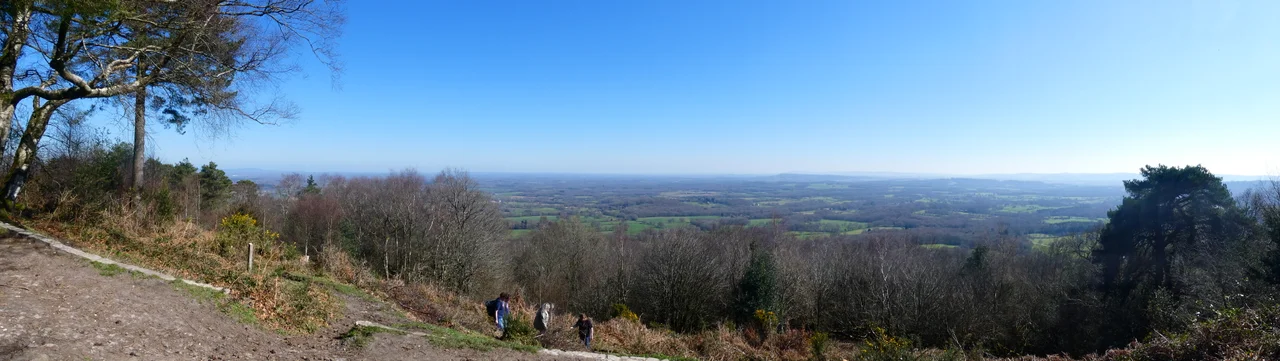
Modern Sussex stretches from Chichester Harbour in the west to the Romney Marshes in the east, with Brighton and Hove as its largest city. The South Downs National Park runs the length of the county, and the chalk cliffs at Beachy Head fall white and sheer to the Channel. There are 138 vineyards in Sussex, a quarter of all the vineyards in Britain, growing the Champagne varieties on chalk that mirrors the soil of Champagne itself a hundred miles south. The seven good things of Sussex are local proverb: Pulborough eel, Selsey cockle, Chichester lobster, Rye herring, Arundel mullet, Amberley trout, and Bourne wheatear. Banoffee pie was invented in 1972 in the village of Jevington. Sussex still does what Sussex has always done. It will not be pushed around. It will tell you so itself.
From the Air
Sussex centred at approximately 50.96°N, 0.14°W. The coastline runs 137 miles from Chichester Harbour to Camber Sands. Visual landmarks from altitude include the white chalk cliffs of the Seven Sisters and Beachy Head, the South Downs ridge, Brighton's Palace Pier and Royal Pavilion. Brighton sunshine averages 1,900 hours a year, well above the UK norm. Airports include EGKA Shoreham 4 miles west of Brighton, EGKK Gatwick on the north border, EGKB Biggin Hill 15 nautical miles north-east. Class D airspace around Shoreham and Gatwick TMA covers most of the county.
Nearby Stories
- Waverley Abbey 6.6 km away
- Battle of Mercredesburne 7 km away
- Fishbourne Roman Palace 9.5 km away
- The Carrington Event: The Solar Storm That Could Happen Again 9.8 km away
- Mereworth Castle 12 km away
- Swanage Lifeboat Station 88 km away
- Wellington Clock Tower 125 km away
- Cléon 154 km away