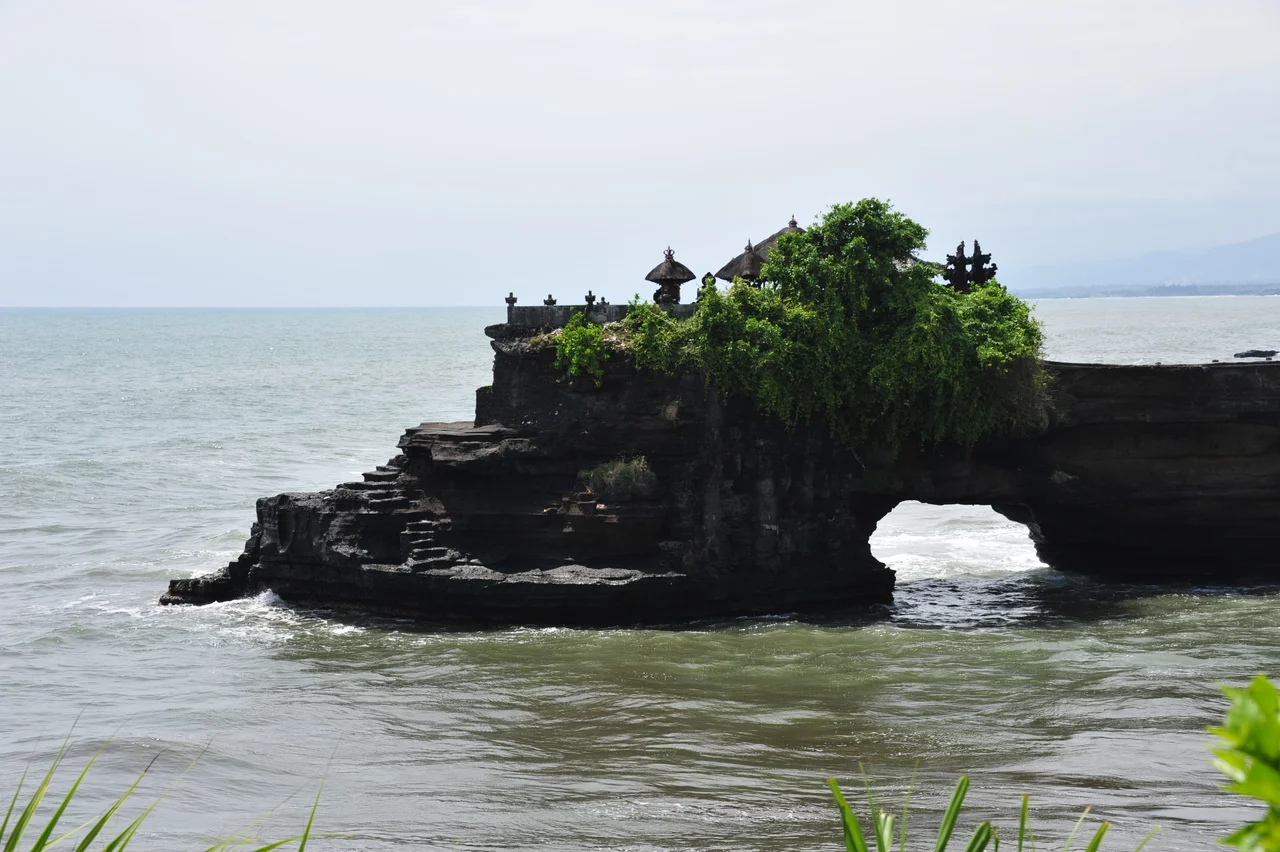

Land in the Sea
Twice a day, the Indian Ocean reclaims the path. Water swallows the rocky causeway, and the temple on its offshore pillar becomes an island again - unreachable, silhouetted against whatever the sky is doing, which at sunset along Bali's southwestern coast tends toward the operatic. This is Tanah Lot, whose name translates simply as "land in the sea," and whose visual drama has made it one of the most photographed places in Indonesia. Half a million tourists visit each year. They walk past souvenir shops lining both sides of a path that descends to the shore, wait for the tide to cooperate, then cross wet rock to a temple that is, in part, not what it appears to be. Over one-third of the stone beneath Pura Tanah Lot is artificial - concrete sculpted and textured to look like natural rock, the result of a massive Japanese-funded restoration after the original formation started falling apart in the 1980s. The temple is simultaneously ancient and engineered, sacred and theatrical, deeply Balinese and partly made of imported technology.
The Wandering Priest
Tanah Lot's founding legend centers on Dang Hyang Nirartha, a 16th-century Hindu religious figure whose travels through Bali, Lombok, and Sumbawa left temples in his wake the way some travelers leave postcards. Nirartha is credited with establishing or consecrating several of the island's most important temples, and Tanah Lot is among them. The story holds that he spent a night on the offshore rock, drawn by its beauty and its natural isolation from the mainland. Whether this account is history or hagiography matters less than what it reveals about the temple's logic: the sea crossing is the point. Tanah Lot belongs to a chain of seven sea temples spaced along Bali's southwestern coast, each positioned so that the next is visible from its shores. The chain forms a spiritual perimeter, and the deity worshipped at Tanah Lot - Dewa Baruna, also called Bhatara Segara, the god of the sea - reflects the temple's identity as a place where land worship meets ocean power.
The Rock That Wasn't
By the 1980s, the natural rock formation supporting Tanah Lot had become dangerous. The ocean was winning its long argument with the stone, and cracks threatened to make the temple inaccessible or worse. The Indonesian government secured an 800-billion-rupiah loan - approximately 480 million US dollars - from Japan to stabilize the site. What followed was one of the more unusual feats of conservation engineering in Southeast Asia. Workers reinforced the crumbling rock face with concrete, then disguised it to match the surrounding natural stone. The result is convincing enough that most visitors cannot tell where geology ends and engineering begins. More than a third of Tanah Lot's visible rock is artificial. The project also addressed other significant historical sites around Bali, but Tanah Lot was the centerpiece - the site whose collapse would have been not just a structural loss but a symbolic one, the most famous image of Balinese spirituality literally falling into the sea.
The Commerce of the Sacred
There is no way to reach Tanah Lot without passing through the market. The path from the parking area to the shore is lined on both sides with outdoor souvenir shops selling sarongs, carvings, T-shirts, and the full inventory of Balinese tourist commerce. This arrangement is not accidental - it is the economic infrastructure that supports the temple's maintenance and the surrounding community's livelihood. On the mainland clifftops above, restaurants serve meals with sunset views of the temple. According to a 2019 study, Tanah Lot averages 500,000 tourists per year, making it one of Indonesia's most visited sites. The tension between sacred space and commercial spectacle is real but not unique to Bali. What distinguishes Tanah Lot is the tide's role as gatekeeper. The souvenir gauntlet delivers visitors to the water's edge, where nature reasserts control. If the tide is in, you wait. If it is out, you cross on slippery rock, shoes in hand, suddenly negotiating with the physical world in a way the paved path did not require.
Seven Temples, One Coastline
Tanah Lot does not stand alone. It is one of seven directional sea temples - the Sad Kahyangan - positioned along Bali's coast to form a spiritual defense line. The temples are spaced so that each one is theoretically visible from the next, creating an unbroken chain of sanctified points between land and ocean. This arrangement reflects the Balinese Hindu understanding of the sea as a source of both spiritual power and potential danger - a realm presided over by Dewa Baruna, whose favor must be continuously maintained. The concept is architectural as much as theological: the temples mark the coastline the way lighthouses mark a shipping lane, each one a fixed point in a system that only makes sense as a whole. Tanah Lot's position in this chain, on the southwestern coast near Tabanan, places it roughly 20 km northwest of Denpasar and 13 km south of the town of Tabanan - central enough to draw pilgrims and tourists from across the island's southern population centers.
Sunset, Ceremony, Performance
What most visitors come to see is the sunset. Tanah Lot's western orientation makes it one of Bali's premier locations for watching the sun drop into the Indian Ocean, and on clear evenings the temple's silhouette against the sky achieves the kind of natural spectacle that no amount of artificial rock can diminish. But the site is more than a backdrop. Odalan rituals - temple anniversary ceremonies - are performed here on the Balinese calendar's 210-day cycle. Kecak dance performances, the hypnotic choral drama in which dozens of men chant interlocking rhythms while enacting scenes from the Ramayana, take place near the temple grounds. Sacred springs at the base of the rock offer holy water to visitors who make the crossing. These layers of activity - devotional, artistic, touristic - coexist without apparent contradiction. Tanah Lot has been a place of worship, a feat of engineering, a commercial engine, and a photographic icon all at once, and it seems entirely comfortable being all of them.
From the Air
Located at 8.62°S, 115.09°E on Bali's southwestern coast, in Beraban village, Kediri district, Tabanan Regency. Ngurah Rai International Airport (WADD) lies approximately 22 km to the southeast. From altitude, the temple is identifiable as a small rock formation just offshore from the coastline, west of Bali's main southern urban area. The surrounding coastline features dramatic cliffs and a series of smaller temple sites. At lower altitudes (2,000-5,000 feet), the rock formation and its temple are clearly visible, especially the causeway connecting it to shore at low tide. The southwestern coast orientation means afternoon and sunset flights offer particularly dramatic views with the sun behind the temple. Best approached from the south or west for optimal viewing angles. Tropical climate; clearest skies typically June-September during the dry season.
Nearby Stories
- Sunset Shattered: The 2005 Bali Bombings 7.6 km away
- Alas Purwo: Where Java Begins and the Surf Never Stops 16 km away
- When the Ground Moved at Dawn: Bali's 1979 Earthquake 25 km away
- The Tiger's Last Stand: West Bali National Park 34 km away
- Lake Segara Anak 81 km away
- The Silent Wave: Java's 1994 Tsunami Earthquake 257 km away
- When the Towers Fell: The Waru Wora Fire 412 km away
- Sumba's Hidden Kingdom of Wings 506 km away