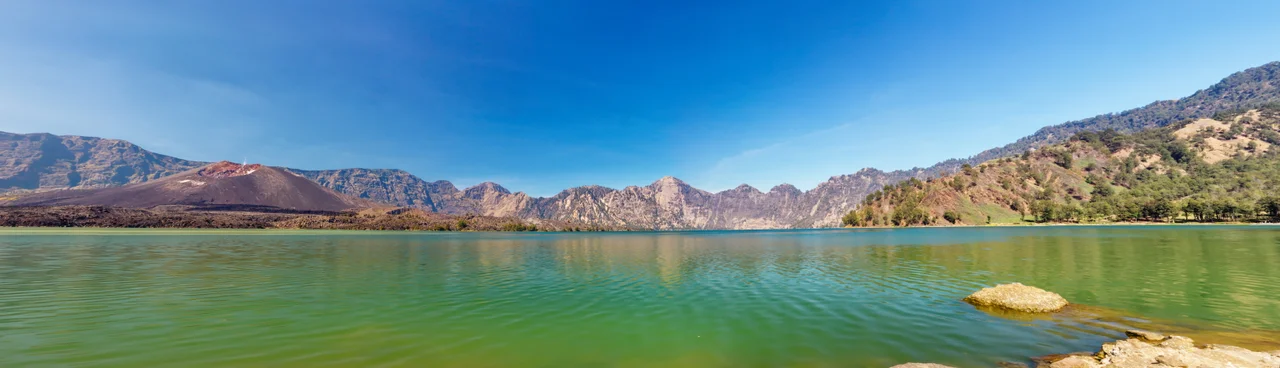

Lake Segara Anak
The name says everything and nothing at once. Segara Anak -- "child of the sea" -- is what the Sasak people of Lombok call the blue crescent of water cradled inside a volcanic caldera two thousand meters above the Indian Ocean. The name captures the lake's impossible resemblance to the sea it can never touch: the same deep blue, the same vast expanse, but ringed by the jagged walls of a volcano that tore itself apart in 1257. That eruption, one of the largest in the last ten thousand years, erased an entire mountain from the skyline and may have helped trigger centuries of global cooling. What it left behind was this lake -- warm, gas-bubbled, sacred -- and a story written in ash and ice cores on every continent.
The Mountain That Vanished
Before 1257, Mount Samalas rose an estimated 4,200 meters above sea level, dominating the northern spine of Lombok. Then it exploded. The eruption ejected roughly 40 cubic kilometers of dense rock into the atmosphere, collapsing the mountain into the caldera that now holds Segara Anak. Pyroclastic flows raced down every flank, burying the city of Pamatan -- capital of Lombok's ruling kingdom -- under meters of volcanic debris. The flows crossed the sea to reach neighboring Sumbawa. Ash fell as far as Java, 340 kilometers to the west. For centuries, scientists puzzled over a massive sulfate spike in ice cores from Greenland to Antarctica, evidence of a colossal eruption they could not identify. Only in 2013 did a French-Indonesian research team match the chemical signature to Samalas, finally solving what had been called the great mystery eruption of the Middle Ages.
A Lake Heated from Below
Segara Anak sits at 2,004 meters above sea level, covering an area that stretches roughly 7.5 by 6 kilometers with a maximum depth of 230 meters. It is Indonesia's second-highest caldera lake with an active volcano. That volcano -- Gunung Barujari, whose cone rises to 2,376 meters at the lake's eastern end -- is the reason the lake curves into its distinctive crescent shape. Magma still flows beneath the lakebed, heating the water to 20-22 degrees Celsius, some five to seven degrees warmer than expected at this altitude. Gas bubbles break the surface continuously, a reminder that the geology here is anything but settled. The lake's pH hovers between 7 and 8, kept neutral by the very volcanic gases that warm it. What visitors see is deceptively calm: a turquoise mirror reflecting the caldera walls, betraying none of the thermal energy churning below.
Fish Where There Were None
For most of its existence, Segara Anak held no fish at all. The volcanic lake, born from catastrophe and fed by geothermal heat, was a sterile body of water surrounded by some of the most dramatic scenery in Southeast Asia. In 1969, volcanologists from the Geological Society of London examined the lake and, somewhat unexpectedly, recommended that it could support fish cultivation. It took sixteen more years for anything to happen. In 1985, the Nusa Tenggara Barat provincial government introduced tilapia and carp to the lake. The fish took to the warm, mineral-rich water with astonishing enthusiasm, breeding so rapidly that the lake soon held millions. Today, Segara Anak is a popular fishing spot, and some local families have built livelihoods around the harvest -- an improbable economy thriving in the crater of a supervolcano.
Offerings to the Queen of Spirits
For the Sasak people and Balinese Hindus of Lombok, Segara Anak is far more than a geological curiosity. According to Sasak oral tradition, Mount Rinjani is the dwelling place of Dewi Anjani, the Queen of the Spirits and guardian of the island's natural world. Each year, during the Mulang Pekelem ceremony, pilgrims trek to the caldera rim and descend to the lakeshore. On the climactic night of the ritual, they submerge offerings of gold, silver, and copper into the lake -- along with small black and gold chickens -- as a gesture of gratitude meant to maintain the balance between the human world and the cosmos. Locals say Dewi Anjani's presence can still be felt around the lake during the ceremony, when the volcano seems to breathe more quietly and the water takes on a deeper blue. The ritual is not performance. It is negotiation -- between people and a landscape that has already demonstrated, with devastating finality, what it is capable of.
From the Air
Lake Segara Anak sits at approximately 8.40S, 116.40E within the massive caldera of the Rinjani volcanic complex on Lombok. From cruising altitude, the caldera is unmistakable: a dark oval gap in the mountain's summit with a vivid blue crescent lake inside and the smaller cone of Gunung Barujari rising from its eastern shore. The lake surface sits at roughly 6,500 feet AMSL, while the caldera rim reaches over 12,000 feet. Lombok International Airport (WADL) lies approximately 70 km to the south. The Bali Strait and Mount Agung on neighboring Bali are visible to the west in clear conditions.
Nearby Stories
- Lombok 25 km away
- The Invisible Frontier: Where Asia Ends and Australia Begins 26 km away
- Nusa Penida: Bandit Island Turned Bali's Last Refuge 55 km away
- The Island Diana Chose 56 km away
- Eight Patrols and a Midnight Torpedo 66 km away
- Forty-Five Men and Thirty-Six Depth Charges 73 km away
- The Island That Shook the World 100 km away
- Isuzu: The Cruiser That Refused to Sink 129 km away