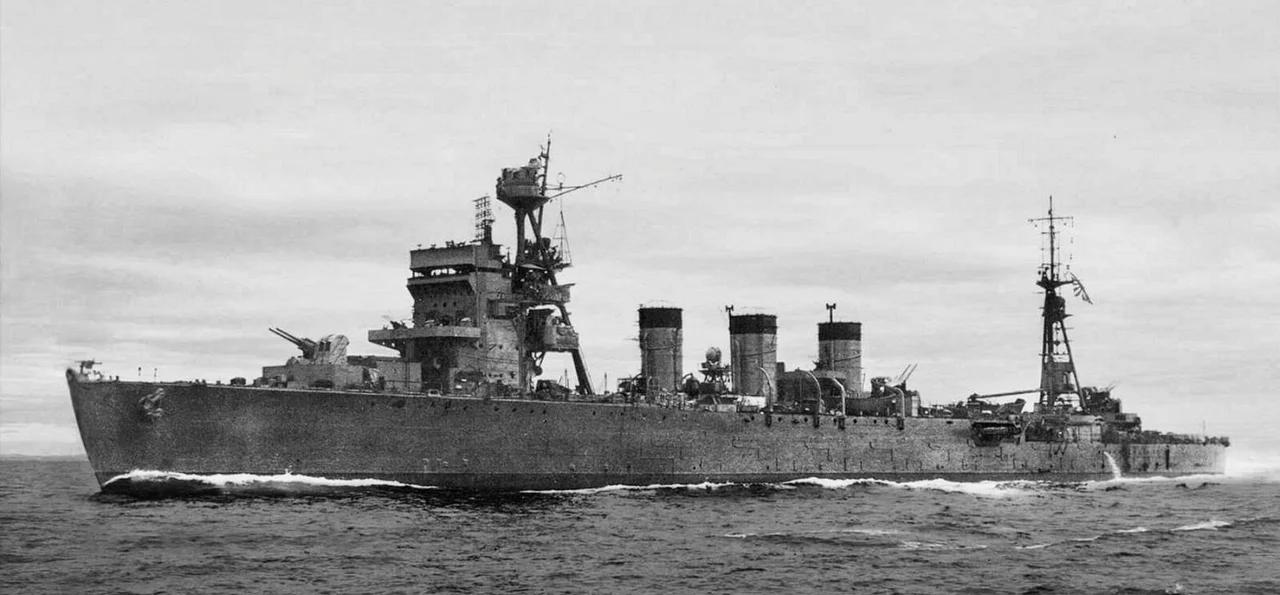

Isuzu: The Cruiser That Refused to Sink
She was torpedoed, bombed, strafed, mined, and rebuilt so many times that her final configuration bore almost no resemblance to the ship launched in 1921. The Japanese light cruiser Isuzu - named for the sacred river near Ise Shrine - spent the Pacific War absorbing punishment that would have ended most vessels, only to limp back to port, patch her wounds, and return to the fight. Her service record reads less like a ship's log and more like a catalog of near-death experiences stretching from Hong Kong to the Solomons to the seas off Sumbawa, where her luck finally ran out on April 7, 1945.
Born for a Different War
Isuzu was the second of the Nagara-class light cruisers, ordered by the Imperial Japanese Navy in 1920 under the 8-4 Fleet Program. At 5,500 tons, she was designed as a destroyer flotilla flagship - fast enough to keep pace with destroyers, armed enough to anchor their formations. Her early career reflected the ambitions of interwar Japan: she patrolled the Yangtze River in China, covered troop landings along the Chinese coast, and rotated through commands that read like a who's who of the coming war. Captain Isoroku Yamamoto commanded her from August to December 1928. Captain Tamon Yamaguchi - who would later go down with the carrier Hiryu at Midway - held command from 1936 to 1937. These were officers training for a conflict that had not yet begun, aboard a ship that would outlast many of them.
From Hong Kong to Guadalcanal
When the Pacific War erupted in December 1941, Isuzu was already in action, supporting the invasion of Hong Kong as part of the Second China Expeditionary Fleet. From there she ranged across Southeast Asia - escorting reinforcements to Thailand and French Indochina, patrolling the Dutch East Indies from Makassar to Surabaya, supporting landings on the Tanimbar Islands. By September 1942, she was deep in the Solomons campaign, escorting transports carrying the 2nd Infantry Division toward Guadalcanal. She fired on Marine batteries at Tulagi during the bombardment of Henderson Field and participated in the Battle of Santa Cruz. At the second Naval Battle of Guadalcanal in November 1942, near misses from Marine dive bombers flooded her No. 3 boiler room and cut her speed to fifteen knots. She crawled back to Shortland for emergency repairs, then to Truk, then all the way home to Yokosuka. It was the first of several forced retirements, but never the last.
Reinvented Under Fire
Each time Isuzu returned to Japan damaged, she came back altered. After Guadalcanal, the Mitsubishi Yokohama shipyard installed air-search radar and replaced gun mounts. After damage from a mine near Kavieng and strafing during the November 1943 carrier raid on Rabaul, she limped home yet again. This time, the Navy transformed her completely. Between May and September 1944, every one of her original 14-centimeter main guns was stripped out. In their place went twin-mount 12.7-centimeter anti-aircraft guns, fifty 25-millimeter AA barrels, air-search and surface-search radar, sonar, and depth charge rails. The cruiser that emerged was an entirely different warship - a dedicated anti-aircraft and anti-submarine platform, her elegant prewar silhouette bristling with weapons pointed at the sky. She was redesignated flagship of CruDiv 31, an antisubmarine unit. The Navy had stopped asking Isuzu to fight surface battles and started asking her simply to survive.
The Decoy Force
Her most dramatic engagement came at the Battle of Leyte Gulf in October 1944, where she served in Vice Admiral Ozawa's Northern Mobile Force - a formation whose explicit purpose was to draw American carriers away from the landing beaches. The plan worked, at terrible cost. During the Battle off Cape Engano, American aircraft hammered the force's carriers. When the carrier Chitose was mortally hit, Isuzu tried to take her in tow but failed. After Chitose sank, Isuzu pulled 480 survivors from the water. She then attempted to shield the carrier Chiyoda, but a force of four American cruisers and nine destroyers arrived and sank Chiyoda with all hands. Isuzu took fire while rescuing survivors, losing thirteen crewmembers. A month later, west of Corregidor, a torpedo destroyed her rudder and she dragged herself to Singapore for yet another round of repairs.
Last Voyage Through the Strait
The end came in the waters between Sumbawa and Flores. Repaired at Surabaya, Isuzu departed in early April 1945 to transport troops from Kupang to Sumbawa. On April 6, ten B-25 Mitchells from a Dutch East Indies squadron attacked her north of Sumbawa, and B-24 Liberators hit her bow near Flores. A wolf pack of American submarines was already tracking her. On April 7, sixty nautical miles northwest of Bima, USS Gabilan struck first with a torpedo below the bridge that flooded her forward compartments and dropped her speed below ten knots. As her crew fought to keep her afloat, USS Charr fired four torpedoes, two of which hit near the aft engine room. Two more followed - one breaking off what remained of Isuzu's bow. She sank in the strait, taking 190 men with her. Her captain and 450 crewmen were rescued. On the same day, hours apart, the battleship Yamato went down in her own final mission. Isuzu was struck from the Navy List on June 20, 1945.
From the Air
Isuzu sank at approximately 7.63°S, 118.15°E, in the waters between Sumbawa and Flores in the Lesser Sunda Islands of Indonesia. The wreck site lies in the strait roughly 60 nautical miles northwest of Bima Bay. From altitude, the islands of Sumbawa, Komodo, and Flores form a dramatic chain. Sultan Muhammad Kaharuddin III Airport (WADS) at Bima on Sumbawa is the nearest significant airfield. The waters here are deep and the currents strong, typical of the Indonesian archipelago passages.
Nearby Stories
- Satonda: The Island That Remembers Earth's First Ocean 22 km away
- The Day the Earth Lost Its Summer 50 km away
- The Island Diana Chose 69 km away
- Dragon Island: Where Monsters Are Real 101 km away
- Komodo National Park: Kingdom of the Dragon 139 km away
- The Bird Letters of Sulawesi 222 km away
- The Ship That Lost Its Name 231 km away
- The Forgotten Citadel of Makassar 273 km away