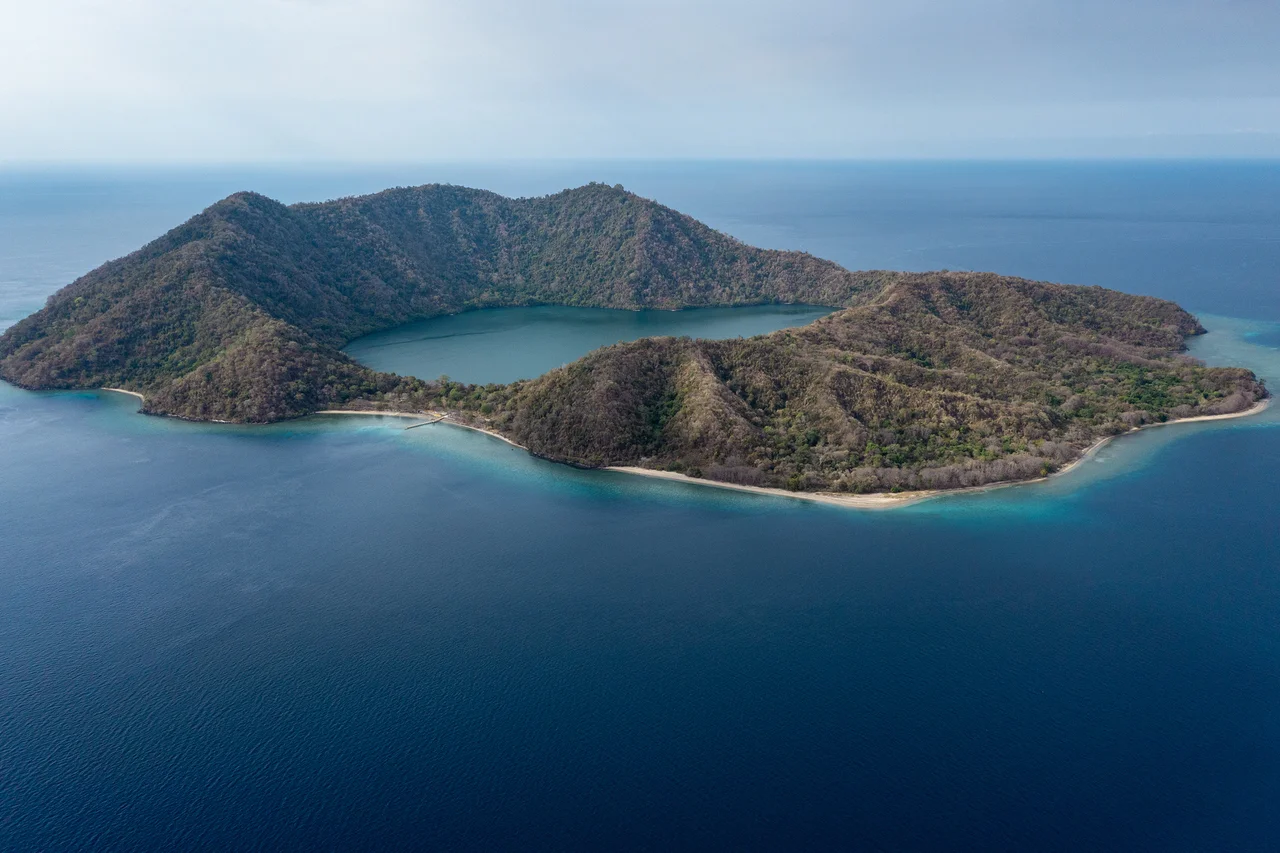

Satonda: The Island That Remembers Earth's First Ocean
Less than 30 kilometers from the volcano that produced the largest eruption in recorded history, a small island holds a quieter secret. Satonda rises from the Flores Sea north of Sumbawa, its caldera walls climbing 300 meters above water that is itself 1,000 meters deep. Inside those walls, a lake sits where the crater floor should be -- a 77-hectare body of water that is neither freshwater nor ordinary seawater, but something far older in character. Scientists who have studied this soda lake believe its chemistry mirrors the oceans of late Precambrian Earth, the very conditions under which life was preparing for the Cambrian explosion over 500 million years ago. Satonda is a time capsule, written in water.
A Volcano's Quiet Afterlife
Satonda's volcano has been dormant for thousands of years, perhaps tens of thousands. The signs are written in its geology: marine terraces along the southern shore record the slow work of waves on rock that no longer pushes back, and steep gullies carved into the tuff ring speak of rainfall eroding stone without any fresh eruptions to rebuild it. The volcano may have formed during the last ice age, when sea levels were lower and the seafloor here was closer to the surface. Today the island measures roughly three by two kilometers, its elongated axis running northwest to southeast, a compact landmass with walls steep enough on the eastern side to discourage vegetation entirely. It is associated with Mount Tambora, its more famous neighbor, and with Sangeang Api to the east -- all eruption centers linked to the same volcanic system that shook the world in April 1815.
The Lake Between Two Craters
Two intersecting craters occupy the island's heart, one 950 meters across and 69 meters deep, the other 400 meters wide and 39 meters deep. A submerged ridge just 10 meters high separates them at the bottom. The lake that fills these craters is surrounded by sandy beaches, and at 13 sites around its perimeter, large calcareous reefs extrude from rocky points, submerged at least 23 meters with tips emerging about half a meter during the dry season. These are not coral reefs. They are built by cyanobacteria and red algae, layered structures of aragonite and calcite that grow in the alkaline water -- reef-building by some of the most ancient organisms on Earth. At one point on the southern rim, the crater wall drops to just 13 meters in altitude with a width of only 30 meters, a thin barrier between the soda lake and the Flores Sea barely 100 meters away.
A World Unto Itself
What makes Satonda's lake remarkable is not just its chemistry but its stubborn isolation. A thriving tropical coral reef surrounds the island just 100 meters from the crater's edge, boasting a rich diversity of marine species. Yet almost nothing from that reef has colonized the lake. When scientists surveyed the lake's fauna in 1990, they found an ecosystem of striking poverty: one species of gastropod, one sponge, one crustacean, one small fish, one hydrozoan, one worm, and three species of green algae. Some of these may be endemic -- found nowhere else. The sponges colonize the reef surfaces, intertwining with algae, while dense worm populations burrow in the black sandy mud along the lakeshore. It is as though the lake exists in a biological parallel universe, sealed off from the abundance just beyond its walls.
A Window Half a Billion Years Deep
Researchers Stephan Kempe and Jozef Kazmierczak proposed that Lake Satonda is, in effect, a recreated model of late Precambrian ocean chemistry -- a soda ocean environment that may have set the stage for the Cambrian explosion, the sudden diversification of complex life roughly 540 million years ago. The cyanobacteria building reefs in the lake's alkaline waters are doing what their ancestors did when the Earth's oceans were far more carbonate-rich than they are today. The reef structures themselves, with their alternating layers of calcifying bacteria and red algae separated by accumulations of gastropod fecal pellets, offer clues about how biological reef-building evolved long before corals existed. In 1999 Indonesia designated Satonda a Marine Nature Park, and it has been proposed as part of Moyo Satonda National Park alongside neighboring Moyo Island. For now, the island remains largely undeveloped -- its greatest value lying not in what humans might build on it, but in what its water remembers.
From the Air
Satonda Island (8.10S, 117.75E) lies in the Flores Sea north of Sumbawa, Indonesia, approximately 30 km northwest of Mount Tambora. The island is small (3x2 km) but its caldera walls rising to 300 m make it visible from altitude. The nearest significant airport is Sultan Muhammad Kaharuddin III Airport (WADS) in Sumbawa Besar, roughly 100 km to the west. Bima Sultan Muhammad Salahuddin Airport (WADB) is approximately 80 km to the east. Tropical weather year-round with wet and dry seasons. The coral reefs surrounding the island are visible in clear conditions from low altitude.
Nearby Stories
- Isuzu: The Cruiser That Refused to Sink 31 km away
- The Third Strike 52 km away
- The Island That Shook the World 57 km away
- Lombok 86 km away
- Forty-Five Men and Thirty-Six Depth Charges 101 km away
- Dragon Island: Where Monsters Are Real 147 km away
- Komodo National Park: Kingdom of the Dragon 168 km away
- The Ship That Lost Its Name 228 km away