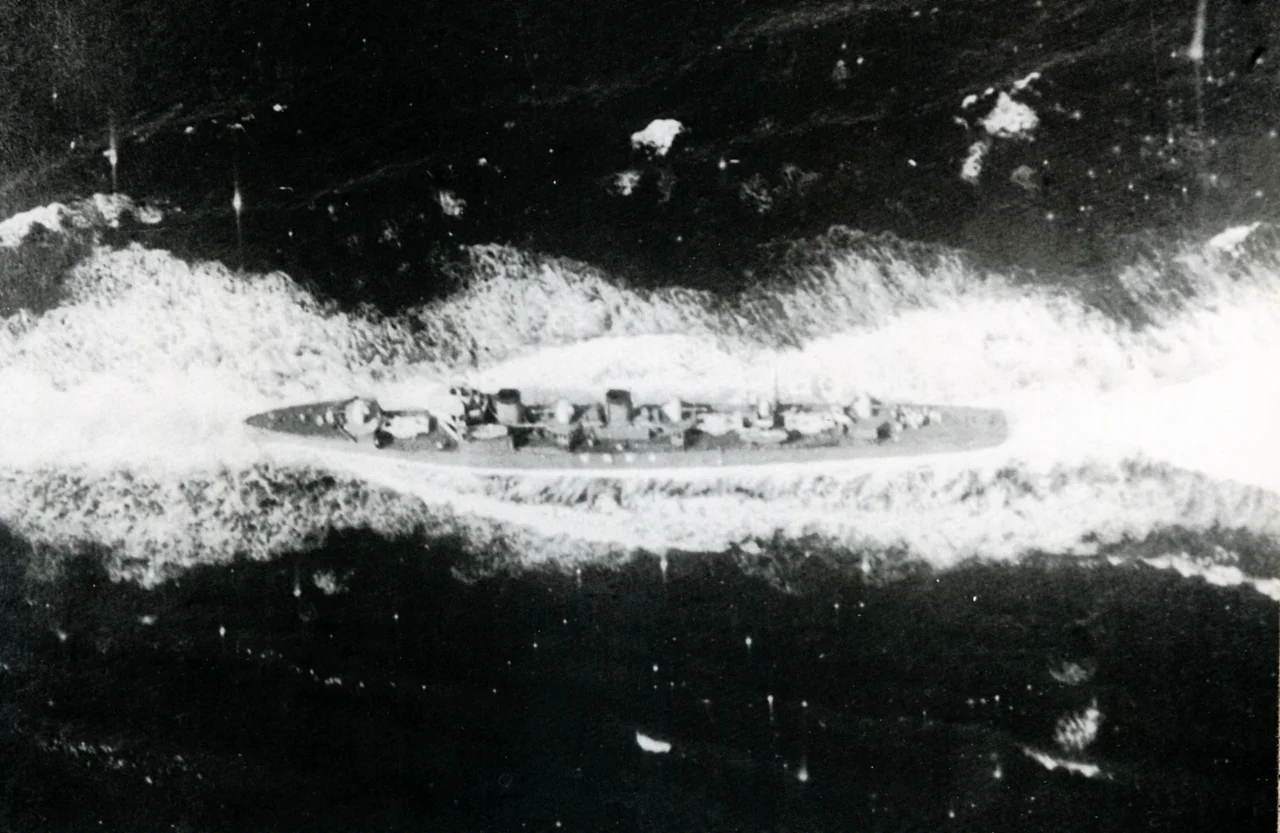

The Ship That Lost Its Name
By the time a British torpedo struck her stern in the Lombok Strait on July 25, 1945, the warship no longer carried the name she had been launched with. The destroyer Nadakaze -- "crying wind" in Japanese -- had been rechristened Patrol Boat No. 2 five years earlier, her sleek silhouette butchered by conversion, her top speed halved, her very purpose rewritten. She was no longer a destroyer in anything but memory. What remained was a slow, overworked escort vessel shuttling convoys between ports of an empire that was contracting by the week. The Royal Navy submarine that sent her to the bottom near the Lesser Sunda Islands did not know her original name. The sea does not care what you were called.
Built for a Different Kind of War
Nadakaze was one of fifteen Minekaze-class destroyers constructed for the Imperial Japanese Navy in the late 1920s, ships designed around a single obsession: speed. Her Parsons geared steam turbines produced 38,500 shaft horsepower, driving her through the water at 39 knots -- and during sea trials she pushed beyond that, reaching 39.81 knots from 40,511 horsepower. At 102.5 meters long with a crew of 148, she carried four 12-centimeter guns and six torpedo tubes in three twin mounts. The Minekaze class represented the interwar Japanese Navy's faith that the next great naval engagement would be decided by fast, aggressive surface action. That faith would prove partly correct at engagements like Savo Island, but by the time it mattered, Nadakaze herself had already been pulled from the line.
The Slow Dismantling
The transformation began in 1937, when Nadakaze had her hull strengthened and her fuel capacity cut nearly in half. She spent two years patrolling the Chinese coast during the Second Sino-Japanese War as part of Destroyer Division 3 under the IJN 2nd Fleet, supporting combat operations along the northern and central shoreline. When the division was disbanded in December 1938, she went to the reserves. Then came the deeper cut. In April 1940, the Navy pulled two of her four boilers, reducing her horsepower from 38,500 to roughly half and her speed from 39 knots to a plodding 20. Two of her guns went. Four of her six torpedo tubes were removed. In their place: ten 25-millimeter anti-aircraft guns and sixteen depth charges. She emerged from the shipyard as Patrol Boat No. 2, a vessel optimized not for the fleet engagement the Minekaze class had been designed for, but for the unglamorous work of hunting submarines and guarding convoys.
Across a Shrinking Sea
When the Pacific War began on December 7, 1941, Patrol Boat No. 2 was immediately assigned to the Philippines Campaign, then the Dutch East Indies campaign in early 1942. She played a minor role in the Battle of Midway that June -- the engagement that shattered Japanese carrier power and tilted the war irreversibly. But Patrol Boat No. 2 was not built for decisive battles anymore. By January 1943, she had been reassigned to convoy escort duty between the home islands and the southern territories: Moji, Takao, Saigon, Manila, Singapore. These were the arterial routes of Japan's wartime economy, and as American submarines tightened their stranglehold on Japanese shipping lanes through 1943 and 1944, the work grew more dangerous. By December 1943, the patrol boat had become the designated support vessel for Imperial Japanese Navy land forces at Balikpapan, Borneo -- a critical oil port that the Allies would eventually target.
The Lombok Strait
The waters between Bali and Lombok have funneled maritime traffic for centuries, a narrow passage connecting the Java Sea to the Indian Ocean. By mid-1945, these straits were hunting grounds. Allied submarines prowled the Indonesian archipelago, intercepting whatever Japanese shipping still moved through waters that had once been securely within the empire's perimeter. On July 25, 1945 -- sixteen days before Japan would announce its surrender -- a Royal Navy submarine found Patrol Boat No. 2 near the Lombok Strait and put a torpedo into her. The ship went down at approximately 7.10 degrees south, 115.70 degrees east, in the warm, shallow waters of the Lesser Sunda Islands. She was struck from the Navy List on September 30, 1945, two weeks after the formal surrender ceremony aboard the USS Missouri. The destroyer that became a patrol boat became a wreck, one of thousands of Japanese vessels scattered across the floor of the Pacific, monuments to a war that consumed the ships and the sailors alike.
From the Air
The sinking location lies at approximately 7.10S, 115.70E, in the waters near the Lombok Strait between Bali and Lombok in the Lesser Sunda Islands. The strait itself is clearly visible from altitude as the narrow channel separating the two islands. Nearest major airports are Ngurah Rai International Airport (WADD/DPS) on Bali to the west and Lombok International Airport (WADL/LOP) to the east. The Java Sea spreads to the north, the Indian Ocean to the south. At cruising altitude, the volcanic peaks of Bali's Mount Agung (3,031 m) and Lombok's Mount Rinjani (3,726 m) frame the strait on either side.
Nearby Stories
- The U-Boat That Planted a Secret on Two Continents 11 km away
- The Ship of Four Names 24 km away
- Battle of Makassar Strait 40 km away
- Trapped on Mount Rinjani 100 km away
- The Night the Mosques Fell 130 km away
- The Ocean's Hidden River Between Two Worlds 139 km away
- Forty Hours in the Masalembo Sea 246 km away
- The Forgotten Citadel of Makassar 383 km away