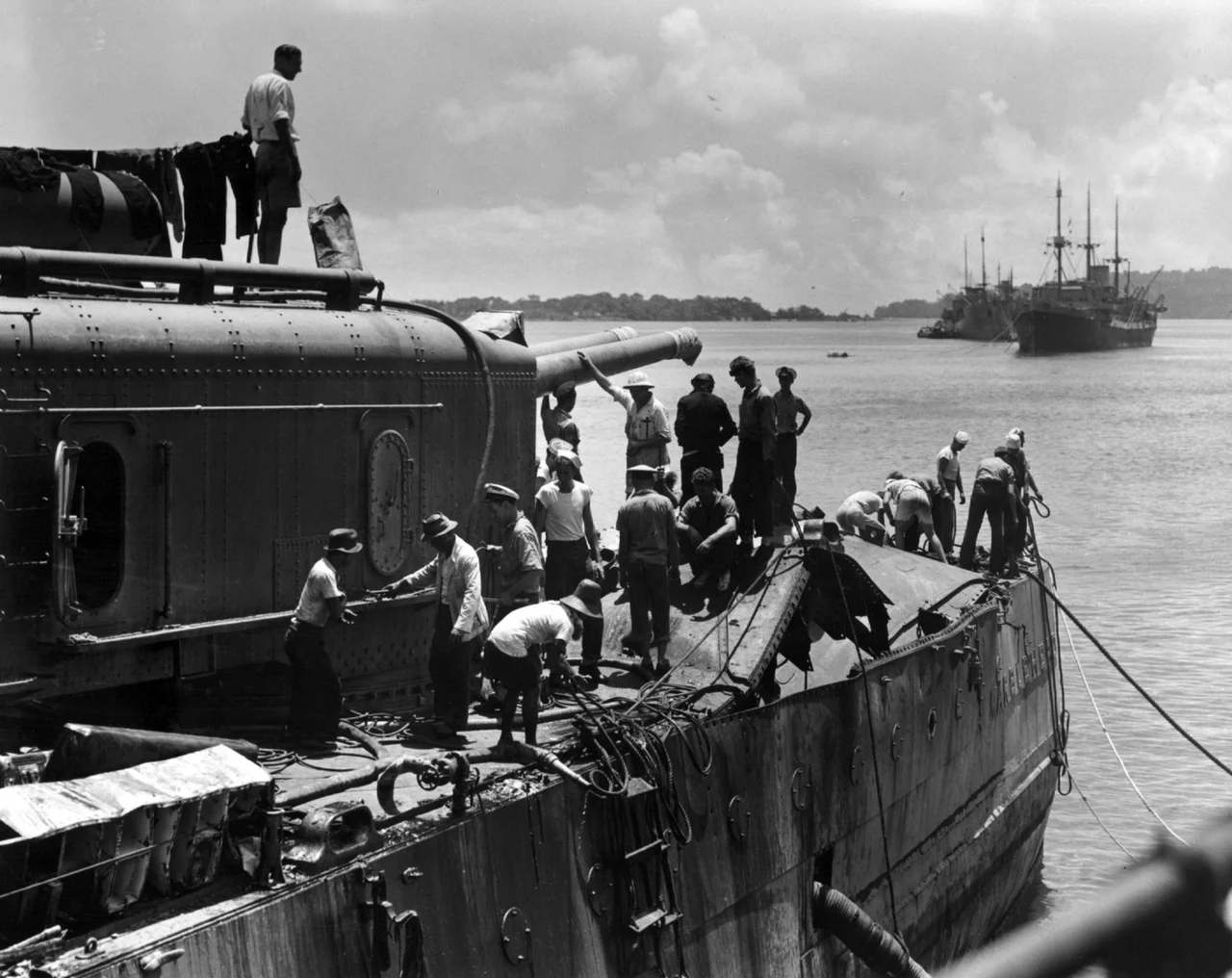
_following_the_Battle_of_Makassar_Strait,_February_1942_(80-G-237439).jpg)
Battle of Makassar Strait
The element of surprise was gone before the battle even started. On the morning of February 3, 1942, while Rear Admiral Karel Doorman's Allied strike force was refueling from the oiler USS Pecos in Bounder Roads, seven Japanese bombers spotted the ships below. The bombers did not attack -- they had other orders, continuing on to strike Surabaya -- but the damage was done. Doorman, a Dutch rear admiral commanding a hastily assembled fleet of American, Dutch, and Australian warships, now faced a choice: press forward against a Japanese invasion convoy without fighter cover and without surprise, or abandon the mission. He pressed forward. What followed, in the waters south of the Kangean Islands on February 4, was a demonstration of what happens when warships operate under skies they do not control.
A Coalition Built in Days
By the end of January 1942, the Japanese advance through the Dutch East Indies had been swift and merciless. Borneo's north and west coasts had fallen. The oil ports of Balikpapan and Tarakan were in Japanese hands. On Celebes, Menado and Kendari had been captured, giving the Japanese airfields within striking range of Java itself. Control of the Makassar Strait -- the vital waterway separating Borneo from Celebes -- was the next objective, and that meant taking the city of Makassar. On February 1, Allied reconnaissance spotted a Japanese invasion force at Balikpapan: twenty troop transports, three cruisers, and ten destroyers preparing to sail. The next day, Admiral Thomas C. Hart, Dutch Vice Admiral Conrad Helfrich, Rear Admiral William A. Glassford, and Australian Commodore John Collins met at Palembang and approved Helfrich's proposal to form a strike force. Within twenty-four hours, Doorman had assembled his fleet and was taking on supplies at the Gili Islands, northwest of Lombok.
Sixty Bombers over the Bali Sea
At midnight on February 4, Doorman's force sailed east from Bounder Roads, swinging south of the Kangean Islands before turning north toward the Java Sea. The fleet consisted of four cruisers -- Doorman's flagship HNLMS De Ruyter, the Dutch HNLMS Tromp, and the American heavy cruiser USS Houston and light cruiser USS Marblehead -- escorted by seven destroyers. At 9:35 that morning, Doorman received a warning: thirty-six Japanese bombers had been spotted taking off from Kendari II Airfield. Fourteen minutes later, the attack began. Sixty aircraft in total -- thirty-six Mitsubishi G4M "Betty" and twenty-four Mitsubishi G3M "Nell" medium bombers -- descended on the Allied ships as they transited the Bali Sea, twenty miles south of the Kangean Islands. Without fighter cover, the cruisers could only maneuver and shoot. The Japanese concentrated their assault on the two American ships.
Houston and Marblehead Under Fire
At 10:27, six high-explosive bombs straddled USS Marblehead. The blasts killed fifteen sailors, wounded eighty-four, flooded compartments throughout the ship, destroyed the steering room, and jammed the rudder hard to port. Marblehead heeled ten degrees to starboard and began circling at twenty-five knots, unable to steer. USS Houston initially dodged the falling bombs with aggressive maneuvering until a delayed-fuse bomb penetrated the main deck near Turret Number Three. The explosion killed forty-eight men instantly and wounded twenty more. Quick action by the crew prevented the resulting fire from reaching the aft magazine, but the turret was destroyed. Captain Albert H. Rooks -- who would later earn a posthumous Medal of Honor for his conduct at the Battle of Sunda Strait -- kept Houston fighting, but the ship had lost a third of its main battery. At 12:25, Doorman ordered the battered fleet south through the Lombok Strait and into the Indian Ocean.
The Long Way Home
Houston and Tromp limped into the port of Tjilatjap on Java's south coast on February 5. Marblehead arrived the following day, barely navigable. Repairs to Marblehead's hull took three days of emergency work, but with no rudder and limited steering, the ship could only limp onward -- to Ceylon, then South Africa, and finally to the Brooklyn Navy Yard in New York, arriving on May 4, three months and an ocean away from where she had been hit. Houston stayed. Without a working aft turret, she remained in the theater because there was simply nothing to replace her. The Japanese, believing they had sunk cruisers in the engagement, sent their invasion convoy forward. On February 8, the transports anchored off Makassar unopposed. The strait that bore the battle's name was now a Japanese highway. For Houston, the reprieve was temporary. Three weeks later, on the night of February 28, she went down fighting in the Sunda Strait alongside HMAS Perth, earning the nickname "the Galloping Ghost of the Java Coast" -- a ship the Japanese claimed to have sunk six times before it finally sank for real.
From the Air
The Battle of Makassar Strait was fought in the Bali Sea at approximately 7.50S, 115.50E, roughly 20 miles south of the Kangean Islands. From cruising altitude, the Kangean archipelago is visible as a chain of low islands between Madura and Bali. The Makassar Strait itself -- the broad waterway between Borneo (Kalimantan) and Sulawesi (Celebes) -- stretches north from here. Lombok Strait, through which Doorman's battered fleet retreated, lies to the east between Bali and Lombok. The nearest major airports include Juanda International Airport at Surabaya (WARR) to the southwest and Ngurah Rai International Airport on Bali (WADD) to the south.
Nearby Stories
- Forty-Five Men and Thirty-Six Depth Charges 26 km away
- The Ship That Lost Its Name 26 km away
- Eight Patrols and a Midnight Torpedo 34 km away
- When Sapudi Shook at Dawn 54 km away
- Island of a Thousand Temples 55 km away
- The Night the Mosques Fell 78 km away
- Where Three Worlds Meet: The Great Mosque of Sumenep 124 km away
- The Forgotten Citadel of Makassar 436 km away