.jpg)
Island of a Thousand Temples
The word means "city" in Sanskrit, but on Bali a pura is something more intimate than a city and more expansive than a building. A Balinese temple is an open-air compound of shrines, multi-tiered towers, and pavilions enclosed by walls and connected by elaborately carved gates -- no roof overhead, no separation from the sky. There are so many of them that Bali has earned the title "Island of a Thousand Puras," though the actual number far exceeds a thousand. Every village maintains at least three. Every family compound has its own. They line cliff edges above the Indian Ocean, rise from lake shores in the volcanic highlands, and cluster on mountaintops where the gods are believed to descend. Unlike the soaring indoor temples of the Indian subcontinent from which Balinese Hinduism ultimately derives, these are places where worship happens under open sky, where incense smoke drifts upward without a ceiling to stop it.
Three Realms in Stone
Every pura follows the trimandala principle, dividing its space into three concentric zones of increasing holiness. The nista mandala, the outermost zone, functions as a transitional space -- an open field or garden where preparations happen before festivals and where religious dance performances unfold. Pass through a candi bentar, the distinctive split gate that looks as though a single tower has been cleaved in two, and you enter the madya mandala. Here the community gathers. Pavilions serve specific purposes: the bale kulkul houses the wooden slit drum that calls worshippers, the bale gong shelters the gamelan orchestra, the wantilan provides a meeting hall, and the perantenan functions as the temple kitchen. The innermost zone, the utama mandala, is reached through a kori agung, a roofed tower gate richly decorated with carved stone. Inside stands the padmasana, the towering lotus throne of Acintya, the supreme god of Balinese Hinduism. Multi-tiered meru towers rise alongside pavilions for Vedic chanting and offerings.
Temples for Every Purpose
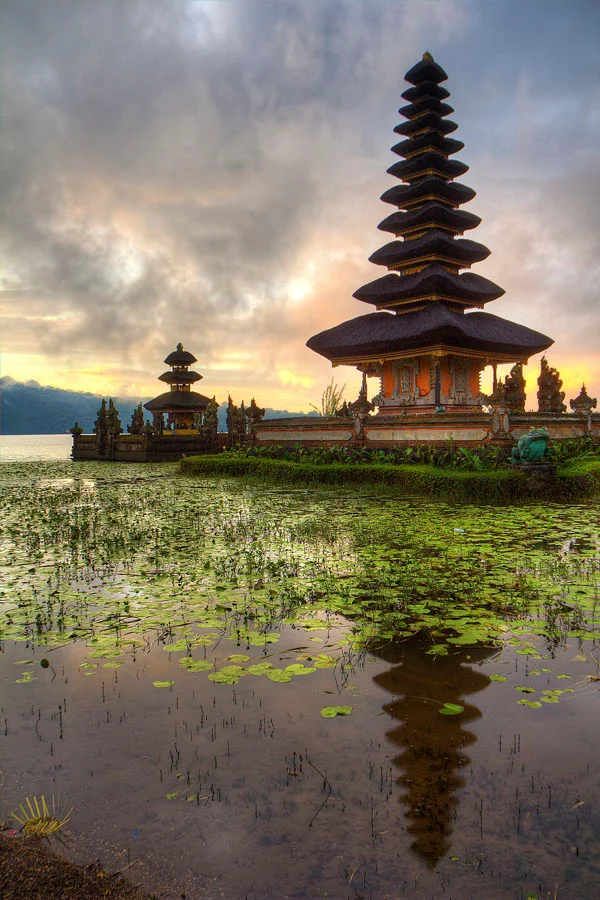
Balinese temples are not interchangeable. Each type serves a distinct function in the spiritual and practical life of the island. Pura Desa temples, dedicated to Brahma, anchor village religious life. Pura Puseh temples honor Vishnu. Pura Dalem temples, dedicated to Shiva and his consort Durga, stand near graveyards and preside over rituals of death and the ngaben cremation ceremony -- banyan trees and kepuh trees grow in their compounds, serving as natural shrines. Then there are the water temples, pura tirta, which manage something both sacred and practical: irrigation. Priests at these temples hold authority over the subak system, allocating water among rice paddies in surrounding villages. Pura Ulun Danu Bratan, built on the edge of a crater lake in the highlands, is considered the primary source of water for all agriculture on the island, and it carries a spiritual weight equal to the great mother temple of Besakih.
The Chain Along the Coast
In the 16th century, a Majapahit sage from Java named Nirartha traveled Bali's coastline and founded a series of sea temples -- pura segara -- to honor the gods of the ocean. According to tradition, each temple was positioned so that it could be seen from the next, creating a spiritual chain of protection around the entire island. Tanah Lot, perched on a coastal rock overlooking the Indian Ocean, is the most photographed of these. Pura Luhur Uluwatu clings to a cliff at the southwestern tip of the Bukit Peninsula, the only sea temple that also serves as one of Bali's six directional temples. Further north, Pura Rambut Siwi marks the spot where Nirartha reportedly offered a lock of his hair to be enshrined -- rambut siwi translates as "worship of the hair." These temples endure monsoon winds and salt spray, their stone carvings softened by centuries of weather, yet they remain active places of worship where the Melasti purification ritual draws thousands to the shore.
Nine Points of Balance
Beyond the village temples and sea temples, Bali maintains a system of nine directional temples -- the Pura Kahyangan Jagat -- positioned at each cardinal and intercardinal point of the island, with one at its center. These are considered the "palaces of the gods," and together they are believed to provide spiritual equilibrium for the entire island. Pura Besakih, the mother temple, anchors the northeast direction on the slopes of Mount Agung, Bali's highest and most sacred volcano. Pura Lempuyang Luhur guards the east. Six of these nine are designated Sad Kahyangan, the holiest places of worship on Bali, considered the pivotal spiritual points of the island. The system reflects a worldview in which geography and theology are inseparable -- the kaja-kelod axis runs from the mountain summit, realm of the gods and hyang spirits, through the fertile plains where humans live, down to the sea and the forces that dwell beneath it.
Living Architecture
What makes Balinese temples remarkable from the air is their sheer density. They are everywhere -- in rice paddies, on lakeshores, atop sea cliffs, within the courtyards of family homes. Each one is maintained by its community, rebuilt after earthquakes and eruptions, decorated daily with fresh offerings of flowers, rice, and incense. The carved gates alone represent a distinct architectural tradition: the candi bentar split gate for outer zones, the kori agung roofed gate for inner sanctums, each following rules that also govern the layout of palaces and noble residences. The architecture is not museum-piece preservation. It is living practice, constantly renewed. New puras are still being built wherever Balinese communities establish themselves across the Indonesian archipelago. The stones may weather, the offerings may be consumed by morning, but the pattern -- outer zone, middle zone, inner sanctum, each step drawing closer to the divine -- repeats itself across the island like a heartbeat.
From the Air
Coordinates: 8.15°S, 114.68°E (general Bali location). Balinese temples are distributed across the entire island, with major sea temples visible along the southern and western coastlines (Tanah Lot, Uluwatu). Pura Besakih is on the slopes of Mount Agung (3,031m) in eastern Bali. Pura Ulun Danu Bratan sits on Lake Bratan in the central highlands. Best viewed at 3,000-8,000 feet to appreciate the density of temple compounds across the landscape. Nearest airport: WADD (Ngurah Rai International, Denpasar).
Nearby Stories
- Pura Kehen 5.2 km away
- Pura Ulun Danu Batur 9.3 km away
- Blue Fire and Bitter Water: Ijen Volcano 13 km away
- Bali 25 km away
- Java's Little Africa 47 km away
- Battle of Makassar Strait 50 km away
- Where Three Worlds Meet: The Great Mosque of Sumenep 110 km away
- Shaken Foundations: The 2021 East Java Earthquake 192 km away