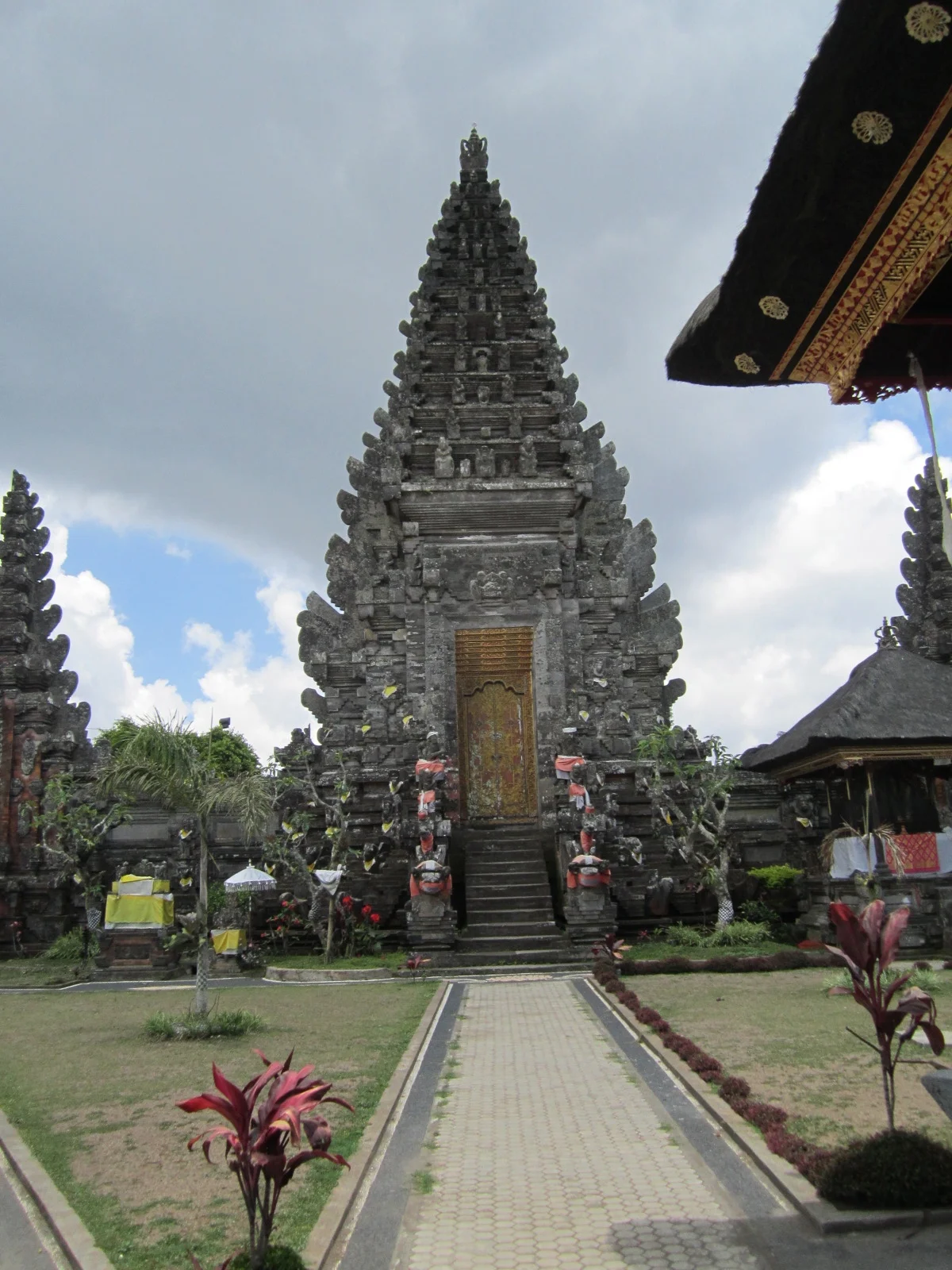

Pura Ulun Danu Batur
In 1917, lava from Mount Batur poured through the village of Karang Anyar and flowed toward the gates of Pura Ulun Danu Batur. The black rock stopped just short of the temple compound. The Balinese read this as a sign from the gods: the temple was protected, and so the people stayed. Nine years later, on August 3, 1926, the volcano erupted again. This time the lava did not stop. It buried the village and engulfed nearly the entire temple compound, leaving only the 11-tiered main shrine standing amid a field of cooling rock. The villagers, who had been evacuated in time, carried that surviving shrine up to the caldera rim and rebuilt everything around it. The temple that stands today is not a relic but a resurrection -- proof that in Bali, the relationship between people, gods, and volcanoes is negotiated in real time.
The Lake Source Temple
The name tells you what matters here. Pura means temple. Ulun means head or source. Danu means lake. Pura Ulun Danu Batur is the Temple of the Lake's Source -- a shrine to the waters that sustain Bali's rice paddies, its agriculture, its life. Established in the 17th century, the temple is dedicated to the god Vishnu and to Dewi Danu, the goddess of Lake Batur, the island's largest body of freshwater. As one of the Pura Kahyangan Jagat -- the temples responsible for maintaining harmony across all of Bali -- it represents the cardinal direction of north and anchors the island's spiritual geography. The word batur itself, after the village where the temple was first built, means pure or spiritually clean. Ancient palm-leaf manuscripts called lontars list it among the sad kahyangan, the six universal temples of Balinese Hinduism.
Carried Up the Mountain
The relocation after the 1926 eruption was a communal effort of remarkable scale. Villagers from Desa Bayung, Tunggiran, Kedisan, Buanan, and Sekardadi came to help. The Dutch Indies government dispatched the Bangli regional army and even prison laborers. The temple's gamelan -- the bronze percussion ensemble essential to Balinese ceremony -- was carried to a special pavilion in Desa Bayung for safekeeping. A guardian spirit figure called Bhatara Gede was transported to another village so residents could continue worship during the resettlement. Land on the caldera rim was parceled out to the original families, with local police officials called mantri polisi overseeing the distribution. Houses and infrastructure went up first, then the Bangli regional government raised a second fund to build the new temple. When it was completed, the gamelan and the Bhatara Gede were brought back in a ceremony that reunited the sacred objects with their home and cleansed everything -- instruments, shrine, and ground -- for the new beginning.
Nine Temples, 285 Shrines
Pura Ulun Danu Batur is not a single building but a compound of nine separate temples containing 285 shrines and pavilions. The principal temple, Pura Penataran Agung Batur, is organized across five courtyards that progress from the public outer sanctum (jaba pisan) through a middle zone (jaba tengah) to the innermost sacred courtyard (jero). Its dominant feature is the 11-tiered meru tower -- the same shrine that survived the 1926 eruption -- dedicated to Shiva and his consort Parvati. Three additional nine-tiered merus honor Mount Batur, Mount Abang, and Ida Batara Dalem Waturenggong, the deified king of the Gelgel dynasty who ruled from 1460 to 1550. The eight surrounding temples serve more specific purposes: Pura Tirta Bungkah for the hot springs, Pura Taman Sari for gardens, others for agriculture, crafts, and holy springs.
Water Democracy
The temple's significance extends far beyond ritual. Bali's subak system -- the cooperative water management network that distributes irrigation across the island's rice terraces -- is coordinated in part through temple ceremonies. Pura Ulun Danu Batur sits at the top of this system, spiritually and hydrologically. The lake it guards is the island's primary freshwater source, feeding the springs and rivers that supply the subak channels downstream. In 2012, UNESCO inscribed the Cultural Landscape of Bali Province as a World Heritage Site, recognizing the subak system and four associated temples, including Pura Ulun Danu Batur, as a manifestation of the Tri Hita Karana philosophy -- the Balinese principle of harmony among people, nature, and the divine. The temple's annual odalan festival, held on the tenth full moon according to the Balinese calendar, typically falls in late March or early April, drawing worshippers from across the island to honor the waters that keep Bali alive.
From the Air
Located at 8.25S, 115.34E on the southwestern rim of Mount Batur's caldera in central Bali. The temple compound is on the caldera ridge near the town of Kintamani. Not individually distinguishable from altitude, but the caldera rim road and the town of Kintamani are visible reference points. Lake Batur and the volcanic cone below the rim provide unmistakable orientation. Nearest major airport is Ngurah Rai International (WADD) approximately 45 nm south. Expect variable visibility due to tropical convection and occasional volcanic haze.
Nearby Stories
- Tenganan: The Village That Stayed Behind 9.2 km away
- The Words Written on Leaves 20 km away
- The Day Seririt Fell Silent 21 km away
- Battle of Makassar Strait 46 km away
- Mayura Park 48 km away
- Forty-Five Men and Thirty-Six Depth Charges 52 km away
- Alas Purwo: Where Java Begins and the Surf Never Stops 61 km away
- Java's Little Africa 66 km away