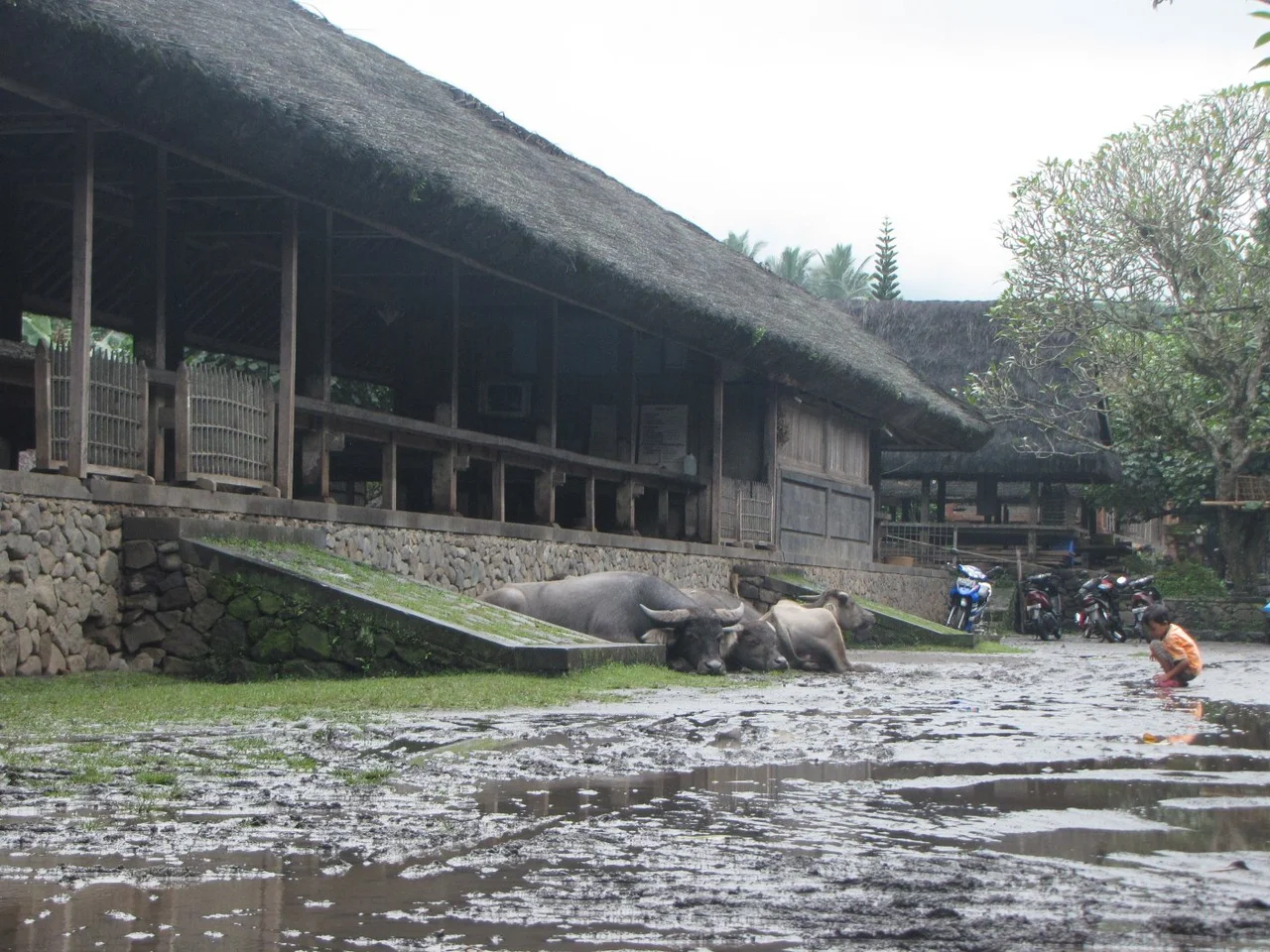

Tenganan: The Village That Stayed Behind
The trick involved a dead horse. When King Udayana of the eleventh-century Bedahulu kingdom sent search parties to find his missing sacrificial horse, a group of Peneges family servants found it in eastern Bali, already dead from exhaustion. The king rewarded them with all the land where the carcass could be smelled. So the Peneges men dismembered the horse, hid pieces of it in their clothing, and walked as far as they could, the stench following them everywhere. By the time the king's inspectors gave up trying to find the boundary of the smell, the Peneges had claimed an entire valley. They called it ngetengahang, meaning "to move to the middle," and brought their families to settle. That valley is Tenganan Pegringsingan, and the descendants of those resourceful servants still live there, governed by rules that predate most of what the outside world recognizes as Balinese.
The Original Balinese
The people of Tenganan are Bali Aga, a term that translates roughly as "the original Balinese." They descend from the pre-Majapahit kingdom of Bedahulu, which means their cultural roots predate the Javanese Hindu influence that shaped most of what visitors now think of as Balinese tradition. Before the 1970s, anthropologists described Tenganan as one of the most secluded societies in the Indonesian archipelago. The village enforced strict endogamic rules: only those born within its boundaries could become full community members, and anyone who married an outsider had to leave. These rules steered the Tengananese through centuries of genetic risk, producing a community that remained remarkably cohesive. At the northern end of the village stands the Pura Puseh, the temple of origin, anchoring the settlement to its founding story. Since the 1970s, central government development and tourism have opened Tenganan to the outside world, and some endogamic rules have loosened. But the village layout, the ceremonies, and the communal identity remain distinct from lowland Bali.
Cloth That Protects the Living and the Dead
Tenganan is one of only three places in the world that produces geringsing, a double-ikat textile in which both the warp and weft threads are individually dyed before weaving. The technique is extraordinarily difficult. Each cloth can take years to complete. According to village tradition, the god Indra himself taught the women of Tenganan to weave geringsing, its star motifs replicating his divine realm. The cloth is not decorative. The Tengananese believe geringsing possesses magical protective qualities, capable of shielding humans from harmful influences and keeping impurities out of the village. A child receives their first geringsing at the hair-cutting ritual, placed beneath the basket that holds the shorn hair on the bale tengah, the platform on which every Tengananese enters and leaves the world. At death, a geringsing hip sash covers the deceased. These burial cloths may never be reused and are typically sold afterward. From first haircut to final rest, the same textile tradition marks every transition.
Ceremonies Written in Fabric
Geringsing appears at every significant ritual in Tenganan, each use following precise rules. When a boy or girl is admitted to the village youth association, they are carried on their father's right shoulder dressed in geringsing cloth. During the teruna nyoman initiation, candidates wear a geringsing alongside a keris, the ceremonial dagger that signifies readiness for adult responsibility. For tooth filing, the essential rite of passage for all Balinese Hindus that symbolizes the taming of human passions, the participant's pillow is covered by geringsing. In the wedding ceremony, the couple sits dressed in festive geringsing while relatives place symbolic gifts on a geringsing cloth spread before them. Even the dead are attended by it: during muhun soul-purification rites, an effigy of the deceased is carried in a geringsing shoulder cloth. The fabric is not merely present at these ceremonies. It is doing something, functioning as a spiritual barrier between the person in transition and the dangers that lurk at the boundaries between life stages.
Iron Music in a Hidden Valley
Tenganan's other distinctive art form is the gamelan selunding, an ensemble of iron metallophones that produces a sound unlike the bronze gamelans heard elsewhere on Bali. The instruments are considered sacred, played only for specific ceremonies and rituals within the village. Where bronze gamelan music shimmers and rings, the iron selunding has a darker, more austere character that matches the village's pre-Majapahit heritage. The gamelan selunding tradition exists in only a handful of Bali Aga villages, and Tenganan's ensemble is among the best preserved. Combined with the geringsing weaving, the village maintains two art forms that exist almost nowhere else on Earth, both of them tied to ritual function rather than performance or commerce. Tourism has changed Tenganan in many ways since the 1970s, but these traditions persist because they are not cultural displays. They are the operating system of a community that has spent a thousand years defining itself by what it keeps.
From the Air
Tenganan sits at 8.467S, 115.567E in a valley in the Karangasem Regency of eastern Bali, roughly 5 kilometers inland from the coast near Candidasa. From the air, the village is recognizable by its distinctive linear layout running north-south along a central concourse, surrounded by lush valley walls. The nearest major airport is Ngurah Rai International (WADD), about 60 kilometers to the southwest. Mount Agung rises dramatically to the northwest. At lower altitudes, the traditional village architecture and the absence of typical Balinese temple towers distinguish Tenganan from surrounding settlements.
Nearby Stories
- The Village That Lets Its Dead Return to the Earth 7 km away
- The Words Written on Leaves 13 km away
- The Day Seririt Fell Silent 21 km away
- Museum Pasifika 28 km away
- Mandalika: The Racetrack That Summoned a Shaman 34 km away
- Clipper Climax 38 km away
- Forty-Five Men and Thirty-Six Depth Charges 89 km away
- The Silent Wave: Java's 1994 Tsunami Earthquake 299 km away