
The Village That Lets Its Dead Return to the Earth
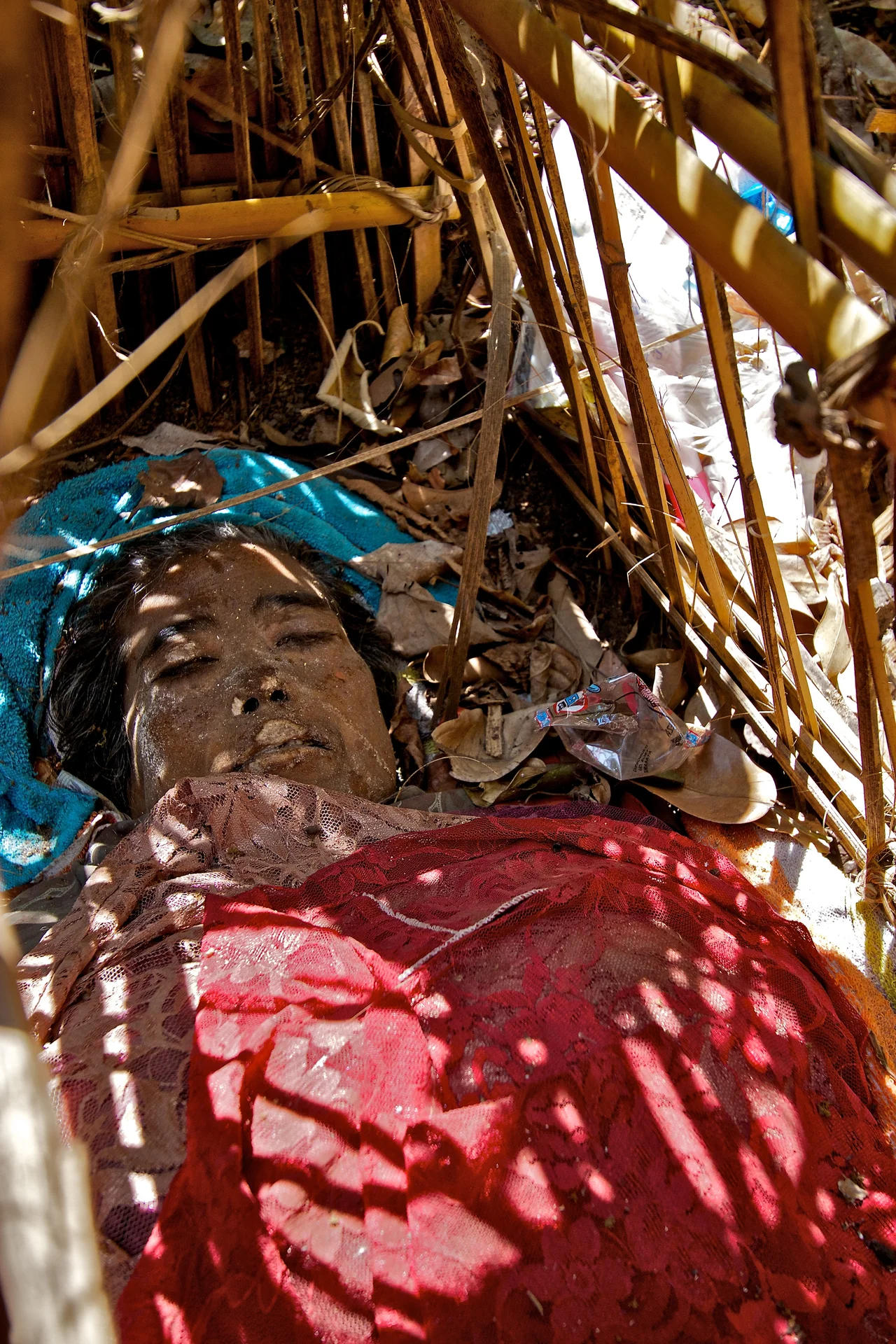
There is no cremation in Trunyan. No burial, either -- at least not for the married dead. In this isolated Bali Aga village on the eastern shore of Lake Batur, the bodies of the deceased are placed on the open ground, covered with cloth and a bamboo cage, and left to decompose beneath the canopy of an ancient banyan tree. The tree is called taru menyan -- literally, "nice smelling tree" -- and its scent is said to neutralize the odor of decay so completely that visitors report no smell at all. The village takes its very name from this tree. Reachable only by boat across the crescent-shaped crater lake, Trunyan sits at the foot of Mount Abang, a peak on the eastern rim of the Batur caldera, and its people practice rituals that predate the arrival of both Hinduism and Buddhism on the island.
Older Than the Temple
The Bali Aga -- the "original Balinese" -- are mountain-dwelling communities whose customs diverge sharply from the Hindu-influenced lowland culture that most visitors to Bali encounter. Trunyan is among the most notable of these communities, alongside the villages of Tenganan and Sambiran. But even among the Bali Aga, Trunyan stands apart. Its isolation -- accessible primarily by boat across the lake -- has preserved traditions that other Bali Aga villages have gradually shed. The village is believed to be older than its own temple, and the people here trace their social structure to bloodlines dating back to the Gelgel dynasty. Two main groups, the banjar jero and banjar jaba, divide Trunyanese society: the jero descend from villagers appointed by the kings of Gelgel to govern, while the jaba descend from those they governed. It is one of the few instances where the outside world left a mark on this otherwise self-contained community.
The Cemetery Beneath the Canopy
The funeral rites are what draw most attention, and they deserve to be understood on their own terms rather than treated as spectacle. When a married person dies, the body is carried by boat to a burial ground 500 meters north of Banjar Kuban, a site reachable only from the water. There, it is laid on the earth, covered with cloth, and sheltered beneath a bamboo canopy. The ancient banyan tree does its work, and the body slowly returns to the soil. Once decomposition is complete, the skull is placed on a stair-shaped stone altar among the skulls of those who came before. Unmarried dead receive a different treatment -- they are buried in a conventional cemetery. These rites trace their origins to the Neolithic Agama Bayu sect, one of six major religious-spiritual traditions in pre-Hindu Bali. The Agama Bayu worshipped the stars and the wind, and their approach to death reflected a worldview in which the body was meant to rejoin the elements directly, without fire as an intermediary.
The Four-Meter God in the Underground Chamber
The Trunyanese worship a local deity called Bhatara Da Tonta, also known as Ratu Gede Pancering Jagat, a figure connected to the Batur volcano itself. His effigy is extraordinary: a four-meter-tall Neolithic statue housed in an underground chamber, regularly cleansed with rainwater, adorned with flowers, and anointed with special oil. The manner of worship follows instructions inscribed on an ancient bronze tablet dating to 911 AD, discovered at Pura Tegeh Koripan -- a temple built in the form of a Neolithic pyramid at Mount Penulisan, the second-highest point on the Batur caldera rim. Once a year, during the Brutuk festival on the full moon of the fourth month, the effigy is brought into the open. The festival itself centers on the Barong Brutuk dance, performed by a select group of unmarried men who have undergone weeks of purification and isolation. They wear sacred masks and aprons of dried banana leaf fiber, and they dance without music -- the silence itself a form of devotion.
The Weight of Ceremony
Life in Trunyan is governed by expectations that can feel crushing. Like other Balinese communities, the Trunyanese place enormous emphasis on prestige, and ceremonies must be held lavishly or not at all. Wedding celebrations are expected to be spectacular -- so spectacular that many married couples with children perpetually postpone their ceremonies because they cannot afford them. The economy is small-scale agriculture, and accumulating enough wealth for a proper wedding can take years. Young men are required to leave the village and travel through lowland Bali for a period, living as beggars -- a practice rooted in a 10th-century Buddhist tradition similar to the mendicant monks of Thailand. They return with an experience of the world beyond the caldera, though the world they return to has changed remarkably little. Trunyan remains a place where the oldest customs are not historical curiosities but daily obligations, where the dead lie open to the sky and a god carved in the Neolithic era still receives fresh flowers.
From the Air
Located at 8.25S, 115.43E on the eastern shore of Lake Batur, inside the Mount Batur caldera in Bangli Regency, central Bali. The village is visible from the air as a small settlement tucked between the caldera wall (Mount Abang, 2,152m) and the crescent-shaped lake. The caldera itself is a prominent visual landmark -- a large collapsed volcanic rim with a lake and the active cone of Mount Batur (1,717m) on its western side. Best viewed from 4,000-6,000 feet AGL. Nearest airport: Ngurah Rai International (WADD/DPS), approximately 40 nm to the south.
Nearby Stories
- Tenganan: The Village That Stayed Behind 9.2 km away
- The Words Written on Leaves 20 km away
- The Day Seririt Fell Silent 21 km away
- Battle of Makassar Strait 46 km away
- Mayura Park 48 km away
- Forty-Five Men and Thirty-Six Depth Charges 52 km away
- Alas Purwo: Where Java Begins and the Surf Never Stops 61 km away
- Java's Little Africa 66 km away