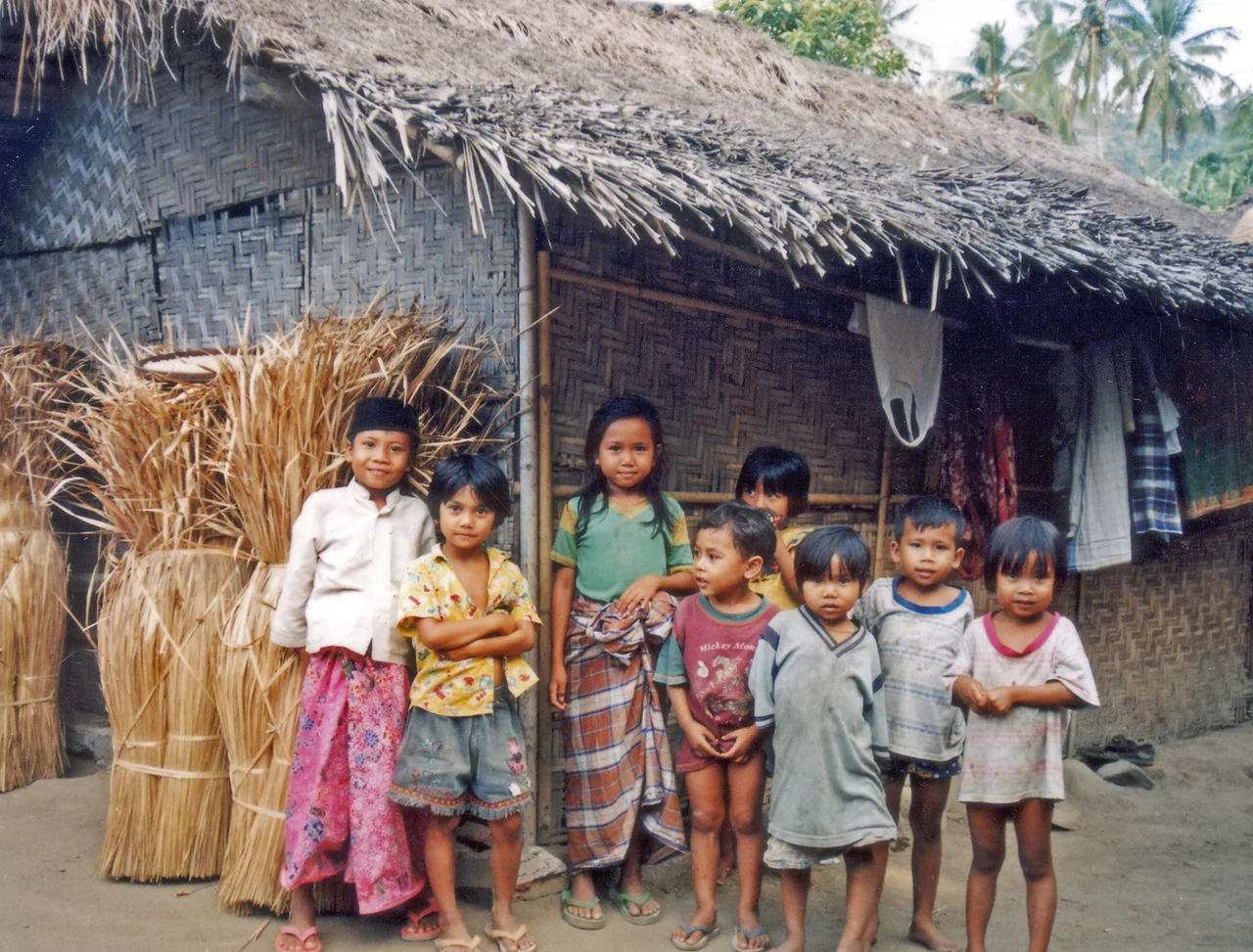

The Words Written on Leaves
How you say "like this" determines where you come from. In northern Lombok, the phrase is Kutó-Kuté. In the northeast, Nggetó-Nggeté. Travel to the center and it becomes Menó-Mené. These are not just words but names—the five dialects of the Sasak language are literally defined by how their speakers express this single, deceptively simple concept. Some of these dialects are so different from one another that speakers from opposite ends of the island cannot understand each other at all. Yet all of them belong to the same linguistic tradition, one spoken by roughly 2.7 million people on an island smaller than Connecticut, a language with no official status, no seat in government, and no place in the classroom—but one that still governs how neighbors greet each other, how ceremonies unfold, and how the past is remembered.
A Tongue Without a Throne
Sasak belongs to the Austronesian family, part of a linguistic lineage that stretches from Madagascar to Easter Island. Its closest relative is the Sumbawa language spoken on the neighboring island to the east, and together with Balinese they form a tight subgroup that linguist K. Alexander Adelaar identified in 2005 as the Balinese-Sasak-Sumbawa cluster. Despite being spoken by roughly 85 percent of Lombok's population, Sasak holds no formal status anywhere. Indonesian—the national language—handles education, government, and literacy. Sasak lives in families and villages, in the rhythms of daily conversation rather than in documents or decrees. In urban areas near Mataram, the provincial capital, younger speakers increasingly mix Sasak with Indonesian, code-switching between the two rather than abandoning either. The language persists not because institutions protect it, but because communities choose it.
Speaking Up, Speaking Down
Sasak is not one language so much as a system of social calibration. Like neighboring Javanese and Balinese, it employs speech levels—entirely different vocabularies depending on whether you are speaking to someone above you, below you, or at your own social rank. Address a village elder the way you would address a friend, and you have committed a serious social error. The upper class, known as the mènak, once took this further still, reaching beyond Sasak into Kawi—a literary language rooted in Old Javanese—for a level of hyperpoliteness that exceeded even Sasak's own "high" register. Kawi also found its way into puppet theater and poetry, blending with Sasak in texts inscribed on lontar palm leaves. These dried leaves, the traditional writing medium, carry a script nearly identical to Balinese. Few people read or write it today, but the lontar texts survive, brought out and recited on ceremonial occasions as living proof that this language once had its own literature.
Five Dialects, One Island
Lombok is only about 70 kilometers across, yet the linguistic variation packed into that space is remarkable. The five named dialects—Kutó-Kuté, Nggetó-Nggeté, Menó-Mené, Ngenó-Ngené, and Meriaq-Meriku—correspond roughly to regions of the island, from the north through the central highlands to the south. Linguist Peter K. Austin has argued that even these five labels fail to capture the full extent of geographic variation within Sasak. The differences run deeper than vocabulary. Eastern dialects, for example, use three distinct types of nasalization on verbs: one to mark transitivity, another for predicate focus, and a third for ongoing actions with unspecified objects. Western dialects handle these functions differently. Word order itself is flexible in Sasak—three of the six possible arrangements of subject, verb, and object occur with roughly equal frequency in certain clause types, a feature unusual even among the region's already flexible languages.
The Grammar of Belonging
Consider a Sasak speaker saying "my hand." The word for "I" and the possessive clitic that attaches to the noun for "hand" vary by dialect, but the underlying structure reveals something intimate: Sasak distinguishes between things you possess and things that are inalienably yours—your body, your family. This grammatical distinction between alienable and inalienable possession runs through the language's system of clitics, small grammatical units that attach to words like suffixes but function as independent elements. A noun can turn into a verb with the nasal prefix: the word for "coffee" becomes the verb "to drink coffee." The language builds meaning through these fluid transformations, reshaping words with prefixes that can swallow the original consonant entirely. Stress always falls on the final syllable, giving Sasak speech a forward-leaning momentum, each word pushing toward its ending.
Holding On at the Crossroads
Lombok sits at a cultural crossroads. To the west, Bali carried forward Hindu traditions that once spread from India across the archipelago. To the east, the islands increasingly reflected different influences. About 300,000 Balinese people live on Lombok itself, concentrated in the west and near Mataram, creating a bilingual landscape where Sasak and Balinese coexist alongside Indonesian. The Sasak people are predominantly Muslim, their faith having arrived centuries ago through trade networks connected to Sulawesi. Against this layered cultural backdrop, the Sasak language continues to do what languages do best—carry identity. It marks where you grew up by the dialect you speak, where you stand in society by the words you choose, and what you value by the ceremonies where lontar leaves are still unrolled and the old scripts read aloud. No government ministry safeguards it. No curriculum teaches it. Yet every morning in Lombok's villages, 2.7 million people wake up and speak it anyway.
From the Air
Coordinates: 8.58°S, 116.12°E, centered on Lombok island in the Lesser Sunda Islands chain. Lombok International Airport (WADL) lies in the south-central part of the island. From cruising altitude, Lombok appears as a roughly circular island dominated by the cone of Mount Rinjani (3,726 m) to the north. The island sits between Bali (visible to the west across the Lombok Strait) and Sumbawa (to the east across the Alas Strait). Best viewed at 15,000–20,000 ft for the full island context. Clear skies are most common during the dry season (May–September).
Nearby Stories
- Ujung Water Palace: The Garden at the Edge 7.8 km away
- Mandalika: The Racetrack That Summoned a Shaman 17 km away
- The Village That Lets Its Dead Return to the Earth 26 km away
- Museum Pasifika 48 km away
- Forty-Five Men and Thirty-Six Depth Charges 85 km away
- The Island Diana Chose 93 km away
- Satonda: The Island That Remembers Earth's First Ocean 122 km away
- The Island That Shook the World 136 km away