
Ujung Water Palace: The Garden at the Edge
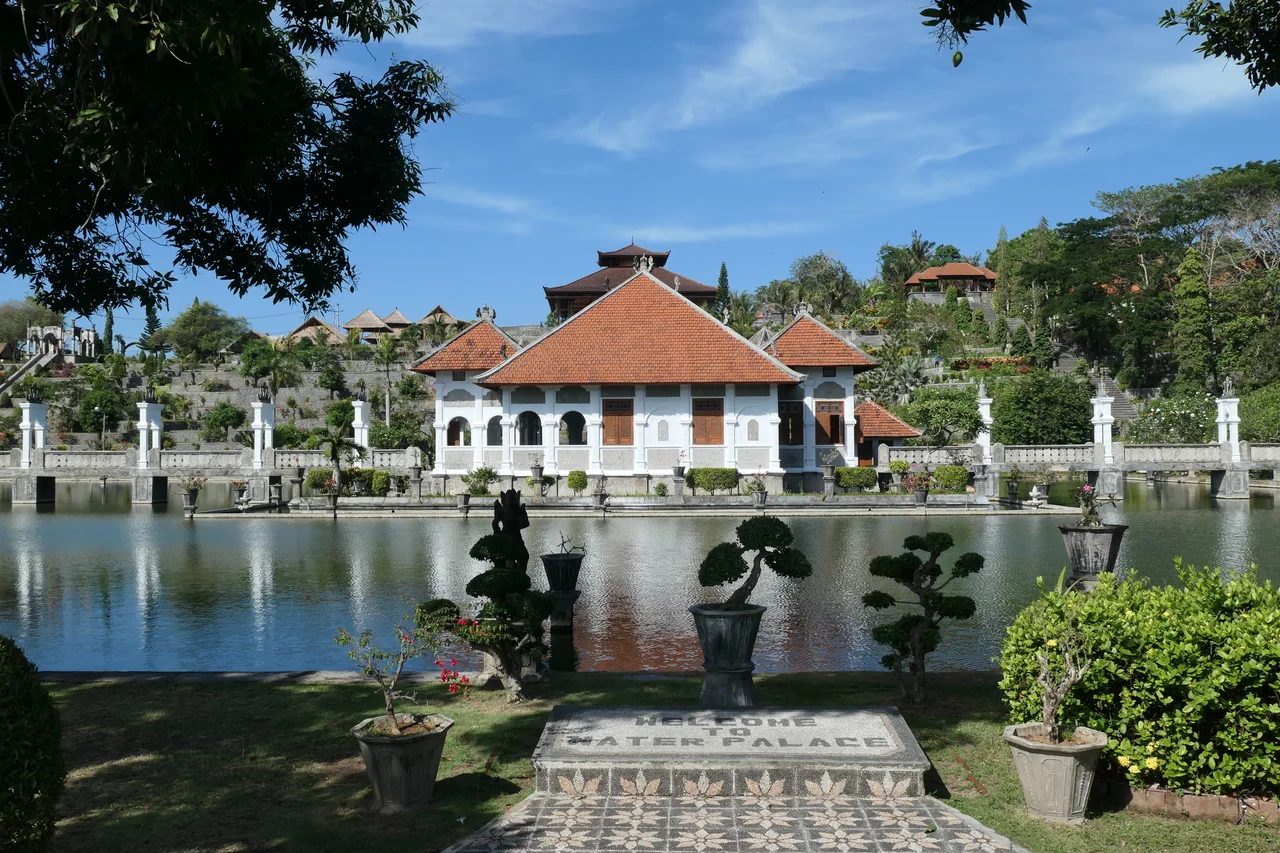
The name says it plainly. Ujung means "edge" or "end," and Taman Ujung, the Garden at the Edge, sits exactly where the name promises: on the southeastern coast of Bali, where the island's volcanic slopes run out of land and meet the Indian Ocean. The last king of Karangasem built his pleasure palace here in 1921, at a moment when Balinese royalty still held enough power to dream on a grand scale but had already absorbed enough colonial influence to dream in concrete and white-washed facades. The result was a twelve-hectare estate of pools, pavilions, and gardens that belonged fully to neither Balinese nor Dutch tradition. In the center pool, connected to shore by a single bridge, the Gili Bale, the island pavilion, rose with walled rooms and a colonial exterior unlike any traditional Balinese bale. It was a building that declared its owner equally comfortable with European architecture and Hindu cosmology.
Three Architects, Three Worlds
The palace was designed by an unlikely collaboration. The Dutch architect van Den Hentz brought European engineering and the use of concrete, then still considered a novel technology in Bali. A Chinese architect named Loto Ang contributed his own design traditions. And Balinese undagi, the traditional master builders who worked from sacred geometric principles, ensured the complex honored Hindu spatial order. The construction, completed in 1921, produced a palace that confounded easy categorization. Three large pools dominated the grounds, reflecting sky and volcano alike, their still surfaces broken only by the Gili Bale at the center. The main pavilion's white-washed walls and European proportions sat within a landscape of Balinese stone carvings and tropical gardens. Concrete, the material of colonial modernity, supported structures adorned with traditional Balinese ornamentation. The king of Karangasem was making a statement about the world he inhabited: hybrid, strategic, unwilling to be defined by any single tradition.
A Stele in Two Scripts
In 1937, the palace received a formal inauguration marked by the installation of a marble stele. The inscription was carved in two alphabets, Latin and Balinese script, and written in two languages, Malay and Balinese. The choice was political as much as ceremonial. Malay was the language of interethnic commerce and colonial administration. Balinese was the language of the court. Latin script carried the authority of the colonizer. Balinese script carried the authority of a literary and religious tradition stretching back centuries. By placing all four on a single stone, the king ensured his palace spoke to every audience that might claim authority over it. The guest list reinforced the message. The king of Siam visited. The governor general of the Netherlands came. The sultans of Surakarta and Yogyakarta, the great Javanese courts, were received here. Taman Ujung was not a provincial retreat. It was a diplomatic stage where a Balinese king received the powers of Asia and Europe on his own terms.
What a Volcano and an Earthquake Leave Behind
Mount Agung, visible from the palace on clear days, destroyed nearly everything in 1963. The eruption that killed more than a thousand people across eastern Bali buried Taman Ujung under volcanic debris. What the volcano spared, an earthquake finished in 1975. For over two decades, the palace lay in ruin, its pools cracked and empty, its pavilions roofless, its gardens overtaken by vegetation. The ruins became a kind of accidental monument to impermanence, the very idea that Balinese Hindu philosophy teaches but that no king building a twelve-hectare pleasure palace really expects to experience. Between 1998 and 2001, the Karangasem government undertook a restoration that rebuilt the pools, repaired the Gili Bale, and replanted the gardens. The work did not attempt to freeze the palace at any single moment in its history. Instead, the restored complex carries the visible marks of what it has survived: fresh concrete alongside original stone, new plantings framing old foundations.
The Temple Beyond the Pools
Between the palace and the sea stands the Pura Lingga Yoni, a temple whose origin story is as improbable as the palace's architecture. During the construction of a breakwall in 2012, workers discovered a two-meter phallic-shaped stone ten meters offshore. The stone was brought to land, and a new temple was consecrated around it. The lingga and yoni, the paired Hindu symbols of Shiva and Shakti, of creation and cosmic balance, gave the temple its name. Its placement between the palace and the ocean adds a layer of meaning to the entire site. Taman Ujung sits at the edge of the land, and the temple sits at the edge of the water, marking the boundary between the human and the infinite. The king who built the palace chose this coastline for reasons the architecture alone does not explain. Land, water, mountain, sea: the Garden at the Edge occupies the intersection of all of them, which is precisely where Balinese cosmology places the sacred.
From the Air
Ujung Water Palace sits at 8.463S, 115.631E on the southeastern coast of Bali, approximately 5 kilometers southeast of Amlapura, the capital of Karangasem Regency. From the air, the palace is identifiable by its three large rectangular pools reflecting sunlight against the green coastal landscape. Mount Agung rises dramatically to the northwest. The nearest major airport is Ngurah Rai International (WADD), roughly 70 kilometers to the southwest. At lower altitudes, the white-washed Gili Bale pavilion at the center of the main pool is the most distinctive feature, and the Pura Lingga Yoni temple is visible between the palace grounds and the shoreline.
Nearby Stories
- The Village That Lets Its Dead Return to the Earth 7 km away
- The Words Written on Leaves 13 km away
- The Day Seririt Fell Silent 21 km away
- Museum Pasifika 28 km away
- Mandalika: The Racetrack That Summoned a Shaman 34 km away
- Clipper Climax 38 km away
- Forty-Five Men and Thirty-Six Depth Charges 89 km away
- The Silent Wave: Java's 1994 Tsunami Earthquake 299 km away