.jpg)
Mayura Park
The name came from a snake problem. When the royal garden built in 1744 by Anak Agung Ngurah Karangasem became overrun with serpents, advisors suggested an elegant solution: bring in peacocks. The birds hunted the snakes, the garden earned a new name - Mayura, Sanskrit for peacock - and the original name, Taman Kelepug, named for the splashing sound of its spring water, faded into local memory. It is a fitting origin story for a place that has always been about transformation. Originally a pleasure garden complementing the Karangasem royal palace in Cakranegara, two kilometers east of Mataram on the island of Lombok, Taman Mayura has served as a court of kings, a battlefield where Dutch colonial ambitions met fierce resistance, and today, a quietly beautiful public park where the past pools visibly in still water.
The Floating Court
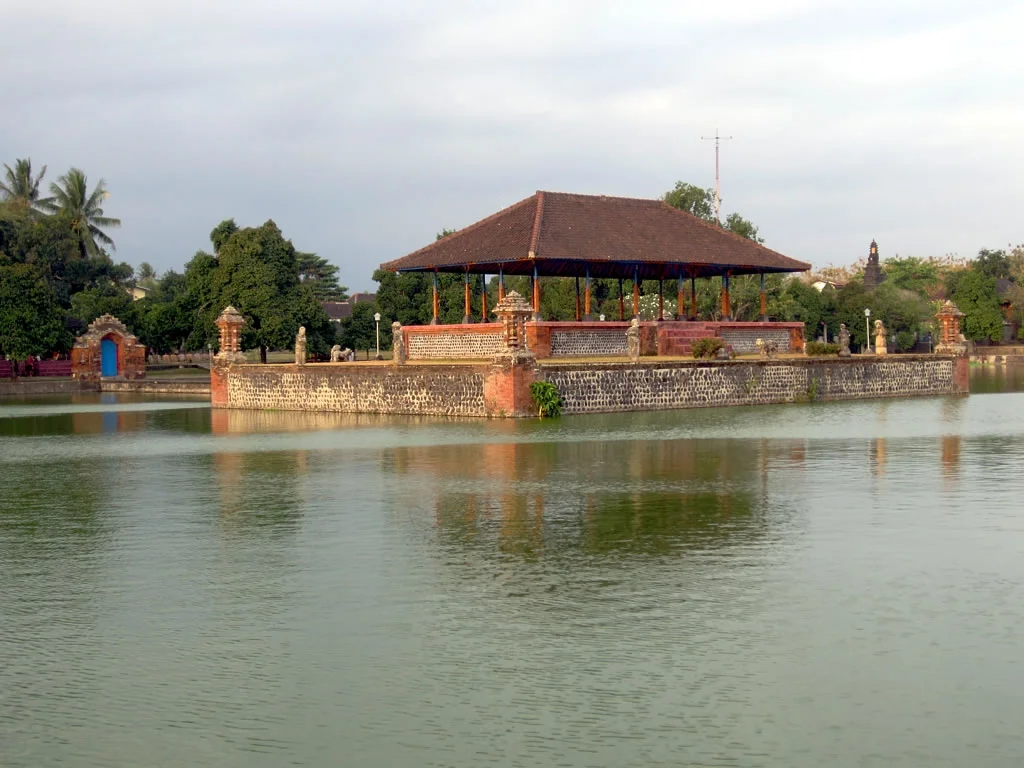
At the center of Mayura Park sits a large rectangular pond, and at its heart rises the Bale Kambang - a floating pavilion reached by a narrow causeway. The structure once served as the nerve center of Karangasem rule on Lombok: a place for royal audiences, judicial proceedings, and religious ceremonies. The park itself spans roughly 244 by 138 meters, enclosed and deliberate in its geometry. Around the pond stand four open pavilions of varying size, oriented to the cardinal directions. Three pairs of statues depicting Muslim leaders in traditional Banjar clothing flank the Bale Kambang courtyard to the east, south, and west - a testament to the complex religious politics of a Hindu Balinese kingdom governing a predominantly Muslim Sasak population. A bronze cannon guards the entrance to the Bale Kambang, and an iron cannon stands near the park gate. These are not decorative. They are remnants of the wars that swept through this garden.
A Kingdom's Rise and Fracture
The story of Mayura Park is inseparable from the story of Lombok's Karangasem dynasty. At the beginning of the 19th century, the island was fractured into small competing kingdoms. By 1838, wars of unification had reduced them to two major powers: Sasak Singasari and Sasak Mataram. War between these kingdoms erupted in 1839. Singasari fell, but the Mataram king was killed in the fighting, leaving behind two sons - Crown Prince Gde Ngurah Karangasem and Anak Agung Ketut Ngurah Karangasem. The surviving dynasty renovated and expanded the garden in 1866, renaming it Mayura and cementing it as the symbolic seat of royal authority. For decades, it functioned as both a retreat and a statement: a water garden in the Balinese tradition, proof that the Karangasem rulers could impose beauty and order on a restive island.
Blood in the Garden
The most consequential chapter in Mayura's history was written in 1894, when Dutch colonial forces arrived to exploit tensions between the Balinese rulers and their Sasak subjects. The Dutch expedition, commanded by General P.P.H. van Ham, initially met little resistance. But at Cakranegara, near the royal compound and gardens of Mayura, the tide turned violently. Sasak and Balinese forces loyal to the king launched a devastating surprise attack that killed General van Ham and sent the Dutch retreating in disarray. It was a humiliating defeat that shocked the colonial administration. The Dutch response was predictable: they returned with a far larger expeditionary force, eventually subduing the Karangasem kingdom and absorbing Lombok into the Netherlands East Indies. The cannons that remain at Mayura Park are relics of that conflict, quiet metal witnesses to the day a garden became a killing ground.
Still Water, Deep Roots
Today Mayura Park operates as a public garden and cultural heritage site, maintained by Indonesia's cultural preservation authority. The Bale Kambang still rises from the pond, its reflection doubling in the still water. Visitors are few compared to Bali's tourist temples, and the park carries a contemplative quality that busier sites cannot match. The surrounding neighborhood of Cakranegara, once the royal capital, has grown into a commercial district of Mataram, the provincial capital of West Nusa Tenggara. Yet within the park walls, the geometry of the original garden persists - the rectangular pond, the cardinal pavilions, the floating court at the center. A Padmasana shrine marks where the king once rested. The statues of Muslim leaders still stand in their Banjar finery, symbols of a kingdom that governed across religious lines with a pragmatism modern politicians might envy. Mayura Park does not shout its significance. It waits, still and green, for those who care to look.
From the Air
Located at 8.59°S, 116.13°E in Cakranegara, approximately 2km east of central Mataram, the capital of West Nusa Tenggara province on Lombok. The park is a rectangular green space visible in the urban fabric of greater Mataram. Lombok International Airport (WADL) is approximately 30km to the south-southwest near Praya. From approach altitude, look for the rectangular pond and surrounding gardens amid the dense urban grid of Cakranegara. Mount Rinjani (3,726m) dominates the skyline to the northeast. The west coast beach strip of Senggigi lies about 10km northwest. Weather is tropical; dry season April-October provides the clearest views.
Nearby Stories
- Ujung Water Palace: The Garden at the Edge 7.8 km away
- Mandalika: The Racetrack That Summoned a Shaman 17 km away
- The Village That Lets Its Dead Return to the Earth 26 km away
- Museum Pasifika 48 km away
- Forty-Five Men and Thirty-Six Depth Charges 85 km away
- The Island Diana Chose 93 km away
- Satonda: The Island That Remembers Earth's First Ocean 122 km away
- The Island That Shook the World 136 km away