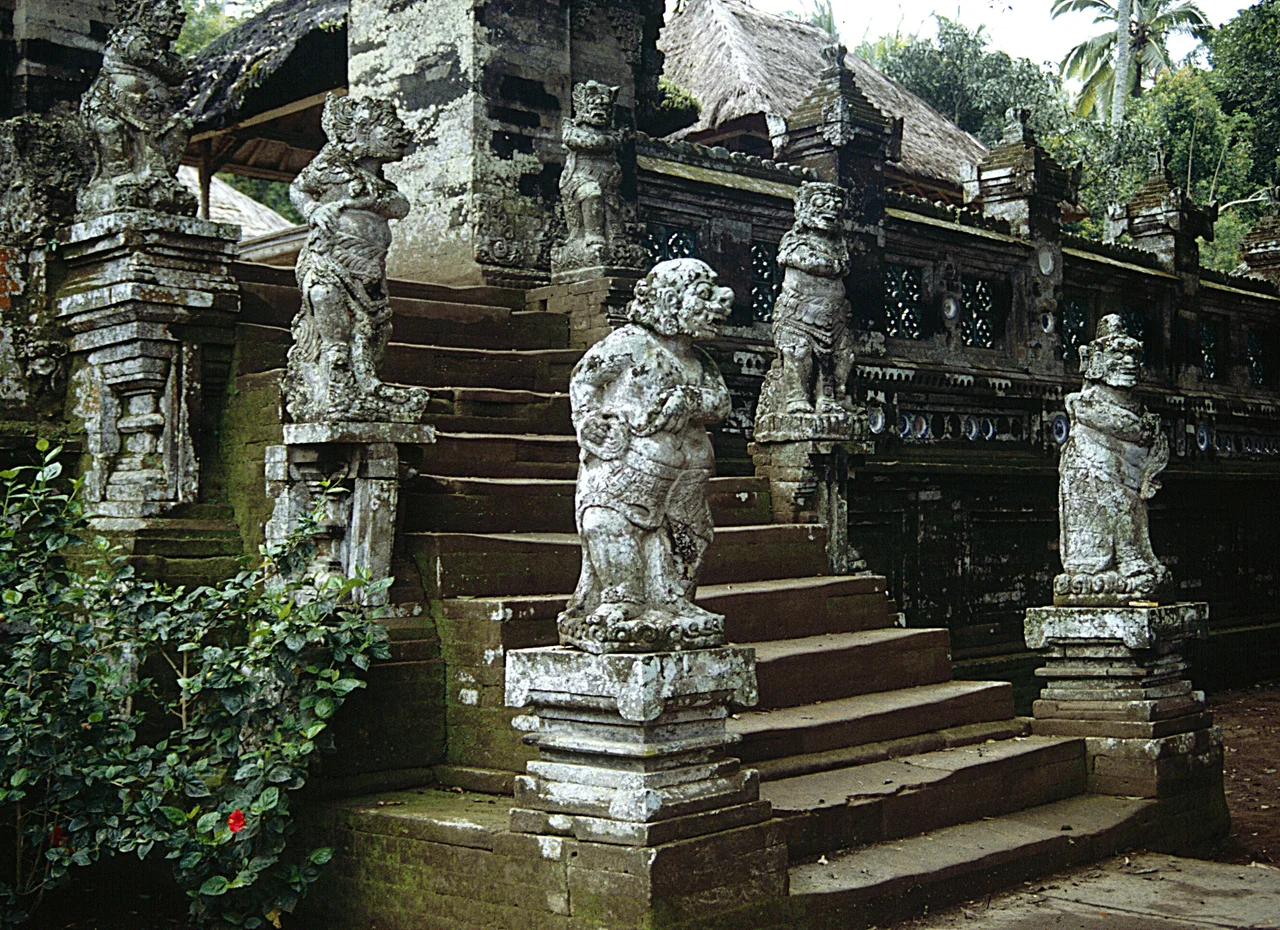

Pura Kehen
The word kehen comes from keren, the Balinese word for flame. This is a temple dedicated to fire. Not the destructive kind, but fire as a divine witness, the presence before which oaths were sworn and the unfaithful condemned. For over a thousand years, Pura Kehen has stood on the wooded hillside above Bangli, a town whose name, bang giri, means red forest. Everything about this place speaks of heat and light: the god Agni, the flame that never goes out, the serpent vessel that sealed a person's fate. It is Bali's most dramatic temple of accountability, where the sacred and the political were fused in fire.
Written in Copper
Pura Kehen's age is not a matter of legend or oral tradition. Three copper inscriptions, dating from the late ninth century, the early eleventh century, and the thirteenth century, document the temple's existence and evolution. The oldest inscription names it Hyang Api, god of fire. By the eleventh century, the name had shifted to Hyang Kehen, reflecting the Balinese word for flame. The thirteenth-century inscription gives the temple its current name. Few Balinese temples can point to such precise documentary evidence of their antiquity. These are not casual mentions: the inscriptions describe the temple's function, its custodians, and the rituals performed within its walls. Copper was expensive. Inscribing it was an act of permanent record-keeping, a deliberate decision to fix this temple's importance in material that would survive the centuries. It has.
The Oath and the Curse
By the early eleventh century, Pura Kehen served as the official site where royal officials swore their oaths of loyalty. The ceremony was performed before the figure of Hyang Api, the god of fire Agni, and the stakes were absolute. Those proven unfaithful would be subjected to the sapata, a terrible curse that fell not only on the oath-breaker but on his family and descendants. The instrument of this ritual was the bejana sarpantaka, a vessel decorated with four serpents winding around its body. The vessel was kept in an enclosed pavilion to the east of the main shrine. There was nothing abstract about the threat. In a society organized around lineage and descent, a curse on your descendants was the most devastating punishment imaginable. It meant that your betrayal would echo through generations. The serpent vessel made the consequences tangible, coiled and waiting.
Kingdom of the Red Forest
Pura Kehen was not just any temple. It was the state temple of the Bangli Kingdom, one of the nine kingdoms of Bali. Bangli was founded as a dependency of the Gelgel Kingdom, itself part of the Majapahit dynasty's reach across the Indonesian archipelago. The kingdom took its name from its landscape: bang giri, the red forest, perhaps referring to the color of the soil or the trees that covered these hills. The temple's position on a wooded hillside two kilometers north of the town center placed it slightly apart from daily life, elevated both literally and symbolically. It was the place where political authority met divine sanction, where the king's power was legitimized not by force but by proximity to Agni. To control Pura Kehen was to control the spiritual foundation of the kingdom itself.
Fire and Porcelain
Pura Kehen shares a decorative tradition with Pura Goa Lawah and other ancient Balinese temples: the use of Chinese porcelain ceramic plates embedded into shrine walls and gates. In the early twentieth century, these imported plates were a common ornamental feature, their blue-and-white patterns creating an unexpected visual dialogue between Chinese maritime trade and Balinese Hindu devotion. The plates were not random decoration. They signaled wealth, international connection, and the temple's ongoing vitality. Today, much of the porcelain has been removed or replaced, but photographs from the colonial period show the shrines gleaming with ceramic. The temple continues to evolve, as it has since the ninth century, each generation adding and subtracting from the physical fabric while the spiritual core, the flame, the oath, the serpent vessel, remains. Pura Kehen is still the place where fire bears witness. The only thing that has changed is who stands before it.
From the Air
Pura Kehen sits at 8.442S, 115.360E on a wooded hillside about 2 km north of Bangli town center in central Bali. The temple compound is identifiable from the air by its terraced layout climbing the hillside, surrounded by dense tropical vegetation. Ngurah Rai International Airport (WADD/DPS) lies approximately 45 km to the southwest. Approach from the south to appreciate the temple's hillside setting, with the volcanic peaks of Mount Agung and Mount Batur visible to the north and northeast. The terraced rice paddies surrounding Bangli provide distinctive landscape context.
Nearby Stories
- The Village That Lets Its Dead Return to the Earth 7 km away
- The Words Written on Leaves 13 km away
- The Day Seririt Fell Silent 21 km away
- Museum Pasifika 28 km away
- Mandalika: The Racetrack That Summoned a Shaman 34 km away
- Clipper Climax 38 km away
- Forty-Five Men and Thirty-Six Depth Charges 89 km away
- The Silent Wave: Java's 1994 Tsunami Earthquake 299 km away