
The Bird Letters of Sulawesi
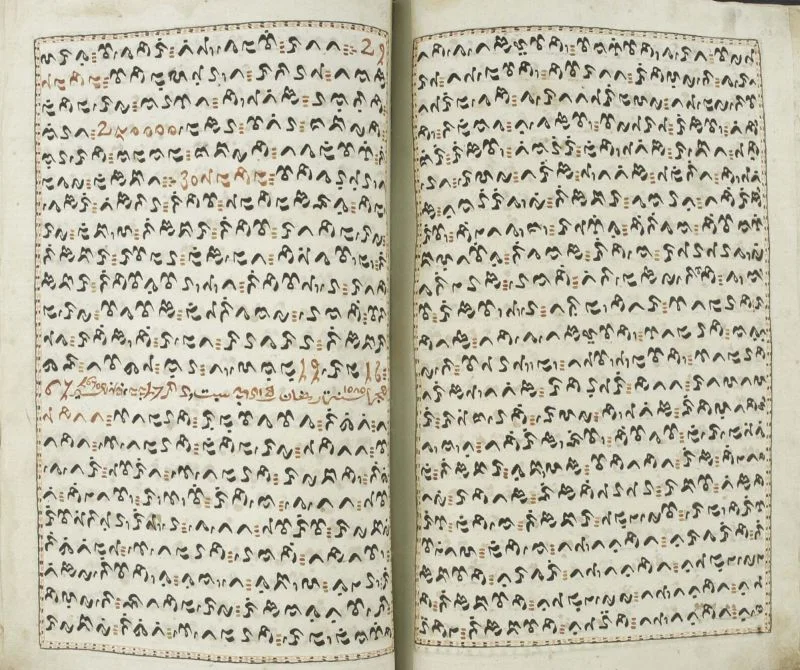
The word for 'where are you going?' in Makassarese doubles as a greeting. Lakerekomae? people ask each other on the streets of Makassar, South Sulawesi's largest city, the same way English speakers say 'how are you?' without expecting an answer. It is a small window into a language that nearly two million people still speak, one that was once written in a script so elegant its users called it huruf jangang-jangang -- 'bird letters' -- because the curving, swooping characters looked like stylized birds in flight. Makassarese belongs to the Austronesian language family, part of the South Sulawesi branch, and it is the most linguistically distinct of its relatives. Where other South Sulawesi languages share roughly half their vocabulary with each other, Makassarese shares only about 43 percent. It is a language that went its own way, and it took its speakers with it -- across the Java Sea, past the Flores Sea, all the way to the northern coast of Australia.
Scripts That Flew and Fell Silent
Before the Latin alphabet arrived, Makassarese possessed not one but three writing systems, each layered over the other like geological strata. The oldest was the Makasar script, the 'bird letters,' derived from the ancient Brahmi script of India. It was used for official purposes in the Makassarese kingdoms during the 17th century. Then came Lontara, a related but visually distinct script that gradually supplanted Makasar by the 19th century. When Islam arrived in 1605, Malay traders brought a third option: Serang, an adaptation of the Arabic-derived Jawi script. Serang had one advantage the others lacked -- it could represent consonants at the ends of syllables. Both the Makasar and Lontara scripts left those consonants unwritten, creating texts riddled with ambiguity. The Lontara spelling of 'baba,' for instance, can correspond to six different words. Readers needed not just fluency but deep contextual knowledge to decode a page. Some scholars called Lontara defective. Its readers would have called it intimate -- a script that rewarded insiders and resisted outsiders.
A Tongue That Crossed the Sea
Centuries before European cartographers finished mapping Australia's northern coast, Makassarese fishermen had already been working it. From at least the early 1700s, fleets of praus sailed south from Sulawesi to harvest trepang -- sea cucumber -- along the shores of Arnhem Land and the Kimberley. By the mid-1800s, roughly a third of all the trepang consumed in China, about 900 tonnes, came from this trade. The fishermen negotiated access with local Aboriginal groups, exchanging cloth, tobacco, metal tools, and rice for the right to fish certain waters. The contact ran deep enough that a pidgin form of Makassarese emerged as a lingua franca among different Aboriginal communities across northern Australia. Makassarese loanwords entered Aboriginal languages; Aboriginal workers sometimes joined the trepang crews. The relationship endured until 1907, when the Australian government banned Makassarese fishermen from its waters, severing a maritime connection that had lasted at least two centuries.
The Architecture of Sound
Makassarese is an agglutinative language, building long words from chains of prefixes, suffixes, and clitics the way a coral reef builds itself from countless small organisms. Words of six or seven syllables are common. Single-syllable words are almost nonexistent unless borrowed from another language. The language has 17 consonants and five vowels, but the real complexity lies in what happens at the edges of syllables. Words that end in certain consonants acquire an 'echo' -- an extra syllable that mirrors the vowel before it, closed with a glottal stop. The word for 'bottle,' botoloq, demonstrates this pattern. So does the word for the language's own homeland: Mangkasaraq, 'Makassar.' Stress typically falls on the second-to-last syllable, but the echo-syllable shifts it further back, creating a distinctive rhythmic lilt that sets Makassarese apart from its neighbors even to untrained ears.
Kingdoms, Chronicles, and Living Memory
Makassarese was the administrative language of the Gowa and Tallo kingdoms, twin polities that dominated southwestern Sulawesi for centuries. Their court records, the Makassar Annals, survive in both Lontara and Serang scripts -- one of the richest indigenous historical archives in Southeast Asia. The Gowa dialect, spoken in the heartland of these old kingdoms, remains the prestige variety today, the form that speakers of other Makassarese dialects reach for when they want to be understood across the wider community. Three main dialects persist: Gowa (or Lakiung), Jeneponto (or Turatea), and Bantaeng. Their grammars are largely the same, but their vocabularies have diverged enough that speakers from different dialect regions sometimes switch to Indonesian to communicate with each other.
A Language at the Crossroads
Ethnologue classifies Makassarese as 6b on the EGIDS scale: 'Threatened.' The word sounds alarming, but the reality is nuanced. In rural South Sulawesi, Makassarese remains the language of daily life. It ranks 16th among Indonesia's most-spoken regional languages and is the second most-spoken language on Sulawesi, after Buginese. Yet in Makassar city, code-switching between Makassarese and Indonesian has become the norm, and middle-class families increasingly raise their children in Indonesian alone. The intergenerational chain -- grandparent to parent to child, each link forged in the same mother tongue -- is beginning to fray. Makassarese is not vanishing. It is shifting, contracting toward the villages and the older speakers who still greet each other with lakerekomae? and mean it as more than a pleasantry. It is a language asking where it is going, and the answer is still being written.
From the Air
Coordinates: 5.65S, 119.83E, on the southwestern peninsula of South Sulawesi, Indonesia. The city of Makassar (formerly Ujung Pandang) is the regional hub, served by Sultan Hasanuddin International Airport (WAAA). From cruising altitude, the southwestern arm of Sulawesi's distinctive spider-like shape is clearly visible, with Makassar on the western coast. The Selayar Strait and Selayar Island lie to the south. Expect tropical weather with frequent afternoon convective activity.
Nearby Stories
- The Village That Said No to the Modern World 18 km away
- Katangka Mosque: Where Spears Guard the Pulpit 40 km away
- Coral Over the Sands 128 km away
- The Three Summits Pact 131 km away
- The Bluff That Worked and the Storm That Didn't Care 194 km away
- Isuzu: The Cruiser That Refused to Sink 217 km away
- The Five Minutes That Swallowed the Teratai Prima 227 km away
- Two Minutes of Distraction 253 km away