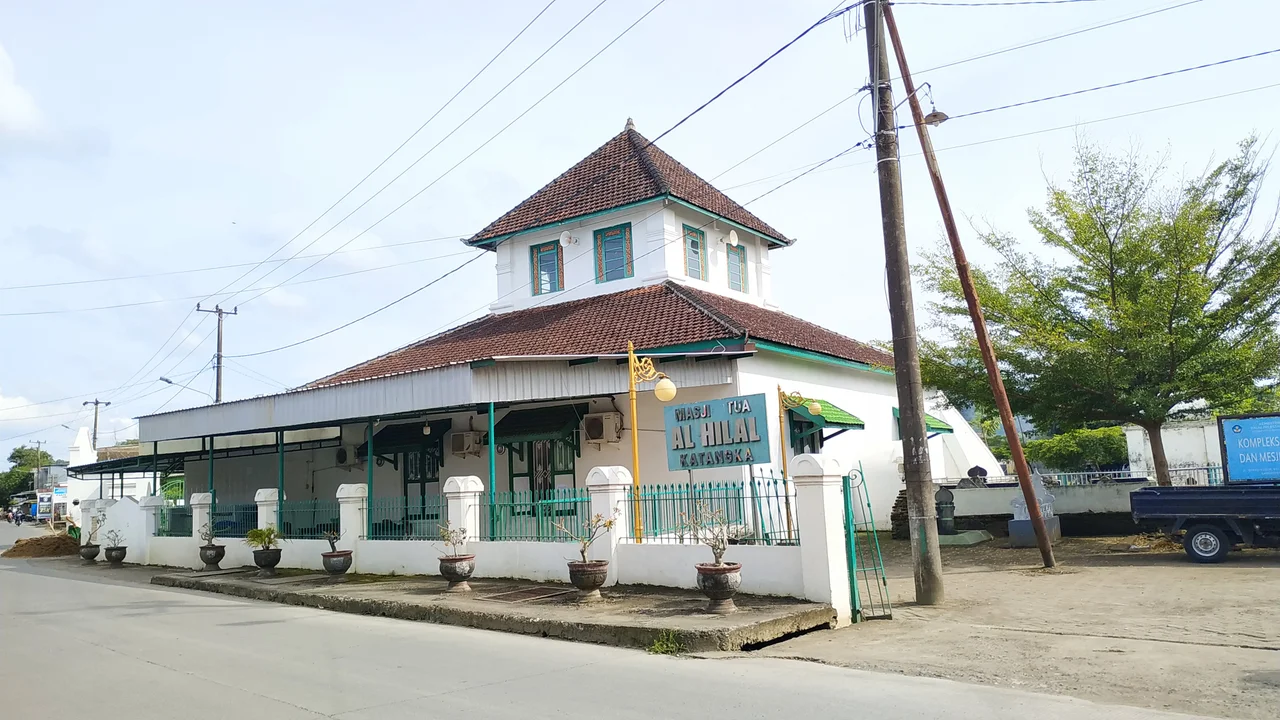

Katangka Mosque: Where Spears Guard the Pulpit
Three-edged spears still ring the pulpit. They have been there for over four centuries, since the first imam delivered his Friday sermon under the watchful gaze of two sword-bearing bodyguards. Katangka Mosque does not separate the sacred from the martial -- it never has. Built in 1603 by Sultan Alauddin, the 14th king of Gowa and the first to embrace Islam, this mosque was both house of prayer and fortress, its walls reaching 120 centimeters thick, solid enough to repel cannon fire. It is the oldest mosque in South Sulawesi, and its history reads less like a religious chronicle than a story of power, conversion, and the restless spread of faith across an archipelago.
A King's Conversion
Sultan Alauddin did not convert quietly. As the 14th ruler of the Sultanate of Gowa, his embrace of Islam around the turn of the 17th century set off a chain reaction that reshaped the political and spiritual landscape of South Sulawesi. He built Katangka Mosque in 1603 inside his fort complex, a declaration carved in stone and timber that the new faith had royal backing. The mosque served the king and his guards first -- the broader population would follow. Three Minangkabau scholars from Sumatra had carried Islam to these shores: Datuk ri Tiro, Datuk Ribandang, and Datuk Patimang. Their names are inscribed inside the mosque, a permanent record of the men who changed the faith of a kingdom. Within two years, in 1605, the neighboring Kingdom of Tallo would follow Gowa into Islam, and together the twin kingdoms would carry the creed outward across the Indonesian Archipelago.
A Fortress That Prays
Step inside Katangka Mosque and the architecture tells you everything about the age that built it. The walls are absurdly thick -- 120 centimeters of solid masonry, more befitting a military bunker than a place of worship. That was precisely the point. During times of war, the mosque doubled as a fortification, its massive walls offering protection to defenders under siege. The design reflects a period when faith and sovereignty were inseparable, when a king's mosque was also his last redoubt. The architectural style draws from the Javanese Islamic tradition, echoing the tiered roof of the Great Mosque of Demak on Java, which was then the center of Islamic expansion in the archipelago. Despite seven renovations across the centuries, roughly eighty percent of the original structure remains intact. The mihrab, the mimbar, and the original windows still stand in their 17th-century forms, unchanged while the world outside transformed utterly.
Exiles and Saints
The ground around Katangka Mosque holds the remains of people whose lives shaped the region. Sultan Hasanuddin, the legendary "Rooster of the East" who resisted Dutch colonization until defeat in 1667, lies buried here. So does Sheikh Yusuf al-Makassari, one of the most remarkable figures in Indonesian Islamic history. Raised by Sultan Alauddin in the shadow of Katangka Mosque, Yusuf grew up to become a scholar and mystic of extraordinary reach. He traveled to Banten and Aceh to deepen his learning, became embroiled in resistance against the Dutch East India Company, and was ultimately captured and exiled -- not to a neighboring island, but to South Africa, where he spent his final years at the Cape of Good Hope. In South Africa, Sheikh Yusuf is remembered as one of the founders of the Muslim community at the Cape. His journey from the grounds of Katangka Mosque to exile on another continent traces the global reach of the conflicts that engulfed this region.
The Spears Remain
Today, Katangka Mosque sits in a Makassar that has grown far beyond the fort walls where Sultan Alauddin once prayed. The city sprawls around it, modern and bustling, while the mosque endures in its 17th-century solidity. Visitors still come to see the three-edged spears arrayed around the mimbar, relics of an era when the sermon was delivered under armed guard -- not because the imam feared his congregation, but because the word of God carried the authority of the state, and the state protected its authority with steel. The Friday prayers continue. The call to worship echoes from the same site where it first sounded over four hundred years ago. Seven renovations have kept the roof sound and the walls upright, but the bones of the building are Alauddin's, a physical connection to the moment when one king's decision redirected the spiritual life of an entire region.
From the Air
Katangka Mosque is located at 5.19°S, 119.45°E in the Makassar metropolitan area on the southwest coast of Sulawesi. From the air, look for the dense urban fabric of southern Makassar near the Gowa Regency border. The nearest major airport is Sultan Hasanuddin International Airport (ICAO: WAAA), approximately 15 km to the northeast. Best viewed at 2,000-3,000 feet AGL. The tiered mosque roof may be distinguishable amid the surrounding urban landscape.
Nearby Stories
- The Forest People Who Vanished 18 km away
- The Morning After the Strongman 24 km away
- Four Sails in the Selayar Strait 40 km away
- The Oldest Paintings on Earth 43 km away
- The Bird Letters of Sulawesi 57 km away
- Two Minutes of Distraction 157 km away
- The Five Minutes That Swallowed the Teratai Prima 193 km away
- Isuzu: The Cruiser That Refused to Sink 254 km away