
Two Minutes of Distraction
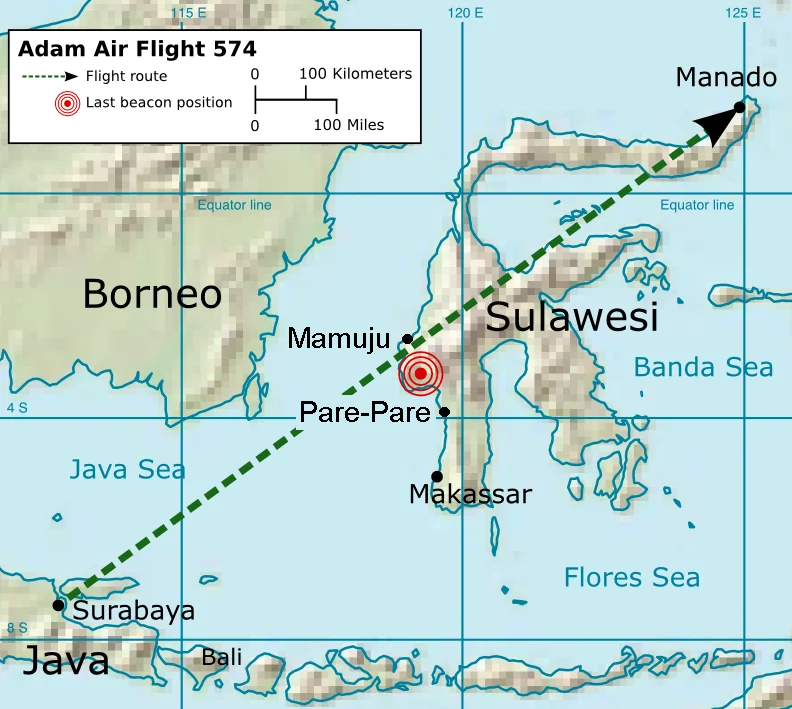
Forty-eight times in three months. That is how often pilots had filed maintenance complaints about the captain's vertical speed indicator on the Boeing 737-400 registered as PK-KKW. The inertial reference system had drawn 30 complaints of its own. On 1 January 2007, this aircraft -- carrying 96 passengers and 6 crew from Surabaya to Manado -- was cruising at 35,000 feet over the Makassar Strait when the navigation system malfunctioned again. What happened in the next two minutes would kill everyone on board, trigger the collapse of an airline, and prompt the European Union to ban every Indonesian carrier from its airspace.
A Knob Turned the Wrong Way
The flight had been unremarkable until the pilots noticed an anomaly in the inertial reference system. First Officer Yoga Susanto attempted a standard troubleshooting step: he switched his IRS unit to Attitude mode, which would reset the system. What neither he nor Captain Refri Agustian Widodo realized was that this action also disconnected the autopilot. A four-second disconnect tone sounded in the cockpit -- but both men were focused on the navigation problem. Without the autopilot holding the aircraft level, a pre-existing aileron maintenance issue caused the plane to begin rolling slowly to the right. The nose dropped. At 35 degrees of bank, a "bank angle" warning blared. Still the pilots did not look at their flight instruments. The aircraft continued rolling. By the time Susanto glanced at his attitude indicator and understood what was happening, PK-KKW was past 100 degrees of bank with its nose pointed 60 degrees below the horizon.
Faster Than Sound Could Save Them
Susanto tried to alert the captain, but Widodo -- still believing the aircraft was flying straight and level -- told him to keep the wings steady for the IRS realignment. Precious seconds burned away. When Widodo finally understood, he pulled back on the yoke. It was the wrong response. At that extreme bank angle, pulling back tightened the spiral rather than leveling the wings. The correct recovery procedure required leveling the wings first, then pitching up. The aircraft was now accelerating through its dive at Mach 0.926 -- 92.6 percent of the speed of sound -- far beyond the 737's structural limits. The airframe experienced 3.5 times the force of gravity. At a calibrated airspeed of 490 knots, the aircraft began breaking apart in flight. All flight recorder data ceased at 9,000 feet. One hundred and two people -- 98 Indonesian citizens, 3 Americans, and 1 German -- were lost to the Makassar Strait.
Searching the Deep
What followed was one of the most difficult search operations in Indonesian aviation history. Some 3,600 military and police personnel combed the Makassar Strait and the jungles of western Sulawesi, aided by Singaporean surveillance aircraft and a fleet of Indonesian naval ships. Heavy rain, strong winds, and rugged terrain slowed the effort. A fisherman south of Pare Pare found the aircraft's right horizontal stabilizer washed up on the beach but initially mistook it for plywood. The black boxes were located by a towed pinger locator operated from the U.S. Navy survey ship USNS Mary Sears, but they lay at such depth that recovery required an underwater remotely operated vehicle -- equipment Indonesia did not possess. A dispute erupted between Adam Air and the Indonesian government over who should pay for the retrieval. The boxes' 30-day battery life expired before agreement was reached. It took until August 2007 for Phoenix International's salvage vessel to retrieve the flight data recorder and cockpit voice recorder from the seabed, at a cost of three million dollars.
An Airline That Couldn't Say No
The investigation revealed a pattern that went far beyond a single malfunctioning instrument. Former Adam Air pilots described an airline where safety regulations were routinely violated under management pressure. Pilots reported being ordered to fly aircraft they knew were unsafe -- one plane operated for months with a damaged door handle, another with a cracked window. Crews were pushed past the daily takeoff limit of five flights per pilot. Spare parts were cannibalized from grounded aircraft to keep others flying. One former pilot told the Associated Press that "every time you flew, you had to fight with the ground staff and the management about all the regulations you had to violate." Pilots who pushed back were grounded or docked pay. The airline's founder denied the accusations, but the evidence painted a grim picture of systemic neglect.
The Reckoning
The consequences cascaded outward from Sulawesi across the entire Indonesian aviation industry. In April 2007, the U.S. Federal Aviation Administration downgraded Indonesia's air safety oversight rating, citing "serious concerns." The American embassy in Jakarta warned U.S. citizens to avoid Indonesian carriers. Two months later, the European Union banned every Indonesian airline from European airspace -- a prohibition that would take over a decade to fully lift. Indonesia responded by creating a tiered safety ranking system for its carriers and announcing that jets older than 10 years would be banned from commercial service, down from the previous limit of 35. Adam Air, already weakened by the crash, suffered another incident 51 days later when a separate 737 cracked its fuselage during a hard landing in Surabaya. The airline's operating certificate was suspended in March 2008 and revoked three months after that. Adam Air filed for bankruptcy and ceased to exist. The 102 people who died over the Makassar Strait had become the catalyst for a wholesale transformation of how Indonesia regulated its skies.
From the Air
Coordinates: 3.68S, 118.15E, over the Makassar Strait between Sulawesi and Kalimantan. The crash site lies in open water west of the Sulawesi coast, near the town of Polewali. From cruising altitude, the strait stretches wide between the two islands. Nearest airports include Sultan Hasanuddin International (WAAA) in Makassar to the south and Sam Ratulangi International (WAMM) in Manado, which was the flight's intended destination. The waters below are deep, which complicated the recovery operation. Stormy weather is common in the strait, with cumulonimbus clouds reaching 30,000 feet.
Nearby Stories
- The Ground Beneath Mamuju 39 km away
- The Drum of God 100 km away
- The Script That Grew on Palm Leaves 144 km away
- Tana Toraja: The Land Where the Dead Never Leave 162 km away
- The Destroyer That Almost Changed History 173 km away
- The Sea Turtle Fort 187 km away
- The Last Beach 279 km away
- The Ocean's Hidden River Between Two Worlds 337 km away