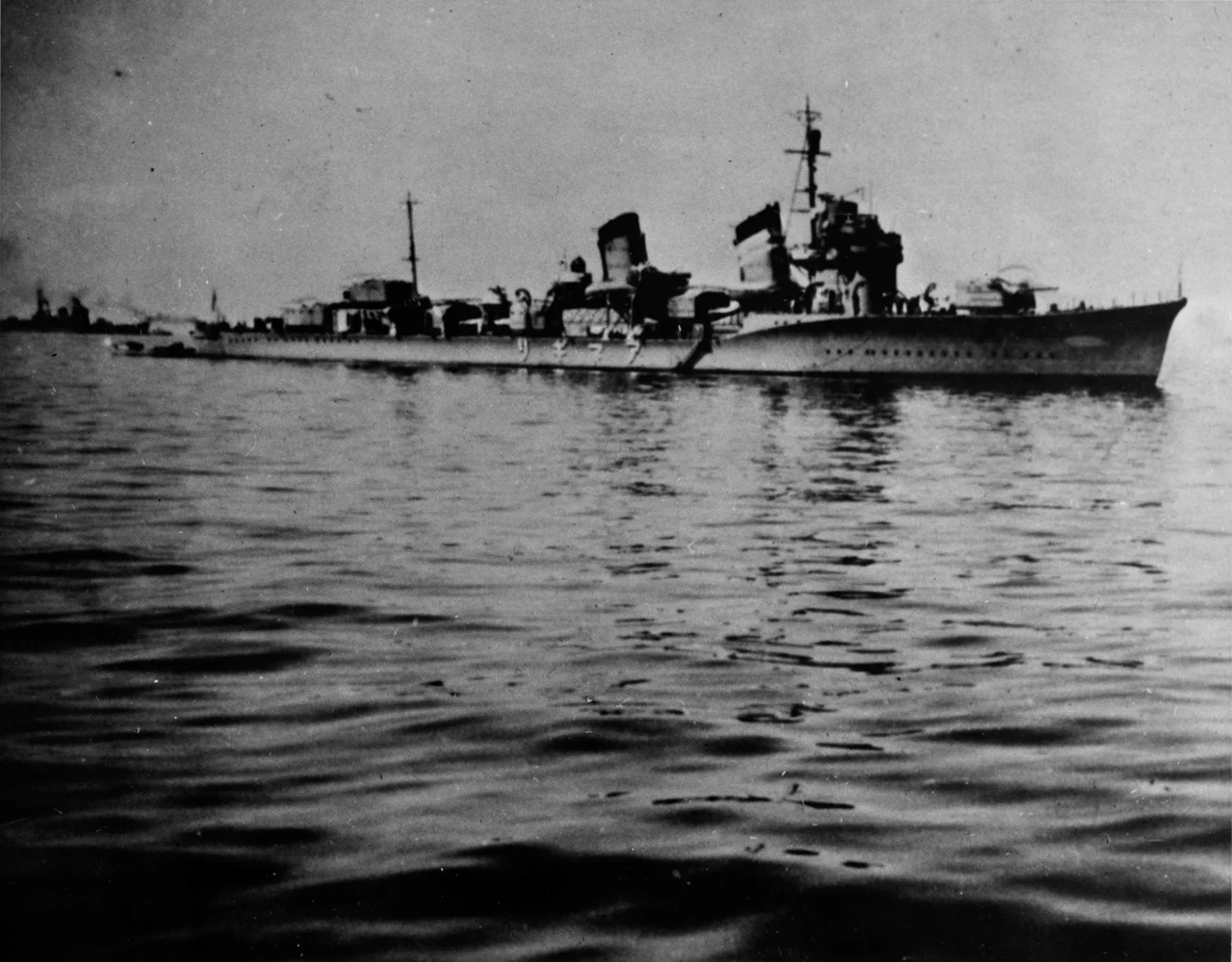

The Destroyer That Almost Changed History
On a moonless night in Blackett Strait, a shape materialized out of the darkness three hundred yards off the starboard bow. The crew of PT-109 had seconds to react. The Japanese destroyer bearing down on them was Amagiri -- a Fubuki-class warship that had already survived typhoons, dive bombers, and nearly every major engagement of the Pacific War. At her helm, the officer of the watch had been ordered to steer directly at the tiny wooden boat. The collision sliced PT-109 in half, hurling fuel across the water and igniting it. The young lieutenant commanding the wrecked patrol boat would spend the next six days swimming between islands, towing a burned crewman by a life jacket strap clenched in his teeth. His name was John F. Kennedy.
A Ship Built to Outclass the World
Amagiri slid down the ways at Ishikawajima Shipyards in Tokyo on February 27, 1930, the fifteenth of twenty-four Fubuki-class destroyers that represented a quantum leap in warship design. The Imperial Japanese Navy designated them "Special Type" for good reason: their size, speed, and armament gave these destroyers firepower rivaling the light cruisers of other navies. Amagiri belonged to an improved batch with gun turrets that could elevate to 75 degrees, transforming her 127mm main batteries into dual-purpose weapons capable of engaging aircraft. She displaced over 2,000 tons -- enormous for a destroyer of her era. The navy that built her intended these ships to be a qualitative edge, compensating for the tonnage limits imposed by international treaty. In that ambition, they succeeded. The Fubuki class stunned foreign observers and triggered a global arms race in destroyer design.
The Tokyo Express
By the time the Guadalcanal campaign erupted in mid-1942, Amagiri had already covered landings in Malaya, participated in the invasion of the Netherlands East Indies, and sailed with the Aleutian force during the Battle of Midway. But it was the grinding struggle for the Solomon Islands that defined her war. The Japanese devised the "Tokyo Express" -- fast nighttime runs using destroyers as high-speed transports to resupply their beleaguered garrisons. Amagiri ran these missions relentlessly through the second half of 1942 and into 1943, threading narrow straits under constant threat from American aircraft, submarines, and surface ships. During one Express run, dive bombers from Henderson Field sank her sister ship Asagiri; Amagiri rescued survivors and towed the damaged Shirakumo to safety. After the Naval Battle of Guadalcanal in November 1942, she helped rescue 1,500 survivors from torpedoed merchant vessels. She returned to Japan for repairs, then went right back to it.
Two Minutes in Blackett Strait
August 2, 1943. Amagiri was returning from another Express mission to Vila, Kolombangara, traveling at high speed to reach harbor before dawn brought Allied air patrols. In the strait south of Kolombangara, PT-109 was idling on one engine to minimize her phosphorescent wake. Kennedy and his twelve-man crew spotted the destroyer's shape too late. Kennedy swung the wheel to bring his torpedoes to bear, but the destroyer closed the distance in seconds. Amagiri's steel bow struck PT-109 just forward of the starboard torpedo tube, shearing the wooden boat nearly in two. For years, the collision was thought to be accidental. But journalist Robert J. Donovan, who interviewed Amagiri's crew in Japan, concluded otherwise -- the helmsman had been ordered onto a collision course. Two of Kennedy's crew died. The eleven survivors clung to the wreckage until Kennedy led them on a harrowing swim to a nearby island. Eighteen years later, Amagiri's commanding officer sent Kennedy a bronze medallion on the occasion of his presidential inauguration.
A Footnote in the Charts
The PT-109 incident became a cornerstone of Kennedy's political mythology. Books recounted it, a 1963 film dramatized it, and country singer Jimmy Dean turned it into a hit single -- "PT-109" climbed into the top ten of the Billboard Hot 100, making Amagiri almost certainly the only Japanese warship ever referenced in American pop music charts. Meanwhile, the real ship fought on. At the Battle of Cape St. George in late November 1943, she exchanged fire with American destroyers under Captain Arleigh Burke and escaped. Weeks later, a collision near Kavieng sheared off her bow entirely. Repaired again and reassigned to escort duty out of Singapore, Amagiri's luck finally ran out on April 23, 1944, when she struck a naval mine in Makassar Strait, 55 nautical miles south of Balikpapan. She took over two hours to sink, listing slowly enough that most of her crew survived. The navy struck her from its rolls on June 10, 1944.
What the Sea Kept
In October 2003, explorer Vidar Skoglie located Amagiri's wreck lying on her starboard side in 28 meters of water. The scene was both haunting and hazardous -- live torpedoes and depth charges lay scattered across the seabed around the hull. But the ship that divers found was already grievously damaged, not by war but by illegal dynamite fishing. An explosion, likely detonating the forward magazine, had ripped apart much of her bow section. In the years since Skoglie's discovery, salvagers have illegally dismantled most of what remained. Today, little of Amagiri survives on the seafloor of Makassar Strait. The destroyer that nearly killed a future president, that ran the Tokyo Express through some of the most dangerous waters of the Pacific War, that somehow became a footnote in American pop music history -- she has been reduced to scattered fragments in the sediment, a ghost of a ship that once held history in her bow.
From the Air
Amagiri's wreck site lies at approximately 2.17S, 116.75E in the Makassar Strait, south of Balikpapan, East Kalimantan, Borneo. The water is shallow (28m/98ft) but the site is unmarked. Nearest major airport is Sultan Aji Muhammad Sulaiman Sepinggan International Airport (WALL) at Balikpapan. The strait is a busy shipping lane visible from altitude. The PT-109 collision occurred far to the east in Blackett Strait, Solomon Islands, near Kolombangara.
Nearby Stories
- The Last Beach 74 km away
- Sixty Seconds Over Banjarmasin 96 km away
- The Mahakam: Borneo's River of Kingdoms and Dolphins 127 km away
- Two Minutes of Distraction 158 km away
- The Invisible Wall of Makassar Strait 173 km away
- The Sultanate of Banjar 217 km away
- The Ground Beneath Mamuju 233 km away
- Borneo's Dayak Heartland 322 km away