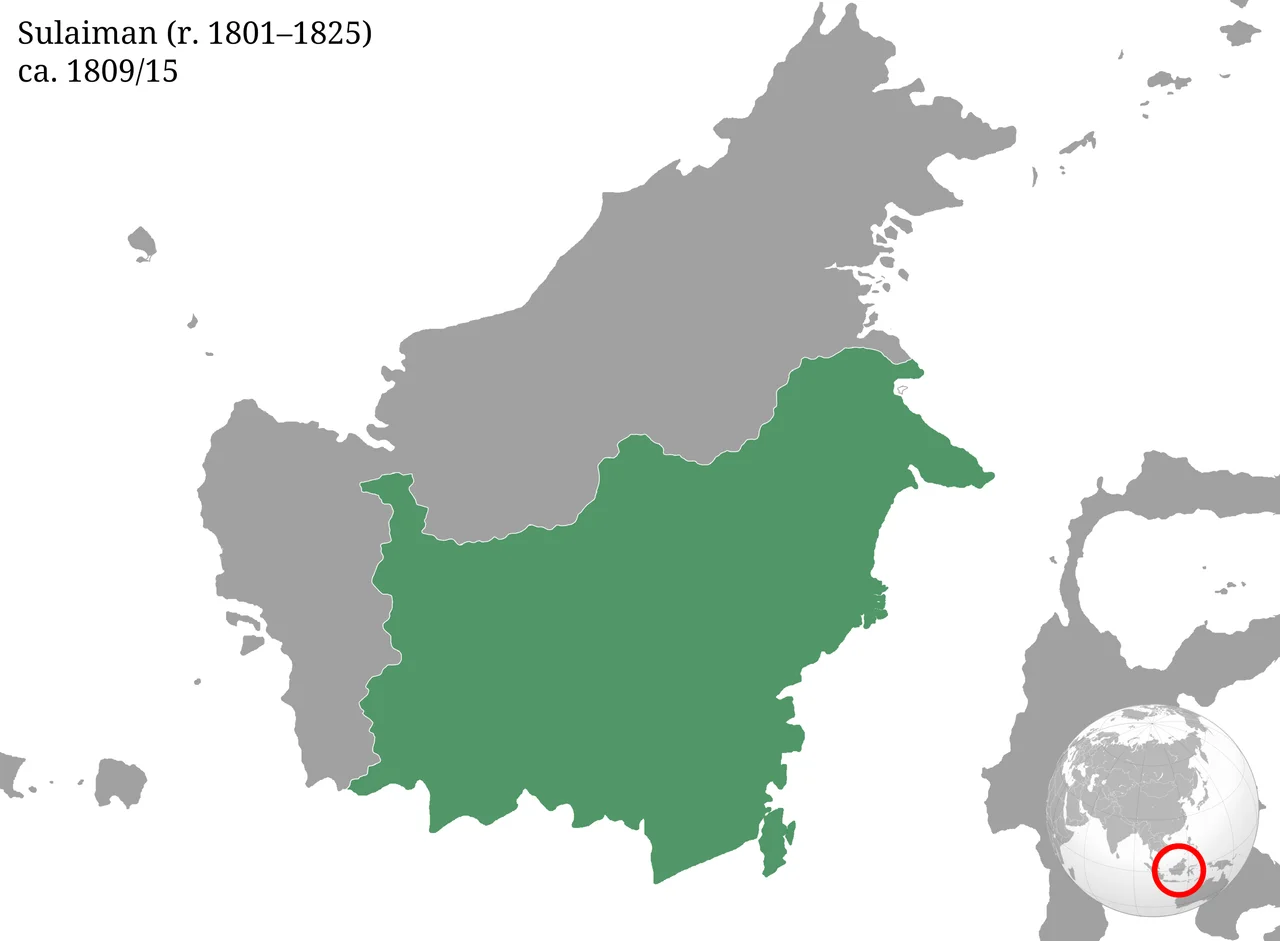

The Sultanate of Banjar
Raden Samudra was supposed to be king. His grandfather, Maharaja Sukarama of Negara Daha, had orchestrated everything -- the royal marriage between his daughter and his nephew, the careful mingling of patrilineal and matrilineal bloodlines -- all to produce a single heir with an unassailable claim to the throne. But succession plans rarely survive the ambitions of the overlooked. When Sukarama died, his sons seized the kingdom by force, and the boy who had been groomed to rule found himself running for his life through the forests of southern Borneo.
From Exile to Empire
Samudra fled south along the Barito River, one of Borneo's great arteries, where it braids through mangrove and peat swamp before emptying into the Java Sea. There, in the marshy lowlands near present-day Banjarmasin, he established a new settlement around 1526. What began as a refuge became a rival power. Samudra converted to Islam, took the name Surianshah, and crowned himself the first Sultan of Banjar. The conversion was more than spiritual -- it forged alliances with Muslim traders who controlled the maritime routes threading through the archipelago. With those alliances came weapons, commerce, and legitimacy. The new sultanate was not content to simply exist. Surianshah launched campaigns westward to Sambas and eastward toward the Sulu Archipelago, assembling a territory that stretched across much of Borneo's southern coast. His son, Rahmatullah, consolidated these gains, and the Sultanate of Banjar settled into three centuries of trade, diplomacy, and occasional war.
Pepper, Power, and the Dutch
Banjar's wealth flowed from its rivers. The waterways of southern Kalimantan carried pepper, diamonds, and forest products downstream to the coast, where traders from Java, China, and eventually Europe waited to buy. Pepper was the sultanate's greatest asset -- so valuable that its politics and trade became inseparable. The Banjar sultans controlled who grew pepper, who bought it, and at what price, making the court at Banjarmasin one of the most commercially sophisticated in Borneo. The Dutch East India Company, the VOC, arrived in the seventeenth century looking to monopolize exactly this kind of trade. Through a series of contracts, military pressures, and interventions in succession disputes, the Dutch gradually tightened their grip on Banjar's commerce and sovereignty. By the nineteenth century, the relationship had shifted from negotiation to domination. In 1860, the colonial government formally dissolved the sultanate. Resistance continued sporadically until 1905, when the last vestiges of Banjar political autonomy collapsed.
What the Rivers Remember
Banjarmasin today is still called the City of a Thousand Rivers. The Barito and its tributaries remain the defining feature of life here, and the floating markets where vendors sell fruit and fish from wooden boats echo a way of commerce that predates the sultanate itself. The Banjar people, who number in the millions across South and Central Kalimantan, maintain a distinct cultural identity shaped by centuries of Islamic tradition blended with older Dayak and Malay customs. Their language, Banjarese, carries traces of Javanese, Malay, and Arabic -- a linguistic record of every trader and conqueror who passed through. In 2010, the Sultanate of Banjar was formally restored in a ceremonial sense, with a new sultan crowned in a public ceremony. The restoration carries no political authority. It is a cultural statement, an assertion that the identity the Dutch tried to dissolve never actually disappeared -- it simply moved from the palace to the people.
A Throne Built on Water
The original capital at Kuin sat where the Kuin River meets the Barito, a location chosen as much for defense as for trade. Water was everything: highway, barrier, marketplace, and source of food. The sultans governed a territory where travel meant boats, not roads, and where the jungle pressed in from every direction. This geography shaped a political culture that was fluid in every sense -- alliances shifted with the tides, and power depended less on holding land than on controlling the movement of goods along the rivers. The early Banjar court was known as the Kayu Tangi Kingdom before the Islamic conversion, and the transition from Hindu-Buddhist traditions to Islam occurred alongside, not in opposition to, older beliefs. Mosques rose beside sacred groves. The sultanate's architecture and court rituals blended Javanese royal traditions with Islamic practice, creating something distinctly Banjarese -- neither purely Malay nor purely Javanese, but a synthesis born of Borneo's position at the crossroads of Southeast Asian trade.
From the Air
Coordinates: 3.32S, 114.77E. The Barito River and its vast delta system are clearly visible from altitude, with Banjarmasin's canal-threaded urban area distinguishable at lower altitudes. Nearest major airport: Syamsudin Noor International Airport (WAOO/BDJ). The surrounding landscape is flat alluvial plain and peat swamp forest extending to the Java Sea coast.
Nearby Stories
- Sixty Seconds Over Banjarmasin 58 km away
- The Million-Hectare Mistake 73 km away
- The Great Dayak River 95 km away
- Borneo Orangutan Survival 136 km away
- Forty Hours in the Masalembo Sea 198 km away
- The Destroyer That Almost Changed History 200 km away
- The Ocean's Hidden River Between Two Worlds 239 km away
- Two Minutes of Distraction 316 km away