The Last Beach
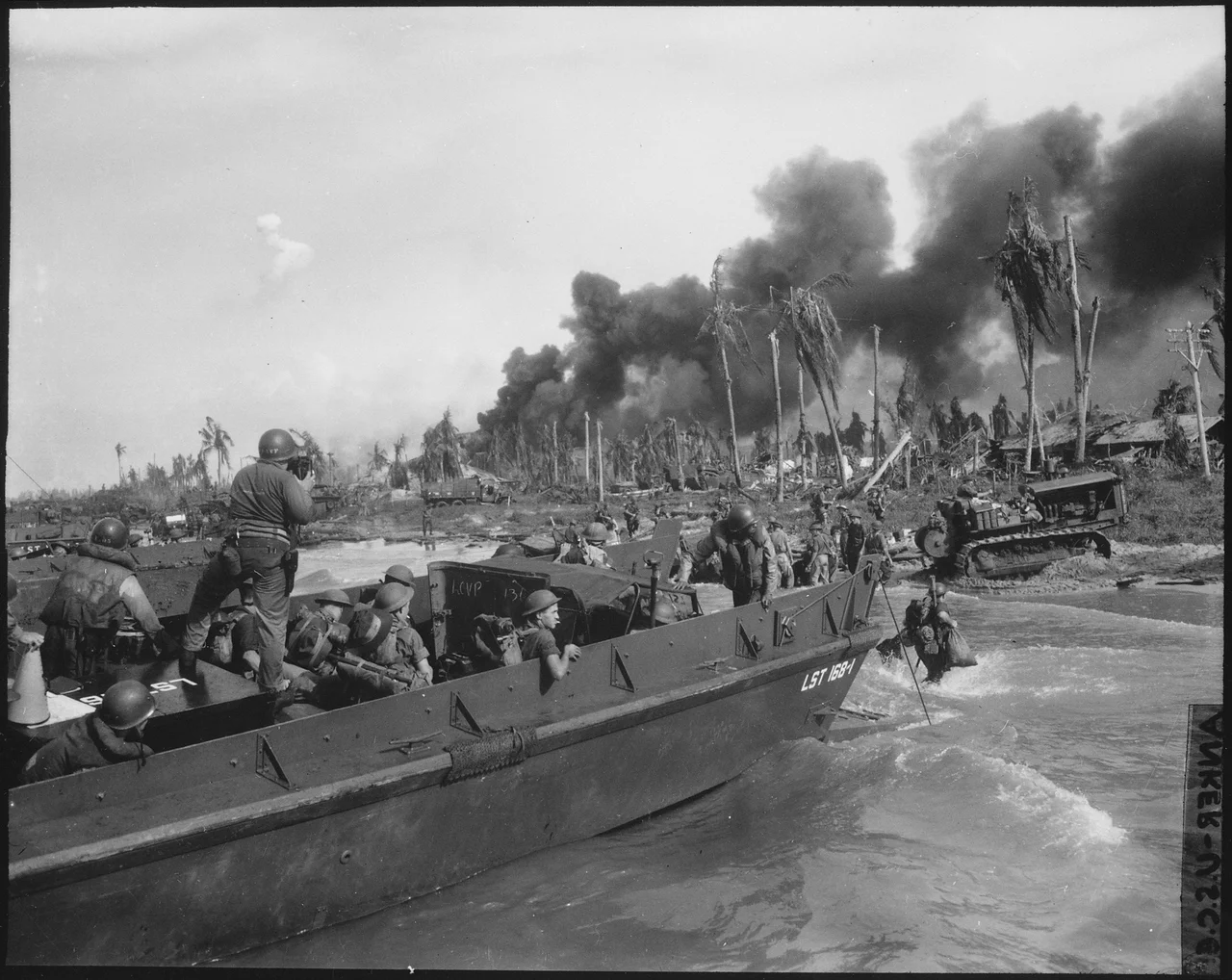
The pre-landing bombardment had been so thorough that the assault troops could no longer recognize the beach. Three battalions of the Australian 7th Division hit the shore just before 9:00 am on July 1, 1945, scrambling across sand they had studied for weeks on maps and aerial photographs -- and landed in the wrong places because the landmarks had been obliterated. Two of the three battalions drifted left, companies tangled with one another, and for a confused quarter-hour, officers worked to sort out the mess. It hardly mattered. The Japanese defenders, battered by twenty days of air strikes and the thunder of five cruisers and fourteen destroyers, offered only scattered fire. Not a single Australian died in those first minutes ashore. The real killing would come later, in the ridges and the jungle, where what remained of the garrison fought with a stubbornness that belied the strategic irrelevance of the entire operation.
Black Gold on the Equator
Balikpapan's value was measured in barrels. Before the war, its refineries on Borneo's east coast produced 1.8 million tons of oil products a year, fed by fields around Sambodja and Sangasanga to the northeast. When the Japanese seized the town on January 25, 1942, Dutch defenders destroyed what infrastructure they could before being overwhelmed. The Japanese retaliated by massacring 78 Dutch civilians and prisoners of war on February 24, 1942. They repaired the refineries and by 1943, the port was delivering 3.9 million barrels of fuel oil to the Japanese war machine. Allied bombers flew seventeen-hour round trips from Darwin to attack it. RAAF Catalina flying boats seeded the approaches with mines, cutting output by an estimated forty percent. By late 1944, sustained American bombing raids had wrecked the refineries so thoroughly that Japan stopped sending tankers altogether. The oil that had made Balikpapan worth conquering was, by the time anyone planned to reconquer it, barely flowing.
A Battle Nobody Wanted
General Douglas MacArthur had originally envisioned Balikpapan as a stepping stone to retaking Java. When that operation was cancelled and the Netherlands East Indies transferred to British command, the strategic rationale evaporated. The commander of the Australian Military Forces, General Thomas Blamey, recommended against the landing, arguing it served no purpose. The U.S. Joint Chiefs shared his doubts. MacArthur pushed the operation through anyway -- historian Garth Pratten concludes he manipulated both the Australian government and the Joint Chiefs into approving it. The stated objective was to secure the port and oilfields and establish a base for future operations. But the future operations never came. The war was five weeks from its atomic conclusion, though no one at Morotai Island, where planning teams gathered in late April 1945, could have known that. What they did know was that shipping was short, coordination was poor, and the tactical planning had a rushed, improvised quality that troubled the experienced officers of the 7th Division.
Parramatta Ridge
If the beach landing was almost bloodless, the terrain behind it was not. The 18th Brigade pushed inland toward the high ground north of Klandasan, where Japanese defenders from the 2nd Garrison Force had dug into a complex of pillboxes, tunnels, and minefields along a feature the Australians dubbed Parramatta Ridge. Lieutenant Colonel Tom Daly's 2/10th Battalion launched the assault on Hill 87 without its promised fire support -- a last-minute diversion and communications failures left the infantry advancing alone. Japanese resistance stiffened through the morning, pinning the Australians below the summit. Just before noon, two Matilda tanks from the 1st Armoured Regiment clanked forward, their guns suppressing the defensive positions long enough for the infantry to storm the crest. By 12:40 pm, Hill 87 was in Australian hands. The fighting continued for days afterward as engineers methodically destroyed tunnels and cleared thousands of mines and booby traps. Along the Milford Highway, the 25th Brigade spent a fortnight working to encircle a Japanese defensive position at Batuchampar, ten miles from the beaches, where the surviving defenders withdrew in good order -- their discipline and fieldcraft earning grudging respect from the Australians pursuing them.
The Cost of Being Right
Major operations ceased around July 21, when the Japanese abandoned Batuchampar. Small clashes continued until mid-August, when Japan's surrender found Australian patrols still combing the jungle for stragglers. The 7th Division lost 229 killed and 634 wounded -- light by the standards of their earlier campaigns in the Middle East and New Guinea, but each casualty sharpened the question that historians have debated since. The airfields at Sepinggang and Manggar, captured in the first week, could not support bombing operations. The port and oil facilities had been wrecked by the very bombardment meant to enable their capture, straining relations with the returning Dutch colonial administration. The oilfields that fed the refineries remained in Japanese hands until the armistice. Historian David Horner concluded the operation was undertaken largely for political reasons, as MacArthur wished to show the Dutch he had tried to recover their territory. Peter Dennis called it "doubtful value strategically" but "tactically skilfully conducted." The Australians who fought it would have appreciated the distinction.
A Monument in a Roundabout
Today a memorial stands in a traffic roundabout in Balikpapan, near Merdeka Square and the Pertamina oil complex. Known locally as Tugu Australia -- the Australian Monument -- it has existed since at least January 1946, when the last of the three Australian brigades completed occupation duties and departed. A copper inscription sculpted by Ross J. Bastian was added in 1998, detailing the battle for visitors who pass by on their way to work in what is now the capital province of East Kalimantan. The refineries were rebuilt. The oil flows again. The 7th Division's soldiers went home to Queensland and lives interrupted by a war that ended, in the end, without needing them to take this particular beach. But they took it anyway, and 229 of them did not come back.
From the Air
Balikpapan is located at 1.27S, 116.85E on the east coast of Borneo, one degree south of the equator. The landing beaches stretch east from Klandasan along the coast toward Sepinggang and Manggar. Balikpapan Bay is visible from altitude, approximately 1 mile wide at its mouth. Sultan Aji Muhammad Sulaiman Airport (WALL) serves the city. The Milford Highway runs northeast toward Samarinda. The terrain rises steeply inland with hills up to 700 feet covered in tropical rainforest. Expect high humidity and potential cloud cover; July is generally the clearest month.
Nearby Stories
- Samboja Lestari: Planting a Forest from Scratch 10 km away
- The Mahakam: Borneo's River of Kingdoms and Dolphins 29 km away
- The Destroyer That Almost Changed History 67 km away
- The Invisible Wall of Makassar Strait 99 km away
- Sixty Seconds Over Banjarmasin 140 km away
- The Ground Beneath Mamuju 230 km away
- The Million-Hectare Mistake 260 km away
- Oil, Empire, and the Fight for Borneo 288 km away