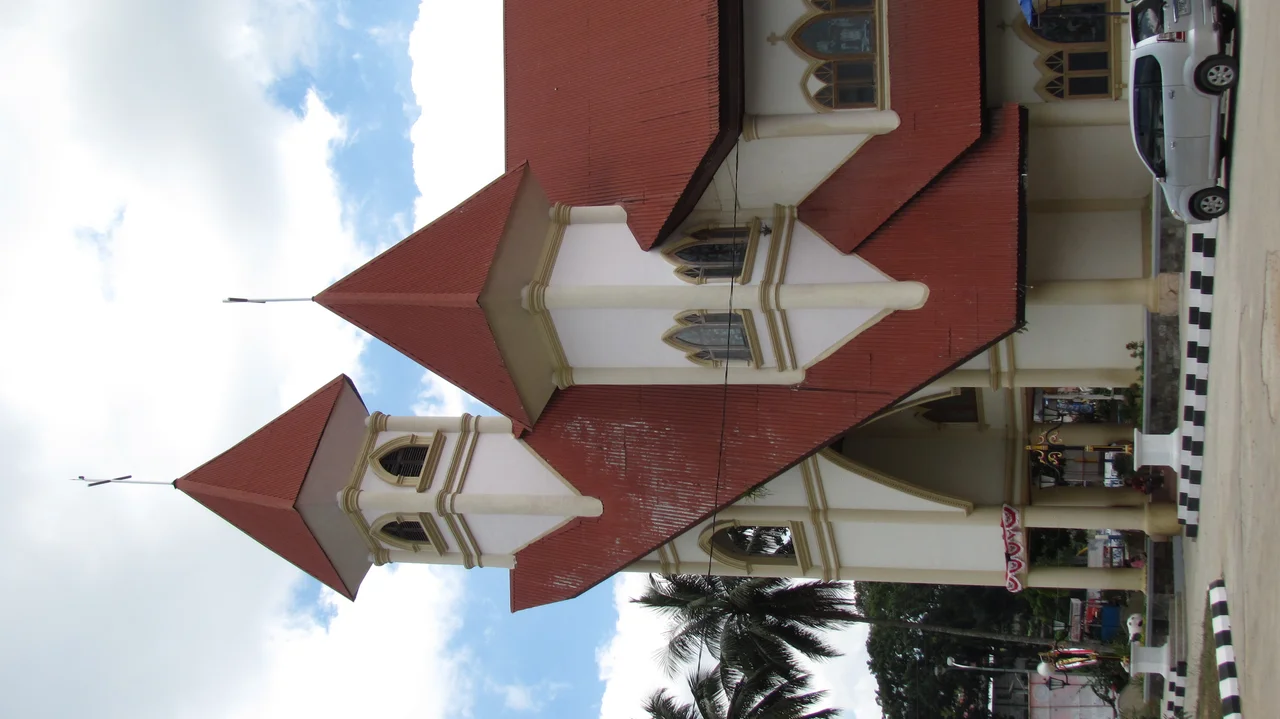

Tana Toraja: The Land Where the Dead Never Leave
At the Lemo burial site, wooden effigies stare out from carved niches in a sheer limestone cliff. These are the tau-tau, figures representing the dead, and behind them -- inside the rock itself -- lie the remains of Toraja nobles placed there generations ago. Below, tourists point cameras upward, but the Toraja people who live in this regency do not treat their dead as spectacles. Death here is the most important social event a person will ever host. Funeral ceremonies last for days, draw hundreds of guests, and can cost a family years of savings. In Tana Toraja, a landlocked regency in the mountains of South Sulawesi, dying is not an ending. It is the beginning of the most elaborate obligation the living will ever fulfill.
The People of the Land Above
The word Toraja comes from the Bugis language: to riaja, meaning "people who live in the land above." It was the Dutch colonial government that formalized the name in 1909, applying it to the highland communities of South Sulawesi's mountainous interior. The Toraja population is estimated at roughly one million people, with about 500,000 concentrated in Tana Toraja Regency, neighboring North Toraja Regency, and Mamasa Regency. Most Toraja today are Christian, a legacy of Dutch missionary activity, though some practice Islam and others follow Aluk Todolo, an ancestral animist belief that the Indonesian government has officially recognized as a branch of Hinduism. The regency's administrative seat is the town of Makale, but the cultural heart beats in Rantepao, about 12 kilometers to the north. In 2008, the original Tana Toraja territory was formally split into two regencies -- Tana Toraja with its capital at Makale, and Toraja Utara with its capital at Rantepao.
Roofs Like Boats, Horns Like Trophies
The tongkonan is Tana Toraja's most recognizable architectural statement: a traditional ancestral house raised on piles, with a massive saddleback roof that curves upward at both ends like the hull of an inverted boat. In original Toraja society, only nobles had the right to build tongkonan. Commoners lived in simpler, less decorated houses called banua. The distinction was not merely aesthetic -- it marked social rank as visibly as any European coat of arms. At Tongkonan Pallawa, set among bamboo trees on a hilltop about 12 kilometers north of Rantepao, rows of buffalo horns are mounted across the front facade, each one representing a funeral ceremony hosted by the family. The more horns, the greater the family's prestige and the depth of their obligation to the dead. At Buntu Kalando, the tongkonan that once served as the palace of Puang Sangalla', the king of the Sangalla' kingdom, the structure now functions as a museum housing prehistoric objects and relics of the old royal order.
Ceremonies That Bankrupt and Bond
Toraja funeral rituals are not private grief. They are public spectacles of obligation, community, and expense. A ceremony can last several days, drawing hundreds of attendees from across the regency and beyond. Water buffalo are slaughtered -- sometimes dozens -- and the number sacrificed reflects the deceased's social standing and the family's commitment to honoring them properly. The cost can consume years of a family's income. But the funerals also reinforce the social bonds that hold Toraja communities together, creating reciprocal obligations that bind families across generations. At Kambira, infants who died before their teeth grew -- six months old and younger -- were buried inside hollowed-out living trees, their bodies enclosed by the growing bark. At the Lemo cliff burial site, the dead are placed in chambers carved into vertical rock faces, with tau-tau effigies standing guard on balconies. And during the Ma'Nene ceremony, families periodically retrieve their ancestors' remains to dress them in fresh clothing -- a practice that reinforces the Toraja understanding that death is not a severance from the community but a continuing relationship.
From Isolation to Indonesia's Second Destination
For centuries, Tana Toraja's mountainous terrain kept it largely isolated. The Dutch did not conquer the region until 1905, and the regency's administrative boundaries were not drawn until 1909. Regency status came on October 8, 1946, the last such designation granted under Dutch rule. The turning point for Tana Toraja's global visibility came in 1974, when delegates from 60 countries attending the Pacific Asia Travel Association conference in Jakarta visited a Tongkonan Siguntu' ceremony. Word spread. By 1984, Indonesia's Ministry of Tourism had designated Tana Toraja as the country's second-most-important tourist destination after Bali. Western anthropologists arrived in growing numbers to study Toraja culture, and hundreds of thousands of international visitors followed. In 2009, Indonesia nominated Tana Toraja as a UNESCO World Heritage Site, with Japan pledging conservation support, particularly for the preservation of traditional tongkonan houses. The nomination recognizes what the Toraja have maintained through colonial rule, religious conversion, and tourism's double-edged embrace: a Proto-Malayo-Polynesian cultural civilization still living, not merely remembered.
From the Air
Centered at approximately 3.17°S, 119.75°E in the mountainous highlands of South Sulawesi. The terrain is rugged and elevated, with the regency sitting in the northern interior of the province. Nearest major airport: Sultan Hasanuddin International Airport in Makassar (ICAO: WAAA), roughly 300 km to the south. Pongtiku Airport (ICAO: WAWT) near Rantepao provides limited regional service. From altitude, the highlands are distinguished by terraced hillsides, dense vegetation, and the distinctive curved rooflines of tongkonan houses visible in clearings. Best viewed at 8,000-12,000 feet to appreciate the highland topography and scattered settlements.
Nearby Stories
- The Drum of God 29 km away
- The Ground Beneath Mamuju 40 km away
- South Sulawesi: Where Kingdoms Built Ships and Honor Demanded Blood 42 km away
- The Ninety Minutes of MV Marina Baru 2B 54 km away
- Two Minutes of Distraction 116 km away
- The Vanishing World of Lake Poso 122 km away
- The Three Summits Pact 144 km away
- The Invisible Wall of Makassar Strait 265 km away