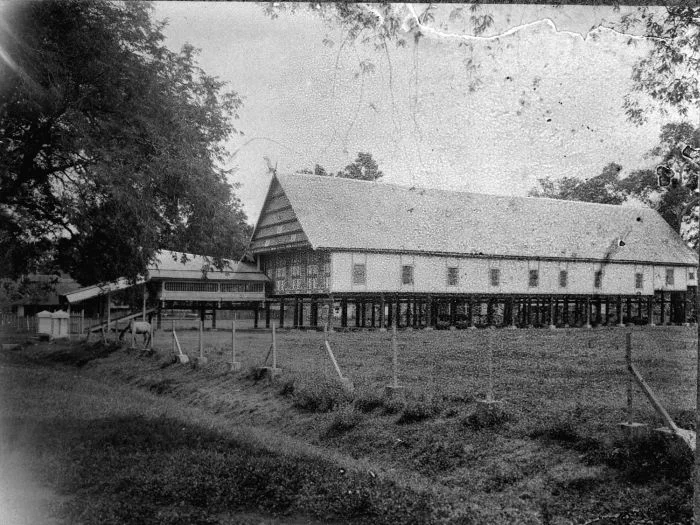

The Three Summits Pact
In 1582, three kingdoms buried stones together at Timurung. The ceremony sealed an alliance between Bone, Wajo, and Soppeng -- the Tellumpocco'e, or "Three Summits" -- forged against the expanding power of the Sultanate of Gowa-Tallo to the south. It was the kind of pact that sounds mythological but was recorded in the Lontara chronicles with the matter-of-fact precision the Bugis people preferred. No embellishment, no divine intervention. Just three kingdoms agreeing that survival required solidarity. The alliance would be tested repeatedly over the next four centuries, as Bone navigated forced conversion, colonial occupation, and the slow dissolution of the royal order that had governed South Sulawesi since the early 1400s.
From Hamlet to Kingdom
Bone began modestly. In the early 15th century, under a ruler named La Umasa, the state amounted to a handful of settlements clustered around what is now Watampone, the modern capital of Bone Regency. La Umasa and his nephew La Saliu expanded these holdings into a small kingdom occupying roughly one-third of the present regency's territory -- an area of about 2,600 square kilometers on the southwestern peninsula of Sulawesi. The kingdom's chief town, Boni, sat 130 kilometers northeast of Makassar, positioned along trade routes that connected Sulawesi's interior to the wider maritime world. By the early 16th century, Bone was pushing northward, fighting the kingdom of Luwu for control of the mouth of the River Cenrana, a critical exit point for east coast trade. Control of river mouths meant control of commerce, and commerce meant power in the competitive world of Bugis politics.
Swords and Conversion
The Three Summits pact of 1582 held for decades, but it could not prevent what came next. In 1611, during the reign of Bone's tenth ruler, We Tenrituppu -- one of several women who held the throne -- the Sultanate of Gowa invaded. The pressure was not merely military. Gowa demanded that Bone convert to Islam, and the invasion succeeded. Bone became a Muslim state, its rulers adopting Islamic titles and incorporating the sultanate's religious framework into the older adat traditions that had governed Bugis society for centuries. Yet Bone was never merely a vassal. By the mid-17th century, the kingdom had recovered and entered a period of prosperity. The great warrior-ruler Arung Palakka, who reigned from 1672 to 1696, even allied with the Dutch East India Company to break Gowa's dominance, reshaping the balance of power across South Sulawesi in the process.
Queens on the Throne
One of the most striking features of Bone's royal succession is the recurrence of female rulers in a region often assumed to have been exclusively patriarchal. We Benrigau, the fourth ruler, governed from 1470 to 1490. We Tenrituppu held the throne when Gowa's armies arrived in 1611. Most remarkably, Sultanah Zainab -- Batari Toja -- ruled in three separate stints between 1714 and 1749, deposed and restored twice. Later queens included Pancaitana Besse Kajuara in the 1850s and Sultanah Fatimah, who reigned for 24 years until 1895. These were not regents holding power for absent men. The Lontara chronicles list them as rulers in their own right, with the same titles and authority as their male counterparts. In total, the dynasty produced 33 monarchs across roughly six centuries, and at least six of them were women.
The Dutch Arrive, Then Leave
Bone's independence ended in 1905. The South Sulawesi military expeditions of that year brought Dutch colonial forces directly into the highlands and coastal kingdoms that had resisted European control for centuries. Bone's last independent ruler, La Pawawoi, was defeated and exiled to Bandung on Java. The kingdom, along with its old rival Gowa, fell under direct Dutch administration. But colonial rule brought its own ironies. By the late 1920s, rising Indonesian nationalism alarmed the Dutch, who found it useful to restore traditional rulers as a counterweight to modern political movements. In 1931, Andi Mappanyukki -- a man descended from both the houses of Gowa and Bone -- was placed back on the throne in Watampone. He remained there through the end of Dutch rule, the Japanese occupation, and the first years of Indonesian independence, until the last king abdicated in 1950. The stones buried at Timurung were never unearthed. The kingdoms they bound together simply became part of something larger.
From the Air
Coordinates: 4.54S, 120.33E, on the southwestern peninsula of Sulawesi, Indonesia. From altitude, the coastline of Bone Bay (Teluk Bone) is visible to the east, with the modern town of Watampone along the shore. The terrain is a mix of coastal lowlands and rolling hills. Nearest major airport is Sultan Hasanuddin International Airport (WAAA) in Makassar, approximately 130 km to the southwest. The River Cenrana, historically contested between Bone and Luwu, drains into the bay to the north.
Nearby Stories
- The Butterfly Kingdom of Sulawesi 23 km away
- The Oldest Paintings on Earth 50 km away
- The Forest People Who Vanished 52 km away
- The Ninety Minutes of MV Marina Baru 2B 57 km away
- Sulawesi's Hidden Wetland: Rawa Aopa Watumohai 117 km away
- Tana Toraja: The Land Where the Dead Never Leave 118 km away
- The Island That Evolution Forgot to Connect 142 km away
- The Ferry That Tipped When Everyone Reached for a Signal 198 km away