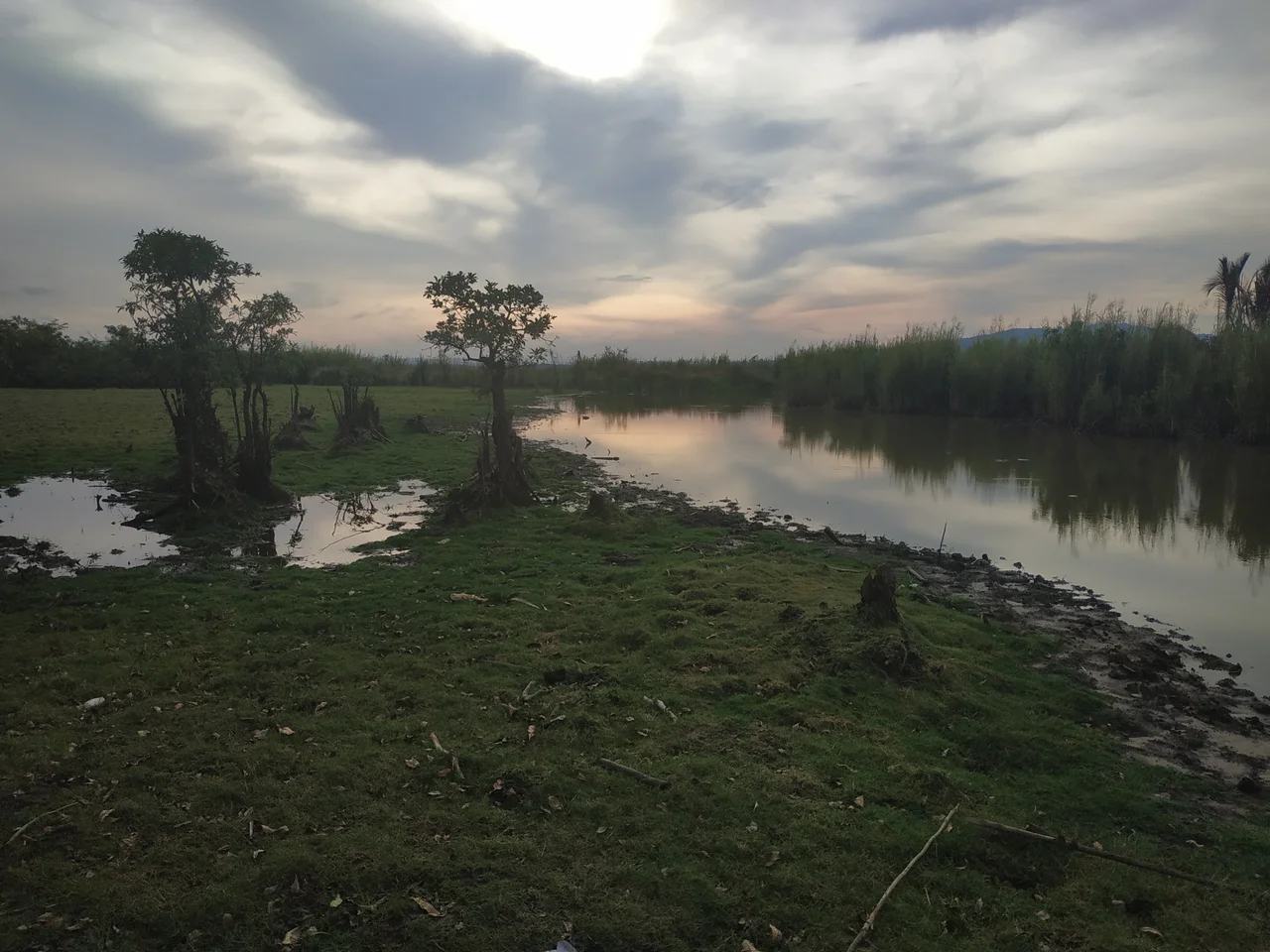

Sulawesi's Hidden Wetland: Rawa Aopa Watumohai
The maleo has a problem that most birds would envy: it never has to sit on its eggs. This chicken-sized bird, found only on the island of Sulawesi, buries its eggs in geothermally heated sand or sun-warmed soil and walks away. Weeks later, fully feathered chicks dig themselves out and immediately fend for themselves -- no parental guidance, no nest, no fuss. Rawa Aopa Watumohai National Park, sprawling across 1,050 square kilometers of Southeast Sulawesi, is one of the last strongholds of this remarkable bird. But the maleo is just the opening act. Beneath the park's canopy and within its vast swamps live creatures so unusual that early European naturalists questioned whether they belonged to the animal kingdom at all.
The Swamp That Holds Sulawesi Together
At the heart of the park lies the Aopa peat swamp, the largest on Sulawesi -- a waterlogged expanse where partially decayed vegetation has accumulated over millennia into deep layers of organic soil. Peat swamps are underappreciated ecosystems. They store enormous quantities of carbon, regulate water flow across entire watersheds, and support species found in no other habitat. The Aopa swamp earned international recognition in 2011 when the Ramsar Convention designated it a wetland of international importance. But its significance runs deeper than scientific classification. The swamp feeds rivers, buffers floods, and filters water for communities downstream. Local people harvest Totole leaves from the swamp's edges, weaving them into mats -- a craft that connects the practical and the ecological in the way that rural livelihoods often do. Surrounding the swamp, the park's terrain rises from sea level to 981 meters, encompassing mangrove forests along the coast, savanna grasslands, freshwater swamp forests, and sub-montane rainforests higher up.
Animals That Defy Expectation
Sulawesi sits at the crossroads of two biological realms -- the Asian and the Australasian -- and its wildlife reflects the collision. The anoa, which lives in Rawa Aopa Watumohai, looks like a water buffalo that someone shrank to the size of a large dog. Both species of this endangered miniature buffalo are endemic to Sulawesi and exist nowhere else. The babirusa is stranger still: a pig-like creature whose upper tusks grow upward through the top of its snout, curving back toward its forehead in a shape that baffled nineteenth-century zoologists. Alfred Russel Wallace, who explored Sulawesi in the 1850s, classified the island as a boundary zone between Asian and Australian fauna -- a line that still bears his name. The park's 155 bird species include 37 found only on Sulawesi, among them the yellow-crested cockatoo, the Sulawesi black pigeon, and the vinous-breasted sparrowhawk. In the coastal mangroves, lesser adjutant storks stand motionless in the shallows, waiting.
The People the Park Displaced
Conservation in Rawa Aopa Watumohai has not been painless. When the Indonesian government declared the park in 1989, it drew boundaries around land that the Moronene people had inhabited for generations. The Moronene are an indigenous group with deep ties to the forests and swamps of Southeast Sulawesi -- ties that predate the Dutch colonial era, when seven Moronene villages existed within what is now park territory. Many families had moved away during upheavals in the 1950s but returned in the 1970s, reclaiming ancestral farmland. The government did not consult them before designating their home a national park. In November 2001, a security operation involving police and military personnel destroyed approximately 100 homes across three Moronene villages -- Hukaea-Laeya, Lampopola, and Lanowulu. Indonesia's environment minister criticized the evictions, but the damage was done. The episode is a reminder that conservation boundaries, however well-intentioned, can impose tremendous costs on the people who live within them.
323 Species and Counting
The park's botanical inventory lists 323 plant species, a number that almost certainly understates the true count given how little of the park has been systematically surveyed. The lontar palm, Borassus flabellifer, rises above the savanna in distinctive fan-shaped crowns. Bruguiera gymnorhiza anchors the coastal mangroves with its distinctive knee-like roots. Higher up, Cratoxylum formosum flowers in pink and white, attracting pollinators that in turn support the park's insect and bird communities. The ecological range is what makes Rawa Aopa Watumohai exceptional -- the same park that contains peat swamp also contains coral-fringed coastline, the same preserve that shelters montane forest species also protects savanna grasslands. Few protected areas anywhere in the tropics span this many habitat types within a single boundary. Yet the park faces persistent threats: illegal logging cuts into its forests, poachers target its anoa and babirusa, and egg collectors raid maleo nesting grounds. Each loss diminishes something that cannot be reassembled.
From the Air
Located at 4.38S, 121.98E on the southeastern peninsula of Sulawesi. The park stretches from sea level coastal mangroves to sub-montane forests at 981 meters. The Aopa peat swamp is visible from altitude as a large, dark-green waterlogged area distinct from surrounding forest. Nearest major airport is Haluoleo Airport in Kendari (ICAO: WAWW), approximately 60 km to the north. The park's coastline along the Banda Sea is visible when approaching from the south. Best viewed at 5,000-10,000 feet to appreciate the habitat transitions from coast to mountains.
Nearby Stories
- Southeast Sulawesi: The Province That Ferries Built 20 km away
- The Island That Evolution Forgot to Connect 43 km away
- Kendari: The Bay That Built a City 47 km away
- The Ninety Minutes of MV Marina Baru 2B 77 km away
- The Language That Borrowed an Alphabet from Across the Sea 104 km away
- The Three Summits Pact 109 km away
- The Ferry That Tipped When Everyone Reached for a Signal 133 km away
- The Village That Said No to the Modern World 134 km away