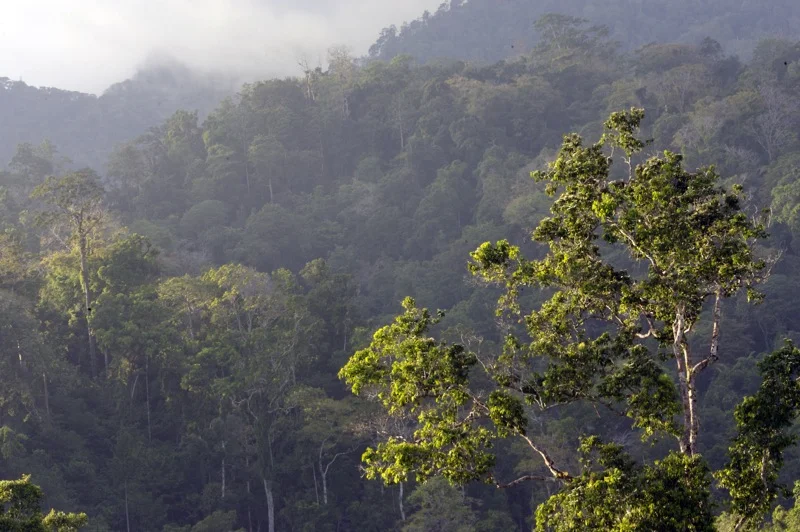

The Island That Evolution Forgot to Connect
Somewhere in the forests of northern Sulawesi, a crested black macaque picks up a camera trap, studies its own reflection, and grins. The image that resulted - a toothy selfie that sparked an international copyright lawsuit in 2011 - introduced the world to one of dozens of primate species found only on this strange, spider-shaped island. But the macaque's fame is incidental. What makes Sulawesi's lowland rain forests extraordinary is not any single species but the sheer improbability of the entire assemblage, a menagerie shaped by millions of years of isolation on an island that never touched a continent.
The Line That Divides Two Worlds
In 1859, Alfred Russel Wallace noticed something peculiar while island-hopping through the Indonesian archipelago. West of a certain line, the animals looked Asian - monkeys, tigers, rhinoceroses. East of it, the fauna turned Australian - marsupials, cockatoos, birds of paradise. That invisible boundary, now called the Wallace Line, runs through the Makassar Strait between Borneo and Sulawesi. Sulawesi sits on the eastern side, within the transitional zone called Wallacea - a scatter of islands that belong to the Australasian realm but were never physically joined to either the Australian or Asian landmasses. When sea levels dropped during the ice ages, Borneo and the western Indonesian islands connected to mainland Asia via the now-submerged shelf of Sundaland. Sulawesi remained isolated. The result is an island where Asian and Australian lineages mingle with species that evolved in place, producing combinations found nowhere else on Earth.
A Bestiary of the Improbable
The lowland forests harbor 104 mammal species, 29 of them endemic or near-endemic. Consider the babirusa, a pig whose upper canines curve backward through the top of its snout, growing in spiraling tusks that can eventually pierce its own skull if not worn down. Three species exist: the North Sulawesi babirusa in the northern and central forests, the Togian babirusa found only on the small Togian Islands in the Gulf of Tomini, and the Celebes warty pig across the wider lowlands. Then there is the lowland anoa, a dwarf buffalo standing just 90 centimeters tall - roughly hip-height on a human - the smallest bovid in the world. Three species of cuscus, woolly marsupials more commonly associated with Australia and New Guinea, climb through the canopy: the Sulawesi bear cuscus, the Sulawesi dwarf cuscus, and the Banggai cuscus, endemic to the Banggai and Sula islands to the east.
Eyes in the Dark
Sulawesi's tarsiers are among the most arresting primates alive. Each weighs barely 100 grams, small enough to fit in a human palm, yet their enormous eyes - each one roughly the same diameter as their brain - are adapted for hunting insects in near-total darkness. The island hosts multiple endemic species, including the Makassar tarsier of southwestern Sulawesi, Gursky's spectral tarsier and Jatna's tarsier on the northern peninsula, and the Peleng tarsier on Peleng Island in the Banggai chain. Three endemic macaque species share the forests: the jet-black Celebes crested macaque of the north, the Moor macaque of the southern peninsula, and the Booted macaque of the southeast. With 337 bird species - 70 of them endemic or near-endemic - the forests sustain several officially designated Endemic Bird Areas, making Sulawesi one of the most important avian regions in Asia.
Ghosts of Giants
The forests were not always populated solely by the small and the strange. During the Pleistocene, Sulawesi was home to Celebochoerus, a giant pig far larger than any living species, and to stegodons, elephant relatives that somehow crossed open water to reach these isolated shores. Both went extinct tens of thousands of years ago, leaving behind fossils that hint at a more dramatic megafauna than the island supports today. Humans may have played a role - cave paintings in the limestone karst of southwestern Sulawesi, dated to at least 45,500 years ago, depict wild pigs and are among the oldest known figurative art in the world. The Celebes rusa deer, a subspecies of the Javan rusa, may itself be an ancient human introduction, carried from Sundaland to Sulawesi by the island's earliest settlers.
Seven Percent Protected
For all its biological wealth, Sulawesi's lowland rain forest ecoregion remains perilously under-protected. A 2017 assessment found that only 8,427 square kilometers - roughly 7 percent of the ecoregion - lies within protected areas. The ecoregion sprawls across Sulawesi's 180,681 square kilometers and extends to neighboring islands including the Banggai and Sula Islands to the east, the Sangihe and Talaud Islands to the north, Buton and Muna to the southeast, and the Selayar Islands to the south. Approximately three-quarters of the unprotected area was still forested at the time of that assessment, but logging, mining, and agricultural conversion continue to press inward. The mountains above 1,000 meters elevation belong to a separate ecoregion, the Sulawesi montane rain forests, meaning the lowlands bear the full weight of human pressure on an ecosystem whose species have nowhere else to go.
From the Air
Centered at approximately 4.00S, 122.20E on Sulawesi, Indonesia. The ecoregion covers the lowlands of the entire island and neighboring archipelagos. Sulawesi's distinctive four-armed shape is unmistakable from altitude. Sultan Hasanuddin International Airport (WAAA) near Makassar is the primary international gateway. Sam Ratulangi Airport (WAMM) in Manado serves the northern peninsula. Best viewed from 25,000+ feet where the full spider shape of the island and its surrounding seas are visible. The Wallace Line runs through the Makassar Strait to the west, separating Sulawesi from Borneo.
Nearby Stories
- Sulawesi's Hidden Wetland: Rawa Aopa Watumohai 28 km away
- The Nickel Furnace of the Electric Future 96 km away
- Wallace's Dreampond: Lake Towuti and Its Living Archive 104 km away
- The Ninety Minutes of MV Marina Baru 2B 112 km away
- The Three Summits Pact 150 km away
- The Coral Archipelago Spelled Out in Islands 158 km away
- Wakatobi: Four Islands, One Name 212 km away
- The Island That Imprisoned a Nation's Greatest Writer 438 km away