
The Island That Imprisoned a Nation's Greatest Writer
Pramoedya Ananta Toer had no paper. Indonesia's most celebrated novelist arrived on Buru in 1969 as a political prisoner, one of thousands shipped to this remote island in the eastern Maluku archipelago under Suharto's New Order regime. He told his stories aloud to fellow inmates, reciting them night after night until fellow prisoners pooled scraps of paper so he could write them down. The result was the Buru Quartet, four novels that would earn international acclaim and a nomination for the Nobel Prize in Literature. The island that was meant to silence him became the place that defined his legacy.
Where the Spice Trade Left Its Mark
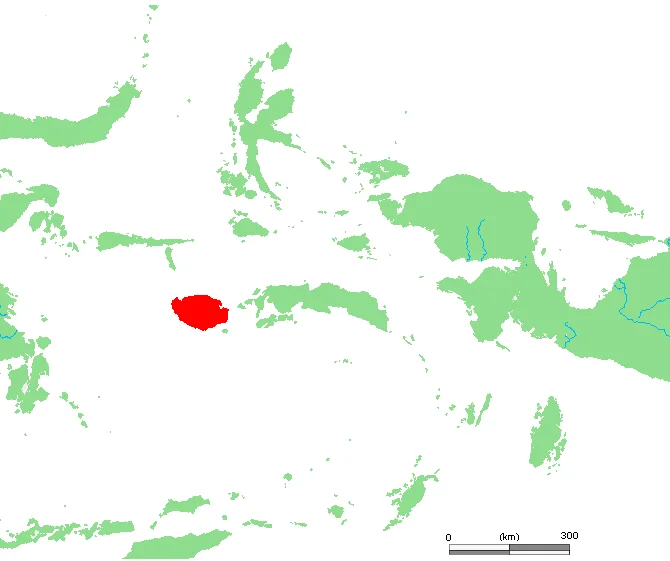
Buru sits between the Banda Sea and the Seram Sea, the third largest island in the Maluku chain at 9,505 square kilometers. The Dutch East India Company arrived in 1658 and stayed for nearly three centuries, drawn by the same commodity that had pulled European powers across the globe: cloves. The colonial administration reshaped the island to serve this trade, relocating indigenous villages to the newly built capital at Kayeli Bay and pressing local populations into plantation labor. To maintain control, the Dutch elevated compliant rajas above the traditional clan heads, fracturing indigenous authority structures that had functioned for centuries. When the Japanese occupied the island from 1942 to 1945, they simply replaced one colonial regime with another. Buru finally became part of independent Indonesia in 1950, but the scars of colonialism ran deep.
A Forested Peak Above the Clouds
Mount Kapalatmada rises from the island's mountainous interior, its slopes blanketed in tropical rainforest that covers most of Buru's rugged terrain. Nearly a fifth of the island sits above 900 meters, and 382 square kilometers climb past 1,500 meters into cloud forest. Flat ground is scarce, confined to narrow coastal strips and the Apo River valley. This isolation has made Buru an evolutionary laboratory. Among the island's 179 bird species and 25 mammal species, roughly 14 are endemic, found here and on a few neighboring islands or nowhere else at all. The most remarkable is the Buru babirusa, a wild pig with curved tusks that grow upward through the skin of its snout. In the mountain villages where traditional beliefs still hold sway, the forest remains not just a habitat but a spiritual landscape, layered with meaning that predates every colonial power that ever claimed the island.
Suharto's Gulag
After the political upheaval of 1965, Suharto's government needed a place to put the people it considered dangerous. Buru, remote and difficult to escape from, became that place. During the late 1960s and 1970s, thousands of political prisoners were transported to the island and held in camps without trial. Conditions were brutal. Prisoners cleared jungle, built their own barracks, and cultivated rice paddies to feed themselves. Many were intellectuals, artists, and suspected leftists whose only crime was association. The camps operated largely out of public view, and the full extent of what happened there remained obscured for decades. Pramoedya, who spent ten years on Buru from 1969 to 1979, described it as a place designed to break the human spirit. That he produced some of Indonesia's greatest literature under those conditions is a testament both to his resilience and to the futility of trying to imprison ideas.
Eight Peoples, One Island
About a third of Buru's population is indigenous, drawn from at least eight distinct ethnic groups: the Buru, Lisela, Ambelau, Kayeli, Masarete, Rana, and Wai Apu peoples, among others. The remainder are immigrants from Java and neighboring Maluku islands, part of transmigration programs that reshaped demographics across Indonesia. Religious life reflects this complexity. Islam and Christianity each claim roughly half the population, while traditional beliefs persist in remote mountain communities where the national language competes with local tongues. Most islanders make their living from the land and sea, growing rice, maize, coconuts, cocoa, coffee, cloves, and nutmeg, or raising livestock and fishing the surrounding waters. Industry remains minimal. Buru's economy is one of subsistence and small-scale agriculture, shaped more by geography and tradition than by global markets.
The Weight of Memory
Buru is no longer a prison island. The camps are gone, reclaimed by the same jungle the prisoners once cleared. But the island carries its history in layers: the indigenous cultures that preceded contact, the colonial plantations that disrupted them, the prison camps that exploited the island's remoteness, and the quiet agricultural communities that endure today. The two main towns, Namlea in the north and Namrole in the south, serve as modest administrative centers with ports and small airports connecting the island to the wider archipelago. For most visitors, Buru is a place glimpsed only from the air or the deck of a passing ferry. Yet this island, easy to overlook on a map crowded with larger neighbors, has witnessed some of the defining tensions of Indonesian history: colonial exploitation, political repression, and the stubborn persistence of both culture and conscience.
From the Air
Buru lies at approximately 3.45°S, 126.63°E in the Maluku archipelago, between the Banda Sea and Seram Sea. The island's mountainous interior, dominated by Mount Kapalatmada, is visible from cruising altitude. Namlea Airport (ICAO: WAPR) on the northeast coast and Namrole Airport in the south provide access. The island's distinctive shape and position west of Ambon and Seram islands make it identifiable from altitude. Expect tropical weather conditions with frequent cloud cover over the mountainous interior.
Nearby Stories
- The Witch That Walks Among the Living 27 km away
- The Night the Wahai Star Went Dark 42 km away
- When the Banda Sea Stood Up: Ambon's 1674 Megatsunami 54 km away
- Where the Spice Routes Converged 110 km away
- Twenty-Five Thousand Islands Between Two Worlds 122 km away
- The Sea That Swallows Itself 318 km away
- Wakatobi: Four Islands, One Name 341 km away
- The Coral Archipelago Spelled Out in Islands 358 km away