
Wallace's Dreampond: Lake Towuti and Its Living Archive
Somewhere in the mountains of South Sulawesi, a shrimp lives on a sponge. This is not, on its face, remarkable -- except that Caridina spongicola is one of only two known commensal freshwater shrimp species on Earth, and the lake it calls home has been running its own evolutionary experiment for more than a million years. Lake Towuti, the largest lake on the island of Sulawesi, is not a place most travelers could find on a map. But for biologists who study how new species are born, it is one of the most important bodies of water on the planet.
Five Lakes, One System
Lake Towuti is the anchor of the Malili Lake system, a chain of five interconnected lakes in East Luwu Regency that together form one of the world's premier natural laboratories for studying speciation. The other four -- Matano, Mahalona, Masapi, and Lontoa -- are smaller, but each harbors its own assemblage of endemic species. Matano, the deepest of the group at 590 meters, feeds into Mahalona, which flows into Towuti. From Towuti, the Larona River carries water southeast to the Gulf of Boni. At 560 square kilometers and up to 200 meters deep, Towuti dwarfs its siblings, and its sheer size has given evolution room to work. The lake hosts at least 13 species of shrimp, 10 species of molluscs, 10 species of fish, and 154 taxa of diatoms -- 39 of them endemic. Across the entire Malili system, more than 120 endemic fishes and invertebrates have been catalogued, a concentration of unique life rivaled among freshwater systems only by the great rift lakes of East Africa.
Creatures Found Nowhere Else
The endemic species of Lake Towuti read like an inventory of evolutionary creativity. Telmatherinid sail-fin silversides flash iridescent flanks in the shallows -- fish so recently diverged that they challenge biologists to define where one species ends and another begins. Glossogobius and Mugilogobius gobies patrol the substrate, while Nomorhamphus halfbeaks skim the surface with their elongated lower jaws. Tylomelania snails, with their dramatically sculpted shells, have radiated into multiple species across the Malili lakes, each adapted to different depths and substrates. And then there is Caridina spongicola, the sponge-dwelling shrimp whose lifestyle has been documented in only one other freshwater species -- a Limnocaridina shrimp that inhabits mussels in Lake Tanganyika, 10,000 kilometers away in East Africa. The parallel is not coincidence. Both Towuti and Tanganyika are ancient lakes, old enough for evolution to have explored niches that younger waters never offer.
A Climate Record Written in Mud
In 2015, the International Continental Scientific Drilling Program brought a drilling platform to Lake Towuti and extracted more than 1,018 meters of sediment core from eleven sites, reaching 175 meters below the lake floor. The cores represent the longest continuous lacustrine sediment succession ever recovered from the Indo-Pacific Warm Pool, a region where sea surface temperatures hover near 28 degrees Celsius year-round and pump enormous quantities of heat and moisture into the global atmosphere. Initial analysis revealed orbital-scale climate variability stretching back through the mid- to late Pleistocene -- a record of how the tropics responded to ice ages, monsoon shifts, and volcanic events over more than a million years. Lake Towuti sits at the intersection of geology and climate science, its sediments encoding the history of a region that influences weather patterns worldwide.
Under Siege
The threats to Lake Towuti are converging faster than its species can adapt. Nickel mining operations in the surrounding watershed introduce sediment and pollutants whose full effects remain unstudied. Dams and gates along the Larona River have fragmented fish populations and disrupted the natural water level fluctuations that many species depend on. But the most urgent danger wears bright colors and has an insatiable appetite. The flowerhorn cichlid, a hybrid ornamental fish released by aquarium hobbyists, has already devastated Lake Matano upstream, spreading through the entire lake in under a decade and driving Caridina shrimp populations toward collapse. Its arrival in Towuti is considered almost certain. In the Malili system, researchers have documented more non-native fish species than native ones -- an astonishing inversion for lakes that have spent a million years building their own biological communities. Conservation groups like Sulawesi Keepers have begun working to protect what remains, but they are racing against a cascading invasion that the lakes' endemic species, having evolved in isolation, have no defenses against.
From the Air
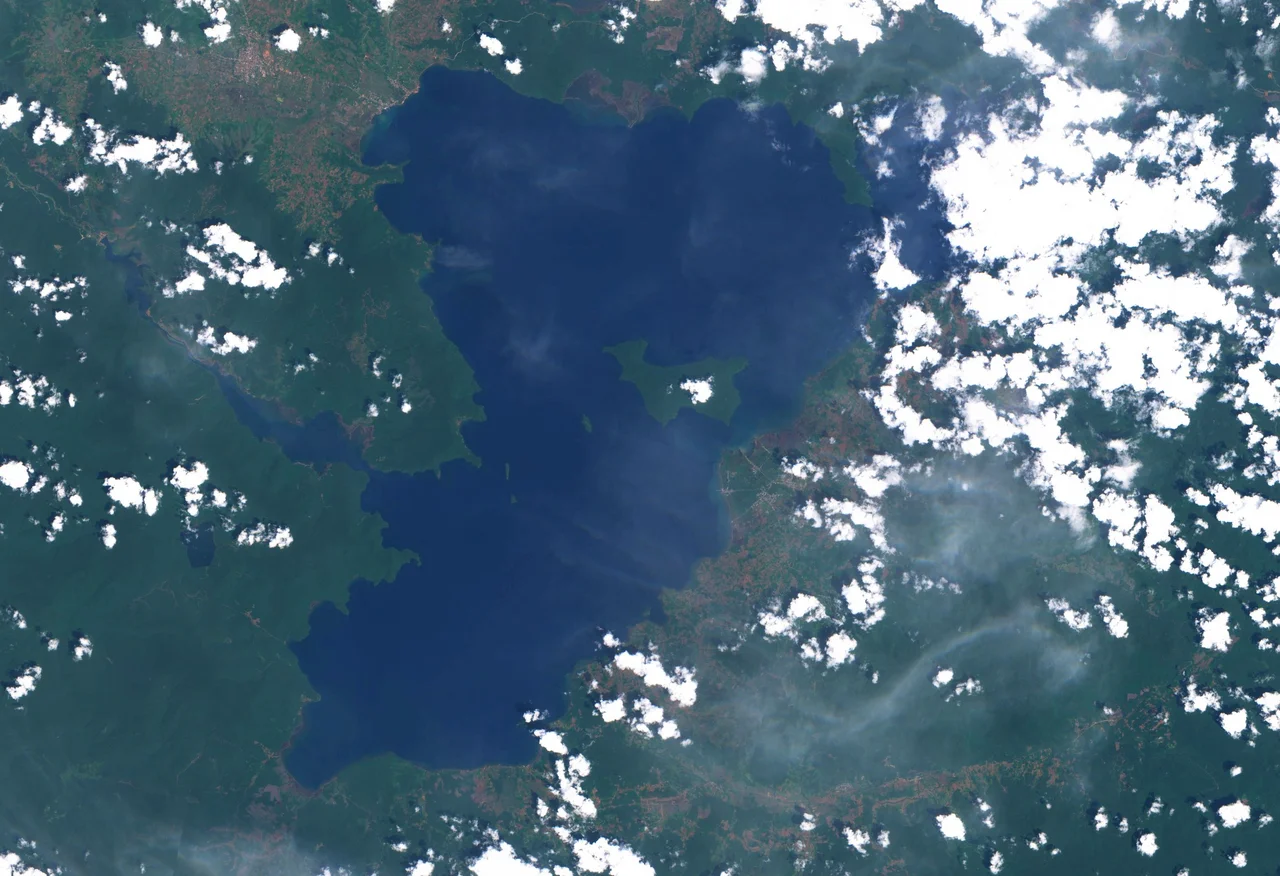
Lake Towuti is located at approximately 2.76S, 121.52E in East Luwu Regency, South Sulawesi. At 560 square kilometers, the lake is clearly visible from cruising altitude as a large, dark body of water surrounded by forested mountains on Sulawesi's southeastern peninsula. The Malili Lake system -- Matano, Mahalona, and Towuti -- can be traced as a chain of water bodies connected by rivers flowing southeast toward the Gulf of Boni. The nearest airport is Sorowako Airport (WAWS), a small strip near the nickel mining town of Sorowako on Lake Matano. The larger Haluoleo Airport (WAWW) in Kendari lies approximately 200 km to the south. Best viewed at 15,000-20,000 feet to appreciate the chain of lakes and their mountain setting.
Nearby Stories
- The Nickel Furnace of the Electric Future 22 km away
- The Vanishing World of Lake Poso 62 km away
- The Island That Shouldn't Exist 73 km away
- The Iron Island's Oldest Kingdom 82 km away
- The Scholar's Gift: Palopo Old Mosque 88 km away
- The Island That Evolution Forgot to Connect 115 km away
- The Ninety Minutes of MV Marina Baru 2B 125 km away
- The Hidden Archipelago of Tomini 237 km away