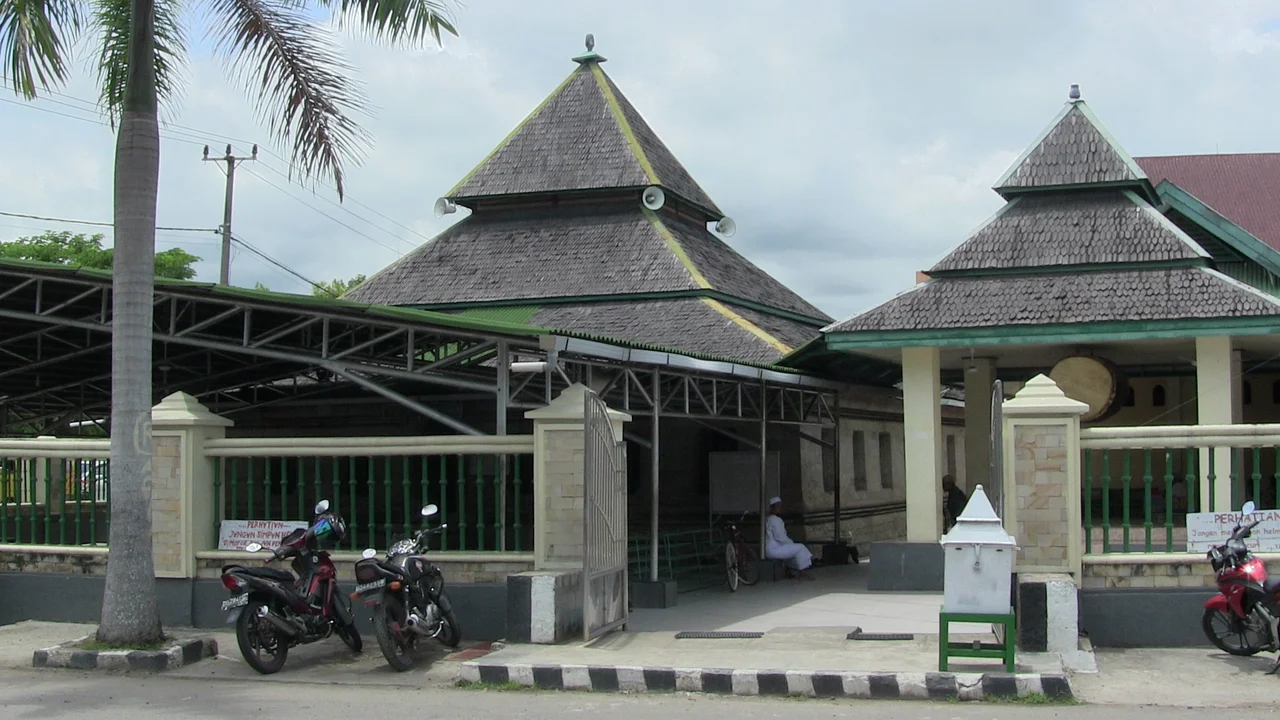

The Scholar's Gift: Palopo Old Mosque
Datuk Sulaiman arrived in Luwu with nothing but faith and an argument. The West Sumatran scholar, known locally as Datuk Pattimang, was one of the Dato Tallu -- three Islamic preachers who sailed from Sumatra to spread their religion across Sulawesi. He chose the most powerful kingdom on the island to make his case. What followed was not conquest but conversation: a lengthy dialogue between the scholar and Datu Payung Luwu XVI, the ruler La Patiwareq. By early 1605, the king had converted, taking the title Sultan Muhammad. And in the city of Palopo, where the kingdom had recently relocated its capital from inland Malangke to access coastal trade routes, Datuk Sulaiman built a mosque. That mosque still stands.
Where Stone Meets Symbol
The Palopo Old Mosque, known locally as Masjid Jami Tua Palopo, is a modest building that carries an outsized legacy. Constructed around 1604, it is among the oldest mosques in the Indonesian archipelago and the oldest surviving evidence of Islam in South Sulawesi. Its walls, nearly a meter thick and made of rock and chalk, have endured more than four centuries of tropical heat and monsoon rain. The main column is carved from a local hardwood called cinna gori, chosen for its resistance to rot. Five pillars support the structure, each one representing a Pillar of Islam -- faith, prayer, charity, fasting, and pilgrimage. The architecture itself is a sermon in wood and stone, fusing pre-Islamic Buginese design with Javanese Islamic traditions and faint traces of Hindu-Buddhist and Chinese artistic influence. It is the kind of building that does not shout its importance. You have to know what you are looking at.
A Kingdom Turns
The Kingdom of Luwu was the oldest and most prestigious kingdom in South Sulawesi, tracing its origins to the mythical figure Sawerigading, a hero of Buginese oral tradition. When Islam arrived at its doorstep, Luwu became the first major South Sulawesi kingdom to accept the new faith -- a decision that would reshape the political and spiritual landscape of the entire region. The conversion was not instantaneous. Datuk Sulaiman engaged the king in sustained theological debate, and the process involved what scholars describe as a power struggle before the ruler acknowledged the scholar's arguments. The mosque was built near the Luwu royal palace, following a pattern common to royal mosques across Indonesia, where proximity to the seat of power signaled that faith and governance were inseparable. From Luwu, Islam spread south to the Bugis kingdoms of Bone and Gowa, eventually reaching across the island.
Termites, Time, and Tenacity
Four centuries take their toll. The mimbar -- the pulpit from which the imam addresses worshippers -- had to be refurbished after termites ate through the original wood, leaving it fragile and unsafe. But the rest of the mosque has largely retained its original form, a fact that astonishes given the climate. Sulawesi's equatorial weather is relentless: heavy rains during the wet season, punishing humidity year-round. Those thick rock-and-chalk walls, it turns out, were engineered for exactly these conditions. At 94 centimeters wide, they keep the interior remarkably cool, a natural air conditioning system designed centuries before electricity reached the island. The mosque remains an active place of worship in Palopo, not a museum exhibit. Worshippers pray in the same space where Datuk Sulaiman once stood, under the same wooden pillars, within the same thick walls that have absorbed four hundred years of devotion.
Palopo's Crossroads
The mosque's location in Palopo is itself part of the story. The Kingdom of Luwu moved its capital from Malangke to Palopo precisely because the coastal city offered access to maritime trade networks that connected Sulawesi to the wider world. Palopo sits at the head of the Gulf of Bone, where the Celebes Sea funnels into a long inlet that cuts deep into Sulawesi's sprawling, orchid-shaped landmass. Traders from Java, Sumatra, and the Malay Peninsula passed through these waters, and it was along these trade routes that Islam traveled. The mosque marks the point where that spiritual current made landfall and took permanent root. Today Palopo is a small city of roughly 180,000 people, and the old mosque sits at its historic heart -- a quiet monument to the scholar who changed a kingdom's mind.
From the Air
Located at 2.99S, 120.20E on the western coast of Sulawesi's southeastern peninsula, at the head of the Gulf of Bone. Palopo sits along the coastal plain with mountains rising steeply to the west. Nearest airport is Bua/Palopo Lagaligo Airport (ICAO: WAFD), approximately 10 km from the city. Makassar's Sultan Hasanuddin International Airport (ICAO: WAAA) is the major hub, roughly 328 km to the south. Best viewed at 3,000-5,000 feet when following the coastline north from Makassar.
Nearby Stories
- The Shortcut That Wasn't 10 km away
- The Drum of God 17 km away
- The Ninety Minutes of MV Marina Baru 2B 48 km away
- The Five Minutes That Swallowed the Teratai Prima 84 km away
- The Nickel Heart of Sulawesi 90 km away
- Sulawesi's Cloud Forests: Evolution's Island Laboratory 103 km away
- The Town the Lake Made Twice 106 km away
- The Invisible Wall of Makassar Strait 267 km away