
Sulawesi's Cloud Forests: Evolution's Island Laboratory
In 2008, a research team from Texas A&M University hiked into the mossy highlands of Mount Rorekatimbo in central Sulawesi, set mist nets in the cloud forest, and caught something that had not been seen alive in over eighty years. Three pygmy tarsiers, tiny primates with enormous eyes and claw-tipped fingers, materialized from the fog like proof that this island still keeps secrets. The species had been presumed extinct since the 1920s. One had been accidentally killed during a rat-trapping expedition in 2000, hinting at survival, but until Sharon Gursky and Nanda Grow fitted radio collars to those three startled animals on Rorekatimbo, no scientist had confirmed a living population. The montane rain forests where the pygmy tarsier hid are themselves a kind of biological riddle, shaped by forces unlike those that built any other forest on Earth.
The Line That Changed Biology
In the nineteenth century, the naturalist Alfred Russel Wallace noticed something strange about the animals on either side of a deep strait west of Sulawesi. To the west, in Borneo, the fauna was unmistakably Asian: monkeys, tigers, rhinoceroses. To the east, in Sulawesi and beyond, the animals looked Australian: marsupials, cockatoos, megapodes. The Makassar Strait, he realized, marked a boundary that no land bridge had ever crossed, not even during the ice ages when sea levels dropped and connected Borneo to mainland Asia. Sulawesi sits on the eastern side of this Wallace Line, in a transition zone called Wallacea, belonging fully to neither continent. Its highlands have been isolated long enough for evolution to run experiments found nowhere else.
A Forest Built on Isolation
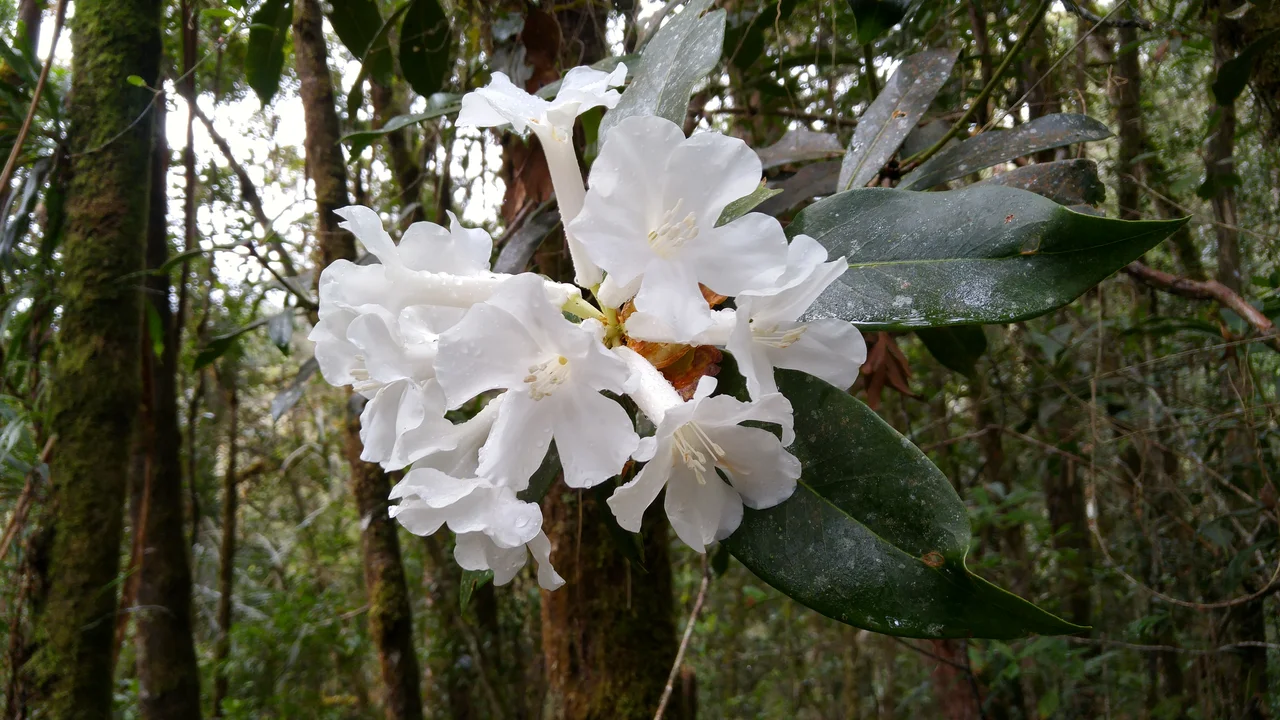
Sulawesi is the fourth-largest island in Indonesia, 180,681 square kilometers of land twisted into four peninsulas radiating from a mountainous core. The highest peak, Mount Latimojong, reaches 3,478 meters. Roughly 40 percent of the island's land area falls within the montane rain forests ecoregion, which begins where the lowland forests yield to cooler, wetter slopes. Above 2,000 meters, moss blankets every surface. The canopy shifts from broadleaf tropical trees to ancient conifers: Agathis, Podocarpus, Dacrycarpus, species whose lineages predate the flowering plants that dominate the lowlands below. Rhododendrons bloom in the understory alongside Vaccinium and Gaultheria, genera more commonly associated with the temperate mountains of Europe and North America.
Creatures That Exist Nowhere Else
The numbers are staggering. Ninety-eight percent of Sulawesi's nonvolant mammals are endemic to the island. The montane forests alone harbor 102 mammal species, a third of them found here and nowhere else. Beyond the pygmy tarsier, there is Dian's tarsier, another highland primate with saucer-sized eyes adapted to nocturnal hunting. There are twenty species of endemic rodents in the montane zone, from the montane long-nosed squirrel to the elegant margareta rat, each filling a niche that mainland competitors never reached. The Sulawesi palm civet, the island's only native carnivore, prowls both the mountain and lowland forests. And the North Sulawesi babirusa, a tusked pig whose upper canines curve backward toward its own skull, grazes in the forest understory like an animal designed by committee.
Guardians in the Mist
Only 12 percent of the montane ecoregion falls within protected areas, roughly 9,066 square kilometers as of a 2017 assessment. Lore Lindu National Park, where the pygmy tarsiers were rediscovered, is the most prominent, but the network extends across the island: Bogani Nani Wartabone in the north, Rawa Aopa Watumohai in the southeast, Ganda Dewata in the southwest. Nature reserves dot the highlands, from Gunung Ambang to Morowali, each preserving a fragment of forest where endemic species persist. The challenge is connectivity. Isolated reserves protect populations but can strand them, cutting off the gene flow that sustains evolutionary resilience across generations.
Between Two Worlds
Seen from above, Sulawesi's four peninsulas splay outward like the arms of a starfish, each wrapped in green where the mountains rise high enough to catch rain and cloud. The montane forests drape these highlands in a living cloak that has been accumulating species for millions of years, ever since the island emerged from the collision of tectonic plates and began its long experiment in isolation. What makes these forests remarkable is not just their biodiversity but the mechanism that produced it: deep water on every side, a position between two continental shelves, and enough altitude to create climate zones stacked one above another. It is a laboratory that Wallace glimpsed from below. From a cockpit window, you can see its full extent.
From the Air
The Sulawesi montane rain forests are centered approximately at 1.90S, 120.20E, covering the highland spine of Sulawesi's four peninsulas. From FL350+, the island's distinctive four-armed shape is clearly visible, with montane forests appearing as darker green bands along the ridgelines compared to the lighter lowland forests below. Mount Latimojong (3,478 m) in the south is the highest peak. Lore Lindu National Park lies in central Sulawesi near Palu. Nearest major airports: Sam Ratulangi (ICAO: WAMM) in Manado, Mutiara SIS Al-Jufrie (ICAO: WAFF) in Palu, and Sultan Hasanuddin (ICAO: WAAA) in Makassar.
Nearby Stories
- The Vanishing World of Lake Poso 17 km away
- Stone Faces in the Cloud Forest 46 km away
- Central Sulawesi: Where the Earth Remembers 79 km away
- The Drum of God 94 km away
- The Town the Lake Made Twice 97 km away
- Land of the Heavenly Kings: Tana Toraja 99 km away
- The Ground Beneath Mamuju 146 km away
- The Invisible Wall of Makassar Strait 173 km away