
Land of the Heavenly Kings: Tana Toraja
The dead do not leave quickly in Tana Toraja. When someone dies in these South Sulawesi highlands, the body stays home -- sometimes for months, sometimes for years -- wrapped in cloth and treated as though merely ill. The family brings food and drink. They speak to the deceased. They save money. Because in Tana Toraja, dying is only the beginning. The funeral that follows, known as rambu solo, can last a week or longer and may cost a family its entire savings. Water buffalo are slaughtered -- dozens of them, sometimes -- to carry the soul to puya, the spirit world. Then the body is placed in a cave carved into a limestone cliff, or inside a hollow tree, or suspended in a bamboo frame from a rock face, with a tau-tau -- a carved wooden effigy -- mounted at the entrance to watch over the valley below.
Where the Roofs Touch the Sky
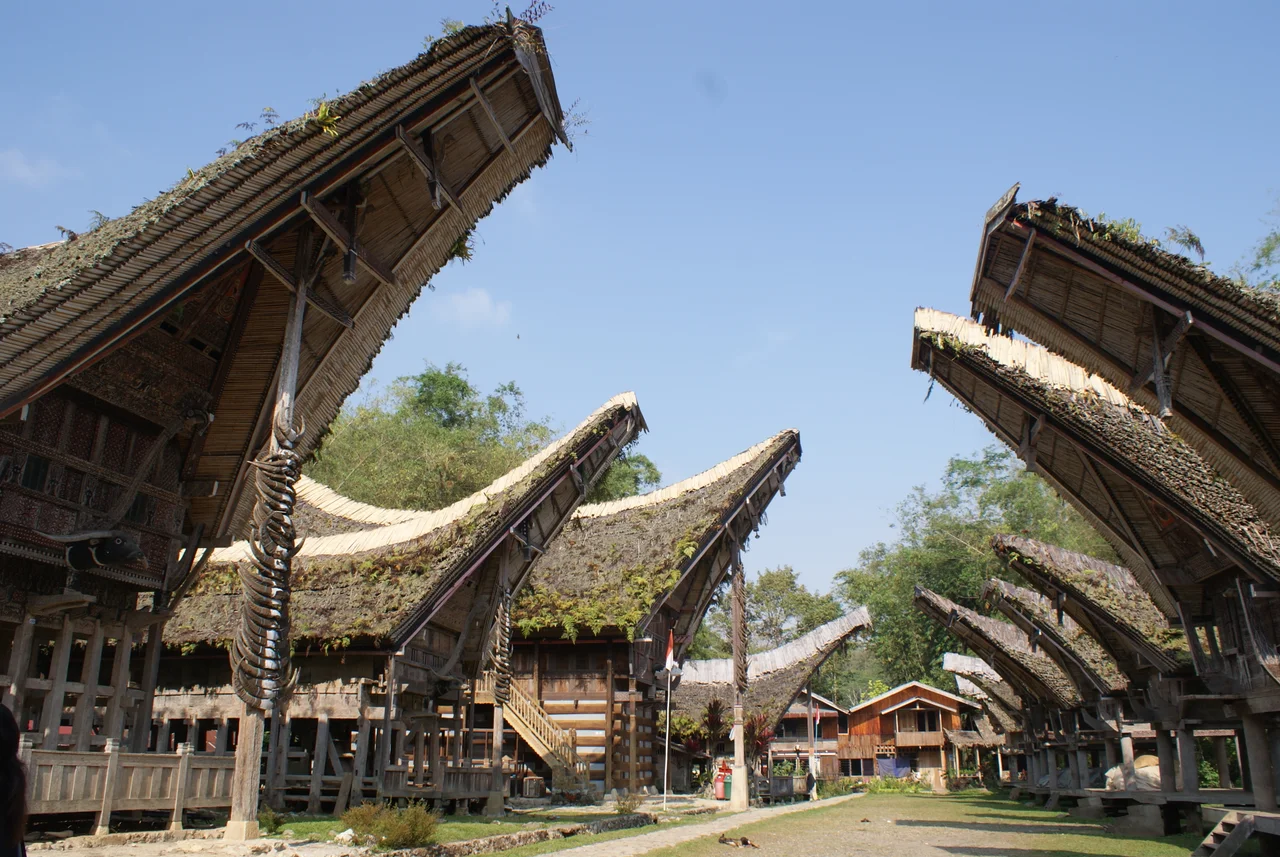
The first thing you notice in Tana Toraja are the roofs. Tongkonan houses rise from the rice paddies like boats turned upside down, their saddle-shaped peaks curving dramatically upward at both ends. No nails or screws hold them together -- only wooden joints and rope lashing, a construction technique passed down through generations. These are not ordinary homes. Each tongkonan is a living archive of a family's lineage, intricately carved with geometric patterns in red, black, white, and yellow -- the sacred colors of Torajan cosmology. The houses face north, toward the direction the Toraja believe their ancestors arrived from. Opposite each tongkonan stands a row of alang, rice granaries elevated on stilts, their smaller roofs echoing the same sweeping curve. Together they form compounds that serve as the ceremonial center of Aluktodolo, the ancestral faith that still shapes daily life even among the region's now predominantly Christian population.
The Weight of a Buffalo
Social standing in Tana Toraja is measured, quite literally, in buffalo. A Tedong Bonga -- a buffalo with distinctive spotted markings -- can sell for 75,000 US dollars or more. The number of buffalo sacrificed at a funeral signals the family's status and the honor owed to the deceased. A noble family's ceremony might require dozens of animals slaughtered over several days, along with pigs in quantities that would stagger an outsider. This is not spectacle for its own sake. The Toraja believe that each buffalo sacrificed becomes a companion for the soul on its journey to puya. Without sufficient sacrifice, the soul wanders. The economic pressure is enormous -- families take on debt, sell land, and work for years to fund a single funeral. But the ceremony is also a massive communal event, drawing hundreds of guests from across the region. Visitors bring gifts of livestock, creating a web of reciprocal obligation that binds Torajan society together across generations.
Stone Galleries of the Ancestors
The burial sites are scattered across the landscape south and north of Rantepao, the region's main town. At Lemo, rows of tau-tau peer down from balconies carved into a sheer limestone cliff -- wooden figures with painted faces and outstretched hands, dressed in real clothing that the families periodically replace. At Londa, caves serve as ossuaries where coffins are stacked alongside scattered bones and skulls, some centuries old. At Ke'te Kesu, a complete traditional settlement includes houses, granaries, ceremonial grounds, rice fields, and burial caves, all within walking distance. The sites feel less like cemeteries and more like neighborhoods where the dead simply occupy a different kind of housing. Bright green rice terraces surround the cliff faces, and the whole tableau -- emerald paddies against grey limestone, wooden effigies gazing out from their stone galleries -- creates a landscape unlike anything else in Southeast Asia.
Coffee, Cloves, and the Quiet Months
Outside of funeral season, Tana Toraja is a sleepy agricultural region cultivating rice, cacao, coffee, and cloves. Torajan arabica coffee has earned a reputation that far outstrips the region's modest infrastructure, and drinking it at its source -- strong, earthy, served in simple roadside stalls -- is one of the quiet pleasures of visiting. The highlands sit between 300 and 2,880 meters above sea level, producing a climate that is tropical but refreshingly cool, with temperatures rarely exceeding 28 degrees Celsius. Morning mist hangs in the valleys, burning off to reveal bamboo groves and limestone outcrops. The dry season from June through September brings the harvest, and with it the funeral ceremonies that transform Rantepao from a backwater into something extraordinary. Despite this, Tana Toraja remains far less touristy than Bali or Java -- partly because reaching it requires an eight-to-ten-hour drive from Makassar, the nearest major city.
Between Two Faiths
The Toraja are mostly devoutly Christian today, a legacy of Dutch Reformed missionaries who arrived in the early twentieth century. But Christianity did not replace Aluktodolo so much as layer over it. The funeral rites, the buffalo sacrifices, the tau-tau, the cliff burials -- all persist, blending animist tradition with Christian observance in ways that confound neat categories. A Torajan funeral might include both a church service and a ritual animal sacrifice. A family might attend Sunday worship and then consult a to minaa, a traditional priest, about the auspicious timing for a ceremony. This is not hypocrisy or confusion. It is the way faith works in a culture where the dead never fully depart, where ancestors are consulted and honored and feared, and where the line between this world and the next is not a wall but a membrane -- permeable, alive, and constantly negotiated.
From the Air
Located at 3.00S, 120.00E in the central highlands of South Sulawesi, approximately 328 km north of Makassar. The terrain is mountainous, rising from 300 to 2,880 meters, with deep valleys and limestone formations. Pongtiku Airport has a 900-meter runway suitable for small aircraft; the newer Buntukunik Airport has a 1,900-meter runway. Sultan Hasanuddin International Airport in Makassar (ICAO: WAAA) is the primary hub. From altitude, look for the distinctive saddle-roofed tongkonan compounds and the bright green rice terraces cut into the hillsides. Best viewed at 5,000-8,000 feet in clear morning conditions before clouds build over the highlands.
Nearby Stories
- The Shortcut That Wasn't 10 km away
- The Drum of God 17 km away
- The Ninety Minutes of MV Marina Baru 2B 48 km away
- The Five Minutes That Swallowed the Teratai Prima 84 km away
- The Nickel Heart of Sulawesi 90 km away
- Sulawesi's Cloud Forests: Evolution's Island Laboratory 103 km away
- The Town the Lake Made Twice 106 km away
- The Invisible Wall of Makassar Strait 267 km away