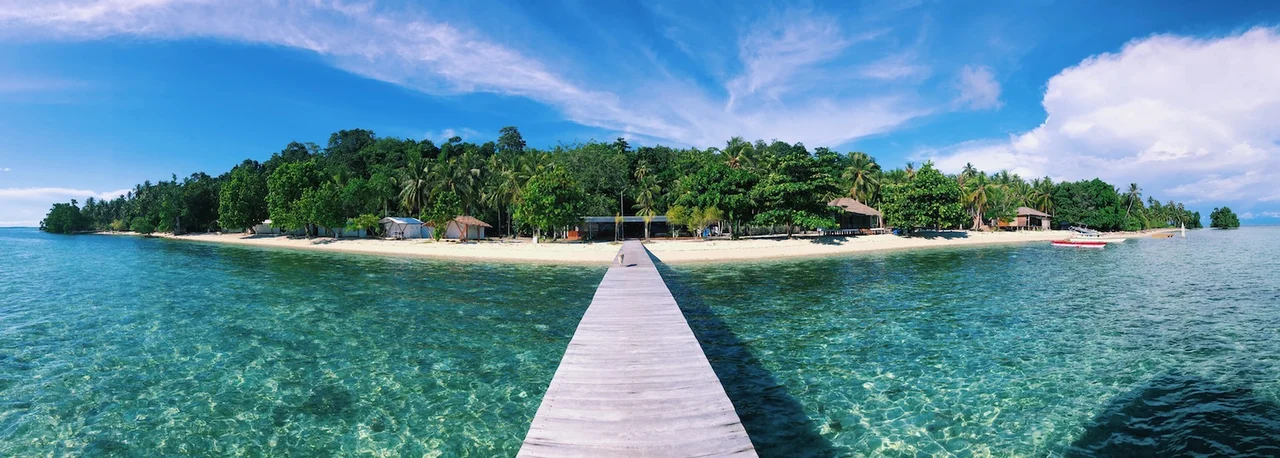

The Hidden Archipelago of Tomini
The jellyfish here don't sting. They drift through the brackish lakes of these islands like translucent ornaments, red-spotted and harmless, relics of an evolutionary path that diverged when rising seas cut their habitat off from the open ocean. It is a fitting introduction to the Togian Islands, an archipelago of 56 islands scattered across the Gulf of Tomini off Central Sulawesi, where isolation has turned ordinary biology into something extraordinary.
An Archipelago Apart
The Gulf of Tomini wraps around the northern arm of Sulawesi like a cupped hand, and the Togian Islands sit in its palm. Getting here requires commitment. From the nearest airports at Palu, Gorontalo, or Luwuk, travelers face overland journeys to the port towns of Ampana or Gorontalo, then hours more by ferry or speedboat. The twice-weekly ferries run to Wakai, the main settlement, but schedules bend to weather and tide. This remoteness has preserved the islands in ways that more accessible destinations in Indonesia cannot match. The 59 villages spread across the chain remain small, their rhythms dictated by the sea rather than by tourism. Among them lives a community of the Bajau people, a seafaring culture whose traditional life has long been tied to the water itself, dwelling in stilt houses over the shallows and diving for their livelihood.
Fire, Forest, and Reef
Volcanic forces built these islands, and the evidence is everywhere. Una-Una, one of the seven largest islands in the chain, is an active volcano whose 1983 eruption forced the evacuation of its entire population. But the same tectonic energy that periodically threatens the islands also created the conditions for their remarkable biodiversity. The surrounding coral reefs stretch across 132,000 hectares, the largest reef system in Indonesia, providing habitat for hawksbill and green turtles and the increasingly rare dugong. Above the waterline, dense rainforest cloaks the volcanic slopes. The Tonkean macaque swings through the canopy, a primate found only on Sulawesi. But the truly unique creatures are the ones that exist nowhere else at all: the Togian babirusa, a tusked pig whose curving canines grow upward through its own snout, and the Togian hawk-owl, a nocturnal raptor that went undetected by science until 1999. Nine years later, researchers described yet another endemic species, the Togian white-eye, a small songbird hiding in plain sight.
A National Park Still Taking Shape
In 2004, the Indonesian government designated a vast swath of the archipelago as Kepulauan Togean National Park, encompassing 292,000 hectares of marine territory, 70,000 hectares of land, and more than 10,000 hectares of protected forest and mangrove. The park is enormous on paper, but enforcement in such a remote and scattered geography remains a work in progress. Coral bombing and cyanide fishing, though declining, still occur in some areas. Conservation groups work alongside local communities to establish sustainable fishing practices, recognizing that the people who have lived here for generations are the park's most effective stewards. The reefs themselves are a draw for researchers studying coral resilience. Situated in the heart of the Coral Triangle, the Togian reefs support a staggering diversity of hard and soft coral species, many of them thriving in the warm, sheltered waters of the gulf.
Below the Surface
Divers come to the Togian Islands for conditions they struggle to find elsewhere in Southeast Asia: warm, clear water, healthy reef systems, and almost no one else around. About 20 small resorts were operating across the islands as of 2023, scattered from Buka Buka Island in the north to Una-Una in the south. The diving ranges from gentle coral gardens accessible to beginners to deep walls and pinnacles where pelagic species patrol. A World War II B-24 bomber rests on the seabed near Kadidiri Island, its fuselage colonized by soft corals and sponges, a ghostly monument transformed into living reef. The islands attracted roughly 12,000 visitors in 2023, a fraction of what Bali or Komodo receives. After the COVID-19 pandemic devastated the local tourism economy, the numbers began recovering slowly, each arriving boat a small economic lifeline for villages where fishing and copra farming remain the primary occupations.
The Patience the Togians Require
There is no fast way to experience these islands. The ferry from Ampana takes hours. Moving between islands means negotiating boat schedules that may or may not hold. Power and internet are intermittent. For travelers accustomed to the polished infrastructure of Bali, the Togians demand a different kind of engagement, one measured in tides rather than itineraries. But the reward scales with the effort. At dusk, the limestone karsts along the shoreline turn gold, then violet. Fruit bats launch from the treetops in ragged columns. Somewhere in a brackish lake behind the mangroves, those stingless jellyfish pulse through water so still it mirrors the sky. The Togian Islands are not easy to reach, and they are not trying to be. That is precisely what makes them worth the journey.
From the Air
Coordinates: 0.33S, 122.0E. The Togian archipelago stretches across the Gulf of Tomini, visible from above as a chain of green, forested islands surrounded by turquoise shallows and coral reef. Nearest airports: Palu (WAFF/PLW) to the west, Gorontalo (WAMG/GTO) to the north, Luwuk (WAMW/LUW) to the east. Recommended viewing altitude: 5,000-10,000 ft to appreciate the reef formations and island chain. The gulf itself is a dramatic feature, the large embayment between Sulawesi's northern and eastern arms.
Nearby Stories
- Mount Colo: The Volcano That Saved an Island 11 km away
- Otanaha Fortress 70 km away
- Central Sulawesi: Where the Earth Remembers 89 km away
- Gorontalo 109 km away
- The Island That Shouldn't Exist 209 km away
- Buyat Bay 297 km away
- Kakaban 420 km away
- Twenty-Five Thousand Islands Between Two Worlds 462 km away