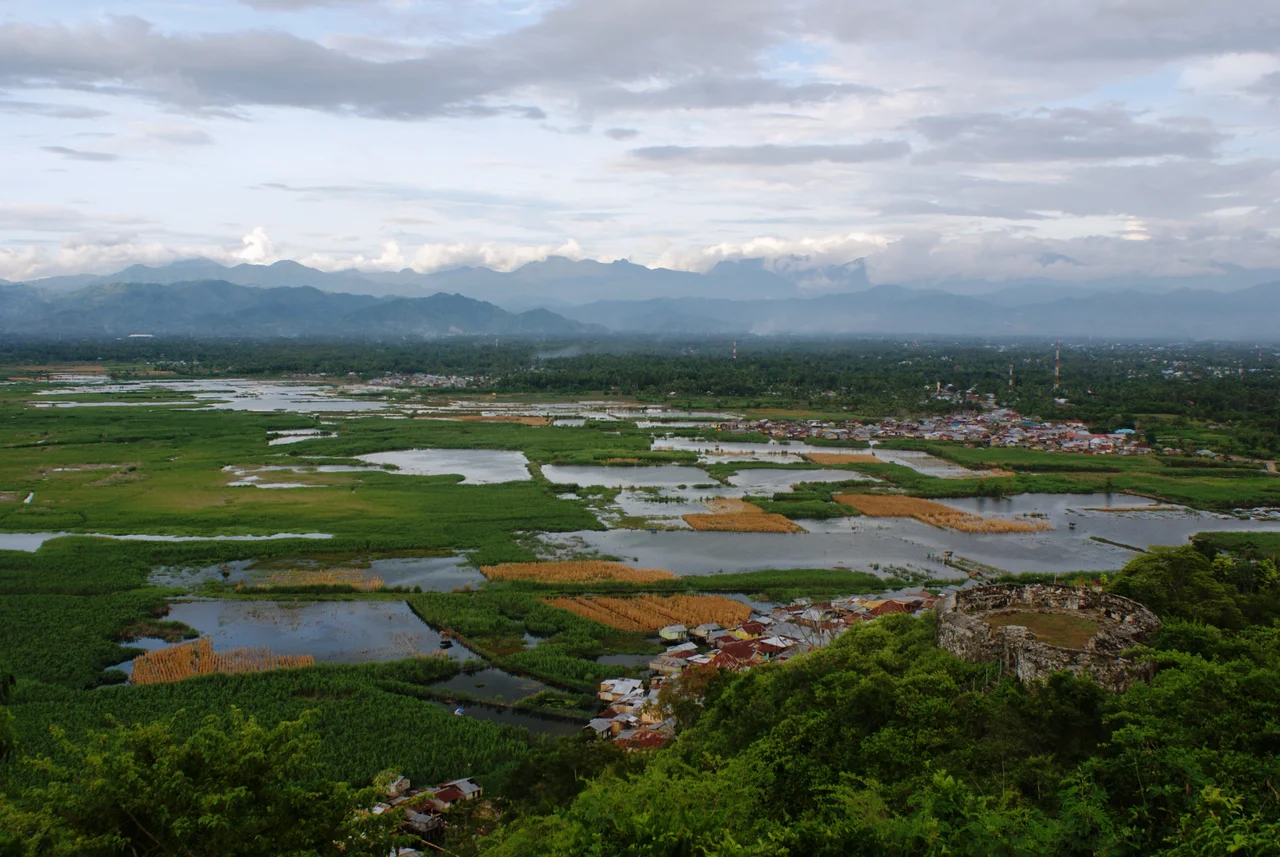

Otanaha Fortress
The mortar holding these walls together contains bird eggs. Not just any bird -- the eggs of the Maleo, a critically endangered megapode found only on Sulawesi, were mixed with sand and calcium to bind the stones of Otanaha Fortress in 1522. That the builders chose such a culturally significant ingredient tells you something about the fortress's importance. That they then used it to expel the very people who helped construct it tells you something about Gorontalo.
A Deal Gone Wrong
In the early 16th century, Portuguese sailors found themselves stranded in Kota Barat, on the coast of Gorontalo, driven ashore by foul weather, pirate threats, and dwindling supplies. They struck a bargain with King Ilato of the Gorontalo Kingdom: in exchange for provisions and shelter, the Portuguese would help build three fortresses atop Dembe Hill to protect the kingdom from external threats. The construction went forward, and three stone strongholds rose above the surrounding landscape. But the alliance soured. The Gorontalo princesses Ndoba and Tiliaya -- King Ilato's daughters -- discovered that the Portuguese were using the kingdom's hospitality as a staging ground for their own operations, leveraging the fortresses to fend off their pirate enemies rather than protecting Gorontalo interests. The kingdom's patience ran out. The Gorontalo people turned on the Portuguese and drove them from the region entirely.
Three Forts, Three Names
The fortresses lay unused for decades until Naha, King Ilato's son, inherited the throne and found himself at war with Hemuto, leader of a transmigrant community in northern Gorontalo. In 1585, Naha rediscovered the hilltop fortifications and used them as a shelter for his wife Ohihiya and their two sons, Paha and Limonu. The war took Naha and Paha's lives -- both killed by Hemuto's forces. Limonu, the surviving son, swore revenge and eventually killed Hemuto, ending the conflict. Each fortress was then named for the family it had sheltered and lost. Otanaha combines 'Ota' -- fort -- with Naha, the king who found it. Otahiya honors his wife Ohihiya. Uwole, the third fort, carries the name of Pahu, the son who fell alongside his father. The naming turned military architecture into a family memorial, written in stone on a hilltop.
Three Hundred and Forty-Eight Steps
Reaching Otanaha Fortress requires climbing 348 steps, divided across four stopovers that break the ascent into manageable stages: 52 steps to the first rest, 83 to the second, 53 to the third, and 89 to the fourth. From the final stopover, another 71 steps reach the fortress itself. The climb rewards persistence with a panoramic view of Limboto Lake spreading below, its waters reflecting the surrounding mountains and rice paddies of the Gorontalo lowlands. The lake, the green patchwork of the valley floor, and the distant ridgeline compose a landscape that explains why King Ilato chose this summit for his defenses -- and why Naha later chose it for his refuge. The strategic advantage is visible in every direction: from Otanaha's walls, you can see anyone coming long before they arrive.
Stone Memory on Dembe Hill
Otanaha Fortress stands today as one of Gorontalo province's primary tourist sites, a tangible link between the modern province and the kingdom that preceded it. The Portuguese colonial influence is visible in the construction techniques, but the story the fortress tells is entirely Gorontaloan: a kingdom that accepted help from foreigners, recognized when that help became exploitation, and acted decisively to reclaim its sovereignty. The Maleo bird eggs in the mortar, the rattan and stone of the walls, the hilltop positioning overlooking Limboto Lake -- every element speaks to local knowledge and local priorities. Five centuries after its construction, the fortress remains a reminder that Gorontalo's independence has deep roots, predating both the Indonesian republic and the colonial powers that tried to shape the region to their purposes.
From the Air
Located at 0.55N, 123.01E on Dembe Hill in Gorontalo province, Sulawesi, Indonesia. The fortress sits on a hilltop overlooking Limboto Lake, which is visible as a large body of water in the Gorontalo valley. Jalaluddin Airport (WAMG) serves the nearby provincial capital. From altitude, the hill and lake combination provides clear visual navigation references. Best viewed at lower altitudes in clear conditions.
Nearby Stories
- The Hidden Archipelago of Tomini 85 km away
- Kepulauan Togean: The Islands Where Jellyfish Forgot How to Sting 115 km away
- HMS Diana (1807) 135 km away
- Buyat Bay 147 km away
- Mount Colo: The Volcano That Saved an Island 152 km away
- Bunaken National Park 216 km away
- The Sea That Swallows Itself 240 km away
- Indonesia-Malaysia Border 410 km away