
Kakaban
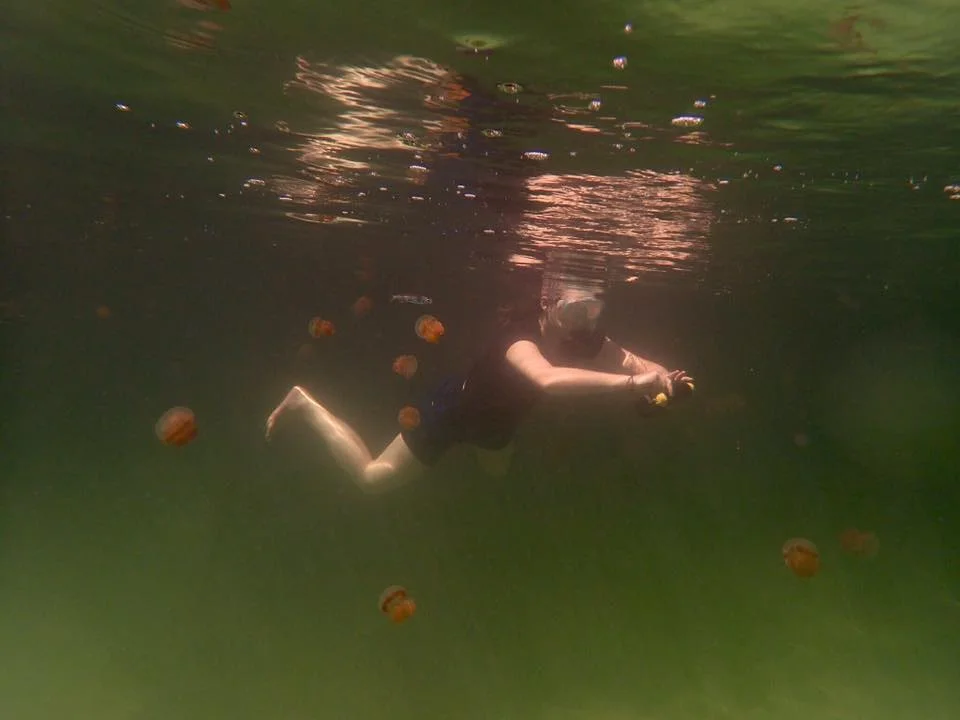
In the local dialect, Kakaban means "hug." The name describes exactly what you see from the air: a ring of jungle-covered limestone, 774 hectares in area, embracing a landlocked lake at its center. The island hugs its lake the way a cupped hand holds water, and the water it holds is unlike almost anything else in the ocean. Thousands of jellyfish pulse through the warm, brackish shallows -- four distinct species, none capable of stinging a human being. Kakaban sits among the Derawan Islands off East Kalimantan, Indonesia, and it is one of only a handful of places on Earth where evolution took a marine ecosystem, sealed it off from the sea, and let it run its own experiment for millennia.
The Lake That Time Enclosed
Kakaban was likely uplifted during the Holocene era, a geological event that trapped seawater inside the island's limestone rim and cut it off from the surrounding Celebes Sea. Rainfall diluted the saltwater over centuries, creating the brackish conditions that exist today. The lake sits slightly above sea level, is at most 17 meters deep, and has poor visibility -- its bottom carpeted with marine green algae. Yet within this murky, enclosed world, life adapted in remarkable ways. Four species of jellyfish lost their stinging capacity, having no predators to defend against: the transparent moon jellyfish Aurelia aurita, the fingertip-sized box jellyfish Tripedalia cystophora, the green-brown spotted Mastigias papua, and the upside-down Cassiopea ornata, which rests on the bottom with its tentacles pointing skyward. Sea cucumbers, gobies, sea anemones, tunicates, nudibranchs, and snakes share the lake. Similar stingless jellyfish lakes exist in Palau and in Siargao in the Philippines, but Kakaban's four-species diversity is exceptional.
Walls and Currents
While the lake draws the most attention, the exterior of Kakaban is equally formidable. The island's limestone cliffs drop vertically into the Celebes Sea, dense jungle growing right to the cliff edge, and the underwater wall plunges to 180 meters. Currents here are serious -- upwelling, downcurrents, and sudden reversals make the diving challenging and rewarding in equal measure. At Barracuda Point, a steep wall on the island's edge, the current funnels large pelagic species into concentrated encounters. Whitetip reef sharks, leopard sharks, jacks, tuna, snapper, and the barracuda schools that give the site its name patrol the drop-off. Drift divers use a grab line permanently secured 24 meters across a flat area on the upcurrent side of the point, holding position against currents that can turn fierce without warning.
Blue Light in the Deep
Below the waterline on Kakaban's outer wall, a crack at just two meters depth marks the entrance to Blue Light Cave. The opening descends through a narrow chimney, squeezing divers downward until, at about 21 meters, the chimney opens into a cavern that extends roughly 120 meters into the island's limestone core. The exit is a long vertical crack in the wall at 44 meters depth. The cave takes its name from what you see when you look back toward the entrance from inside the cavern: the blue light of the open sea filtering through rock, transforming the darkness into something luminous. It is a dive for the experienced only, but the reward is a perspective few places offer -- seeing the ocean's light from inside the bones of an island.
An Island Between Worlds
Kakaban is uninhabited. No resorts perch on its cliffs, no villages line its shores. Divers and snorkelers reach it by boat from the other Derawan Islands, spending a few hours swimming with jellyfish in the lake or testing themselves against the currents on the outer walls before returning to their bases. The island exists in a kind of double life: its interior is a quiet, prehistoric lake where evolution took a gentler path, stripping jellyfish of their weapons; its exterior is a high-energy reef system where sharks and barracuda hunt in powerful currents along vertical walls. The ten-minute walk from beach to lake crosses from one world to the other. Kakaban asks nothing of its visitors except that they come prepared for both.
From the Air
Located at 2.14N, 118.54E in the Celebes Sea, part of the Derawan Islands archipelago off East Kalimantan, Indonesia. The island appears as a distinct, roughly circular forested landmass surrounded by deep blue water. Nearest commercial airport is Berau/Kalimarau Airport (WALK). From altitude, the interior lake is visible as a darker area within the jungle canopy. The surrounding Derawan Islands chain provides good visual navigation references.
Nearby Stories
- Borneo's River of Names 81 km away
- Indonesia-Malaysia Border 86 km away
- Sangkulirang-Mangkalihat Karst 138 km away
- 2006 Southeast Asian Haze 141 km away
- Ambalat 150 km away
- Martin B-10 198 km away
- Cutting the Orchid in Half: The Proposed Sulawesi Canal 250 km away
- Sheikh Karimul Makhdum Mosque 309 km away