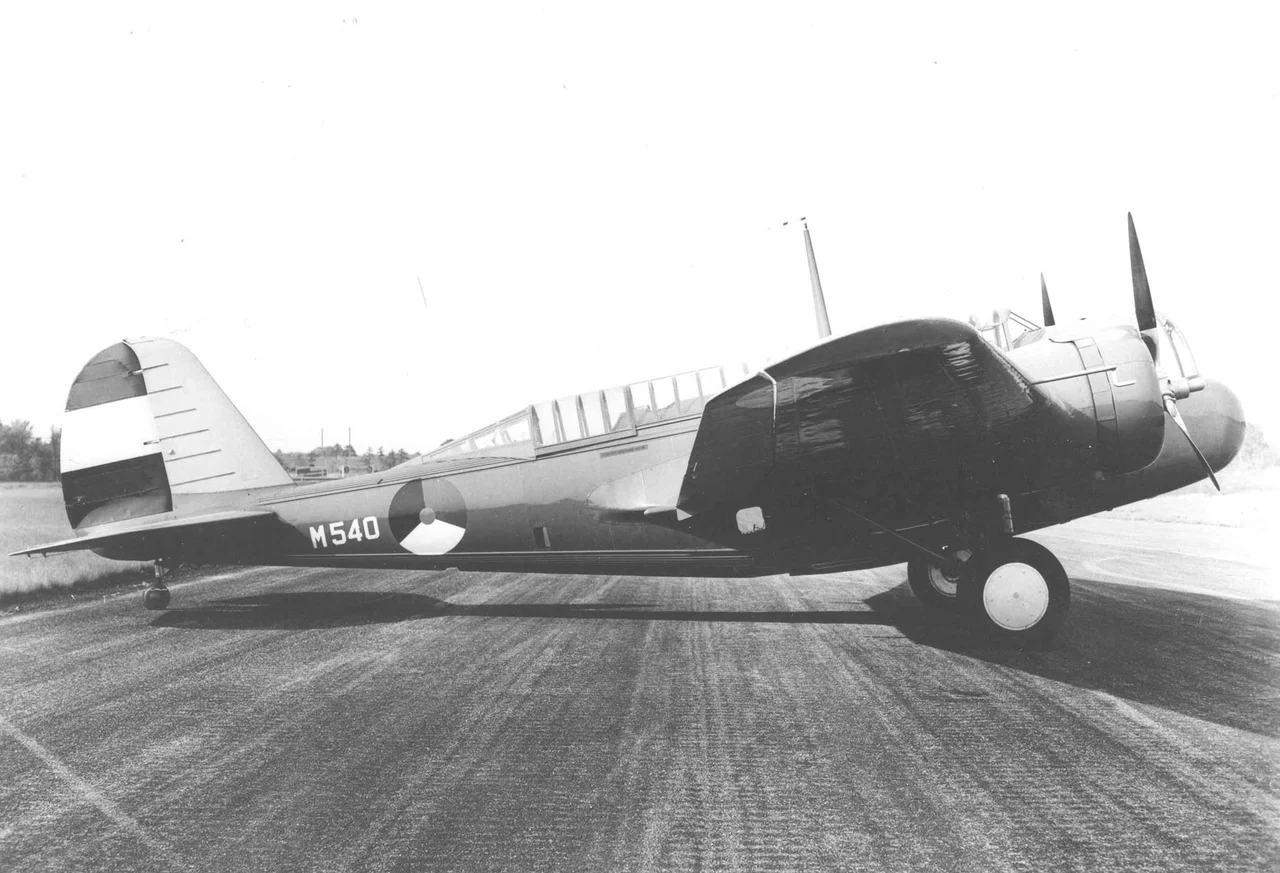

Martin B-10
In 1932, President Franklin Roosevelt presented the Collier Trophy to the Glenn L. Martin Company for an airplane that had made every bomber in every air force on Earth obsolete overnight. The Martin B-10 was the first all-metal monoplane bomber to enter regular service with the United States Army Air Corps, and when it flew during trials in June 1932, it did something no bomber had done before: it outran the pursuit fighters tasked with intercepting it. Closed cockpits, rotating gun turrets, retractable landing gear, an internal bomb bay, full engine cowlings -- features that seem elementary today were revolutionary then. Within a few years, every serious bomber design in the world would copy them. But the B-10's own story was just beginning, and it would play out not in American skies but across the war-torn landscapes of China, the Dutch East Indies, and the jungles of Borneo.
Born in Baltimore
The B-10 started life as the Martin Model 123, a private venture built at the company's plant in Baltimore, Maryland. It was a gamble. Glenn L. Martin's engineers designed it with a crew of four -- pilot, copilot, nose gunner, and fuselage gunner -- seated in open compartments, as was standard for the era. But the airframe broke with convention in almost every other way: a deep belly housed an internal bomb bay, and the main landing gear retracted into the wings. Powered by Wright SR-1820-E Cyclone engines, the Model 123 first flew on February 16, 1932, and was delivered to the U.S. Army on March 20 as the XB-907. The Army sent it back for improvements. Martin rebuilt it as the XB-10, adding enclosed cockpits, a nose turret, upgraded Wright R-1820-19 engines, and eight extra feet of wingspan. A total of 348 aircraft across all variants would eventually be built, with the U.S. taking 166 and the Netherlands purchasing 121.
The Alaskan Expedition
The B-10 earned its reputation not through combat but through endurance. In July 1934, Lieutenant Colonel Henry H. 'Hap' Arnold -- the future five-star general who would command all U.S. Army air forces in World War II -- led ten B-10s on an 8,290-mile round-trip flight from Bolling Field near Washington, D.C., to Fairbanks, Alaska. The squadron departed on July 19 and reached Fairbanks on July 24, then spent the next month conducting exploratory flights over Alaska's interior, including aerial photography of 23,000 square miles of territory in just three days. Arnold received the Mackay Trophy for the flight, and the mission demonstrated that American bombers could project power across vast, unforgiving distances. Two years later, the B-10 proved its versatility in a gentler cause: in February 1936, thirteen B-10Bs of the 49th Bomb Squadron dropped food supplies to the residents of Virginia's Tangier Island and Maryland's Smith Island after heavy Chesapeake Bay ice left the islanders facing starvation.
Leaflets Over Nagasaki
When the U.S. Army's orders were filled in 1936, Martin received permission to export the bomber, and the B-10 began its second life as a weapon of war in other nations' hands. China purchased nine -- six Model 139WC-1s and three WC-2s -- making the B-10 the fastest aircraft in the country when it arrived. During the Second Sino-Japanese War, Chinese B-10s flew bombing missions over Shanghai alongside Heinkel He 111As and Northrop Gammas in desperate strikes against Japanese positions. But the most remarkable Chinese B-10 mission involved no bombs at all. On May 19, 1938, Captain Hsu Huan-sheng and Lieutenant Teng Yen-bo led two B-10s on an unescorted nighttime flight over the Japanese home islands -- the first air raid on mainland Japan. Instead of explosives, they dropped two million leaflets over Nagasaki, Fukuoka, Kurume, and Saga, urging the Japanese people to confront the atrocities of their country's invasion of China. The bombers returned safely, having struck a blow that was moral rather than military.
Defending the Dutch East Indies
The Netherlands became the B-10's largest foreign customer, purchasing 121 Martin 139 variants to defend the Dutch East Indies. The Dutch strategy was stark: cancel orders for defensive fighters entirely and bet everything on bombers. By December 1941, about 58 Martins were operational across six squadrons, with 20 older models held in reserve. When Japan struck, the Dutch Martins were thrown into action immediately. From December 16 to 20, 1941, bombers based at Singkawang and Samarinda attacked Japanese invasion shipping off Miri in British Borneo, sinking a transport and the minesweeper W-6 off Kuching on December 26. Twenty-two Martins reinforced Singapore, arriving on December 9 -- only to be fired upon by confused British anti-aircraft crews who mistook them for Japanese planes. In the weeks that followed, Dutch Martins bombed Japanese ships at Kuantan and struck at forces along the Muar River, losing aircraft steadily until the surviving crews withdrew to Java.
A Ghost on a Mountaintop
Today, only one complete Martin B-10 survives, displayed at the National Museum of the United States Air Force near Dayton, Ohio. It is painted to represent the 1934 Alaskan flight, though the airframe is actually an Argentine export model recovered and restored between 1973 and 1976. But deep in the forests of East Kalimantan, another B-10 endures in a different form. In August 2018, journalists from the Berau Post newspaper followed local villagers' stories to the summit of Gunung Besar, near Long Keluh Village in the Kelay District of Berau Regency. There, on a mountaintop wrapped in moss and tropical growth, they found the wreck of a Dutch Martin 166WH-3 -- its two engines, mid and rear fuselage, tail, elevators, and right wing still recognizable after more than seven decades in the jungle. The aircraft number 'M-574' was still visible beneath the moss. Records show that M-574 was reported missing during a mission over southeast Dutch Borneo on January 5, 1942. Its crew never came home. The mountain kept their aircraft, and for seventy-six years, it kept their secret.
From the Air
Coordinates: 1.88N, 116.87E, in East Kalimantan, Borneo, Indonesia -- near the location where Dutch Martin B-10 wreck M-574 was found on Gunung Besar. Best viewed from 3,000-6,000 feet over the Berau Regency jungle. The terrain is mountainous and heavily forested. Nearest airports: Kalimarau Airport, Berau (WALK), and Samarinda International (WALS). Tropical climate with frequent cloud cover and afternoon thunderstorms. Morning flights offer best visibility over the jungle canopy.
Nearby Stories
- Sangkulirang-Mangkalihat Karst 55 km away
- Borneo's River of Names 90 km away
- Kakaban 128 km away
- The Unmapped Heart of Borneo 155 km away
- Battle of Tarakan (1942) 157 km away
- Badak LNG: Borneo's Gas Giant 163 km away
- Our Forests, Our Name 226 km away
- Oil, Empire, and the Fight for Borneo 317 km away