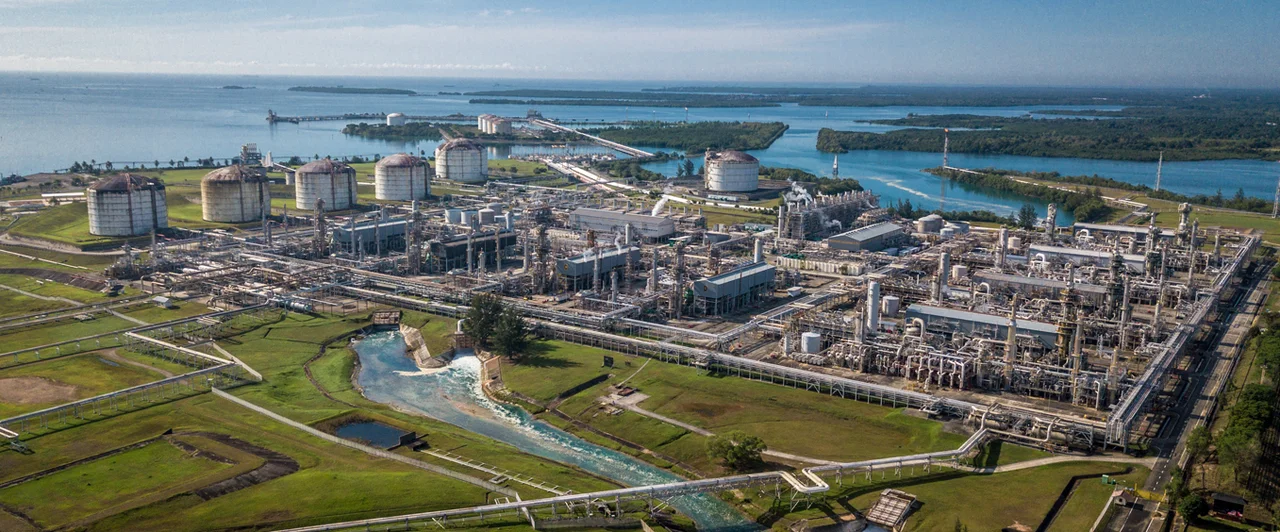

Badak LNG: Borneo's Gas Giant
On December 5, 1973, five Japanese energy companies signed a contract with an Indonesian consortium that most of the world had never heard of. The deal was audacious: Indonesia would liquefy vast quantities of natural gas from fields near the Mahakam River delta in East Kalimantan and ship it across the sea to Japan. At the time, only four LNG plants existed anywhere on Earth, each with barely three or four years of operating experience. Nobody involved had ever liquefied gas at industrial scale. What they built in the coastal city of Bontang became Badak LNG -- Indonesia's largest liquefied natural gas facility and one of the biggest on the planet, with eight processing trains capable of producing 22.5 million metric tonnes per year.
The Field That Started Everything
The word "Badak" comes from the Badak natural gas field, a cluster of reserves in the Samberah, Nilam, and Mutiara formations near Muara Badak in the Kutai Kartanegara Regency. The field sits near the Mahakam River delta, where Borneo's longest river empties into the Makassar Strait. Discovered in 1970 by Huffco -- an American oil and gas contractor working under a production-sharing contract with Pertamina, Indonesia's state oil company -- the field began producing natural gas and condensates by 1971. Its proven reserves amount to roughly seven trillion cubic feet, with daily production capacity around 500 million cubic feet. That single discovery transformed the swampy delta region from a backwater into one of Indonesia's most strategically important energy zones.
Building Without a Playbook
The LNG industry barely existed when Huffco and Pertamina decided to build a liquefaction plant in Bontang. Together with Mobil Oil, they needed to convince buyers that Indonesia could deliver a product only a handful of facilities worldwide had ever produced. The effort paid off with the 1973 contract, which secured commitments from Chubu Electric, Kansai Electric Power, Kyushu Electric Power, Nippon Steel, and Osaka Gas. Construction followed, and the plant grew over decades from its initial capacity into an eight-train complex connected to the gas fields by four parallel pipelines -- two measuring 36 inches in diameter and two at 42 inches. The scale of the infrastructure reflects the scale of the ambition: Badak LNG became a major contributor to Indonesia's GDP and to the economy of Bontang, a city whose identity is now inseparable from the gas industry.
From Pupil to Professor
Having spent decades learning the intricacies of gas liquefaction through trial and operational necessity, Badak LNG made an unusual pivot: it began teaching others. Through its Corporate Strategic Planning and Business Development division, the company now provides training, technical assistance, and refinery start-up support to LNG operators around the world. Its international client list reads like a map of the global gas frontier -- Angola LNG, Cameroon LNG, Mozambique LNG, Yemen LNG, and Dominion Cove Point in Maryland. Domestically, it advises Pertamina Gas, Tangguh LNG, and Donggi-Senoro LNG. The company also established the LNG Academy, converting its employee training facilities into an educational institution that collaborates with Indonesian universities including Brawijaya, Gadjah Mada, and the Bandung Institute of Technology.
A Company Town on the Equator
Bontang sits just north of the equator on Borneo's eastern coast, a city that owes its modern existence to the gas beneath the seafloor. Before the LNG plant, this stretch of coast was defined by fishing villages and dense tropical vegetation. The arrival of industrial-scale gas processing reshaped everything -- the economy, the demographics, the infrastructure. Badak LNG operates alongside the Kutai National Park to its north, creating one of the stranger geographic juxtapositions in Southeast Asia: one of the world's largest industrial gas facilities neighboring one of Borneo's most important rainforest reserves. The company maintains three labor unions representing its workforce, a detail that speaks to the plant's scale as an employer. More than eighty percent of the workforce belongs to SP-FPLB, the dominant union that negotiates collective labor agreements with management.
The Long Game
Fifty years into its operating life, Badak LNG occupies an unusual position in the global energy landscape. It is both a legacy facility -- one of the pioneers of an industry that now spans six continents -- and an active exporter still pushing gas through those original pipelines from the Mahakam delta fields. The company has reinvented itself as a knowledge exporter, leveraging half a century of hard-won operational expertise. Its partnerships with universities aim to build Indonesia's human capital in energy technology, a bet on the country's future as a gas producer even as the world's energy mix shifts. Whether viewed from the air as a bright industrial footprint on the dark green Borneo coast, or from the boardroom as a case study in resource-led development, Badak LNG remains one of the most consequential things ever built on the equator.
From the Air
Coordinates: 0.11N, 117.47E. The Badak LNG complex is visible on the coast south of Bontang, East Kalimantan. Look for the industrial waterfront with LNG tanker berths and storage tanks along the Makassar Strait. The Mahakam River delta spreads to the south. Nearby airports: WALL (Sultan Aji Muhammad Sulaiman Airport, Balikpapan), WALS (Samarinda International Airport). At altitude, the contrast between the industrial footprint and the adjacent Kutai National Park forest is striking. Best viewed at 5,000-10,000 ft for facility detail.
Nearby Stories
- The Bridge That Tried to Be Golden 31 km away
- Kutai: Where the Rainforest Holds the Line 37 km away
- Equally Low: Samarinda and the Mahakam 61 km away
- The Invisible Wall of Makassar Strait 73 km away
- Building a Capital From Scratch in the Borneo Rainforest 125 km away
- Martin B-10 171 km away
- Kakaban 205 km away
- Cutting the Orchid in Half: The Proposed Sulawesi Canal 210 km away