
Kutai: Where the Rainforest Holds the Line
The orangutan census of 2009 counted sixty individuals. Five years earlier, there had been six hundred. Somewhere in the lowland dipterocarp forest of Kutai National Park on Borneo's eastern coast, an entire population had apparently vanished. Then a more thorough survey in 2010 found over two thousand. The orangutans had not disappeared -- they had retreated deeper into a forest that keeps shrinking around them. That tension between abundance and loss defines Kutai, a 2,000-square-kilometer park straddling the equator in East Kalimantan, Indonesia, where some of the most biodiverse rainforest on Earth survives alongside logging scars, fire damage, and the steady encroachment of human settlement.
Eight of Nine
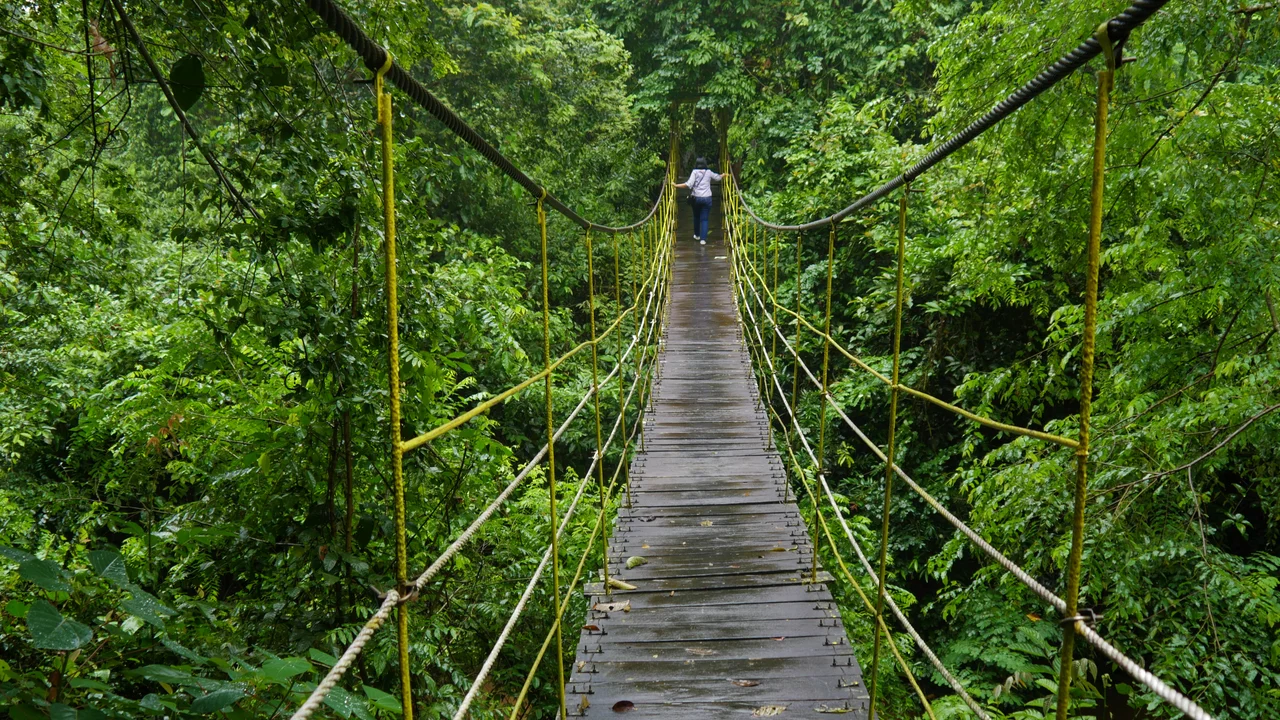
Kutai's botanical significance is almost absurd in its richness. The park harbors 958 species of flora, including eight of the world's nine genera of the Dipterocarpaceae family -- the towering hardwood trees that define Southeast Asian lowland rainforests. Forty-one species of orchids grow here, along with 220 species of medicinal plants. The forest types range from coastal mangroves along the Makassar Strait to freshwater swamp forests inland, with patches of kerangas -- the nutrient-poor heath forests that grow on white-sand soils. Walk the elevated boardwalk at Sangkima, one of the park's two tourist access points, and you pass through a cathedral of dipterocarp canopy that once sheltered some of the largest individual trees known in the park.
A Menagerie at the Equator
Ten species of primates call Kutai home, from the Bornean gibbon swinging through the upper canopy to the proboscis monkey -- that improbable, pot-bellied creature with its pendulous nose -- haunting the riverine forests. The park provides habitat for ninety species of mammals and three hundred species of birds. Malayan sun bears forage in the understory. Clouded leopards, rarely seen but confirmed through camera traps, patrol the forest floor alongside marbled cats and flat-headed cats. Banteng, the wild cattle of Southeast Asia, graze in clearings. Sambar deer move through the twilight zones where forest meets grassland. The smooth-coated otter works the rivers, and above it all, the black flying squirrel glides between emergent trees in the fading light.
Fire, Chainsaws, and Boundaries
Kutai's story is one of protection that arrived too late and has never been sufficient. The area was first designated as the Kutai Game Reserve in the 1970s, but that status failed to prevent loggers from clearing a third of the forest. The national park was formally established in 1982, an attempt to halt the bleeding. Within a year, the great Borneo fires of 1982-83 tore through large sections of the forest, erasing decades of growth in weeks. Along the eastern boundary, the pressure has never stopped. The park sits adjacent to the industrial city of Bontang and the coal-mining town of Sangatta, and the boundary between park and settlement blurs a little more each year. Today, approximately thirty percent of Kutai's original primary-growth forest remains. Traditional Bugis settlements dot the park's interior, communities that predate the conservation boundaries.
Two Ways In
Reaching Kutai requires commitment. The nearest major gateway is Samarinda International Airport, 120 kilometers to the south. From there, visitors choose between two access points that offer very different experiences. Sangkima lies along the road between Sangatta and Bontang, accessible by car or bus. It features aging national park buildings and a loop walking track with boardwalk sections threading through old-growth forest. Because the road runs right past it, Sangkima bears the heaviest pressure from encroachment -- the forest here is as much boundary marker as wilderness. Prevab, the second access point, demands more effort. You drive to Kabo Pier on the northern bank of the Sangatta River, then take a twenty-five-minute ride upriver in a ketinting, the narrow traditional boat that Kalimantan's river communities have used for generations. The remoteness pays off: the jungle here remains in far better condition, with less disturbance and a stronger sense of the forest as it once was across the entire park.
The Count That Matters
The orangutan numbers tell Kutai's story in miniature. The dramatic drop from six hundred to sixty between 2004 and 2009 made international headlines and reinforced the narrative of irreversible loss. But the 2010 survey's discovery of over two thousand individuals complicated that story. The apes had not been wiped out -- they had shifted deeper into the interior, away from the encroaching edges where earlier surveys had concentrated. It was a lesson in both the resilience of wild populations and the limits of human observation in dense tropical forest. Kutai remains one of the most important orangutan habitats on Borneo, but the forest they depend on continues to contract. Every hectare of primary dipterocarp forest that falls to logging or fire narrows the margin. The park holds the line, for now, in a part of the world where holding the line is never quite enough.
From the Air
Coordinates: 0.37N, 117.27E. The park spans the coast of East Kalimantan, visible as a green wedge between the industrial areas of Bontang to the south and Sangatta to the north. The Mahakam River lies south of the park. Nearest airport: WALS (Samarinda International Airport, formerly Sultan Aji Muhammad Sulaiman Sepinggan). At cruising altitude, look for the contrast between the dark green canopy of the park and the lighter patterns of cleared land at its edges. Best viewed at 10,000-15,000 ft to appreciate the park's extent and its proximity to coastal development.
Nearby Stories
- Badak LNG: Borneo's Gas Giant 25 km away
- Sangkulirang-Mangkalihat Karst 52 km away
- The Invisible Wall of Makassar Strait 120 km away
- Building a Capital From Scratch in the Borneo Rainforest 128 km away
- Kakaban 181 km away
- Cutting the Orchid in Half: The Proposed Sulawesi Canal 256 km away
- Oil, Empire, and the Fight for Borneo 306 km away
- The Unmapped Heart of Borneo 309 km away