
The Bridge That Tried to Be Golden
They wanted a Golden Gate Bridge in Borneo. When the Kutai Kartanegara Regency commissioned a suspension bridge across the Mahakam River in 1995, the design brief was explicit: make it look like San Francisco's icon. Six years and 150 billion rupiah later, a 710-meter span with soaring towers and sweeping cables connected the towns of Tenggarong and Tenggarong Seberang in East Kalimantan. For a decade, the Mahakam II Bridge -- as locals also called it -- served as the region's proudest piece of infrastructure. Then, on a Saturday afternoon in November 2011, the dream snapped along with its cables.
Ambition Over the Water
The bridge was conceived in the mid-1990s as more than a river crossing. Kutai Kartanegara Regency, rich with oil and coal revenue from the Mahakam delta, wanted a landmark. The 710-meter structure featured a 270-meter suspended central section, twin towers, and the signature profile of a suspension bridge designed to evoke one of the world's most recognizable spans. Construction began in 1995 and finished in 2001 at a cost of roughly US$16.4 million. The bridge connected Tenggarong, the regency's capital and former seat of the Kutai Kartanegara Sultanate, to Tenggarong Seberang on the opposite bank, while also serving traffic heading to the provincial capital of Samarinda. For the communities on either side of the Mahakam, it eliminated a time-consuming ferry crossing and became a symbol of the regency's ambition and modernity.
Forty Seconds of Collapse
November 26, 2011, around 4:20 in the afternoon. Maintenance workers were on the bridge when a support cable gave way. What followed was not a gradual sagging but a catastrophic chain reaction: the roadway tore free and plunged into the Mahakam River, fifty meters below. Vehicles, motorcycles, and pedestrians went down with it. Only the two bridge towers and fragments of cable remained standing above the water. At least twenty people died. Forty more were injured, and nineteen others were reported missing in the deep, murky current. Rescue teams struggled in the river's strong flow, and the final toll may never be precisely known. The collapse was the deadliest bridge failure in Indonesia in years, and it sent shockwaves through a country where infrastructure investment was accelerating rapidly.
Cast Iron and Blind Spots
Investigations revealed failures so fundamental that engineers called them basic errors. The proximate cause was the shear failure of cable band clamps -- the devices connecting the vertical hangers to the main suspension cable. These clamps had been manufactured from cast iron, a material that is brittle and sensitive to impact loading. Under the published engineering standards, the connecting hardware should have been stronger than the cables themselves. Instead, the clamps were the weakest link. Fatigue cracks had been accumulating for years, worsened by corrosion that nobody had adequately monitored. When maintenance workers disturbed the deteriorating system, it cascaded. A post-collapse analysis published in the Journal of Japan Society of Civil Engineers concluded that the design possibly deviated from civil engineering rules, a diplomatic way of saying the bridge was flawed from the start. Poor maintenance compounded the problem, but the seeds of disaster were planted in the original specifications.
A Different Kind of Bridge
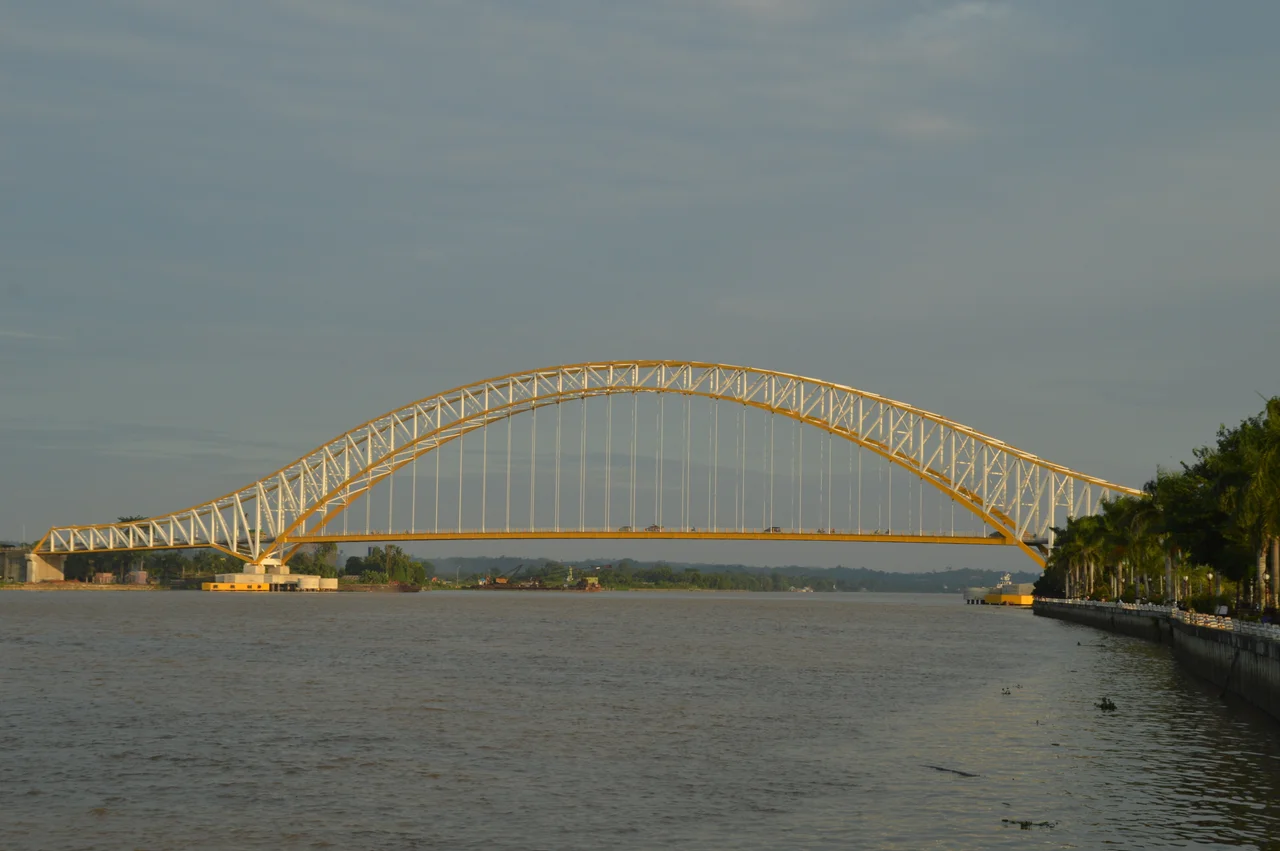
The replacement came without pretension. After three years of planning and eighteen months of construction, a new bridge opened on the same site in December 2015. This time the engineers chose an arch design -- structurally simpler, mechanically more forgiving, and carrying none of the suspension bridge's aesthetic ambitions. There would be no second attempt at recreating the Golden Gate. The new Kutai Kartanegara Bridge serves the same communities and carries the same traffic, but it does so quietly. A local regent presided over the opening ceremony, and the crossing resumed its role as utilitarian infrastructure connecting two sides of a river. The original bridge's towers, which had stood eerily above the water for years after the collapse, were dismantled. What remains is a crossing that works, and the memory of twenty lives lost to the gap between aspiration and engineering competence.
From the Air
The Kutai Kartanegara Bridge crosses the Mahakam River at approximately 0.44S, 117.00E, near Tenggarong. The bridge is visible from moderate altitudes as a river crossing point on the wide, brown Mahakam. Nearby airports include Sultan Aji Muhammad Sulaiman Airport (WALL) at Balikpapan, approximately 100 km to the south, and APT Pranoto Airport (WALS) at Samarinda, roughly 30 km to the east. Best viewed at 3,000-8,000 ft. The equatorial climate means frequent afternoon thunderstorms; morning approaches offer clearer conditions.
Nearby Stories
- The Mahakam: Borneo's River of Kingdoms and Dolphins 11 km away
- Badak LNG: Borneo's Gas Giant 33 km away
- Building a Capital From Scratch in the Borneo Rainforest 36 km away
- Kutai: Where the Rainforest Holds the Line 73 km away
- The Invisible Wall of Makassar Strait 94 km away
- Sixty Seconds Over Banjarmasin 222 km away
- Oil, Empire, and the Fight for Borneo 264 km away
- The Vanishing Green Heart of Borneo 315 km away