.jpg)
The Vanishing Green Heart of Borneo
In 2019, a team of climbers in Sabah's Danum Valley scrambled up a yellow meranti tree they had named Menara, the Malay word for tower. Their tape measure read 100.8 meters, confirming it as the tallest tropical tree ever recorded. The tree had grown slowly over centuries in a lowland dipterocarp forest that stretches, in diminishing patches, across 428,438 square kilometers of Borneo. That single tree tells the story of the entire ecoregion: staggering natural achievement, measured just in time, in a landscape where the clock is running out.
A Canopy Like No Other
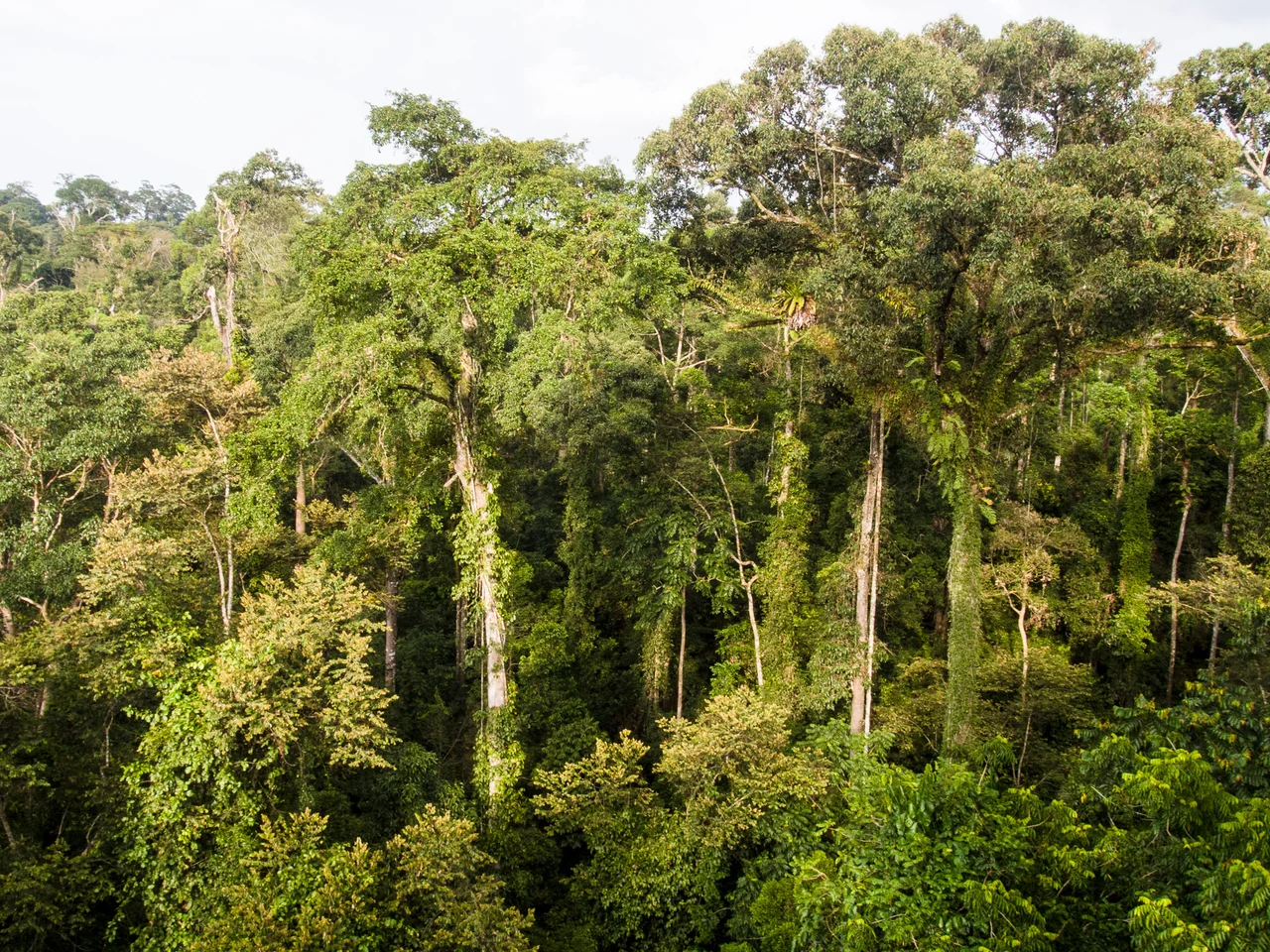
Borneo's lowland rain forests blanket roughly 57 percent of the island's land area, spanning everything below 1,000 meters of elevation across three nations: Indonesia, Malaysia, and Brunei. The forests are dominated by dipterocarps, a family of hardwood trees that grow taller here than anywhere else in the tropics. In Sabah, dipterocarps comprise up to 90 percent of the emergent canopy layer, their crowns forming a living ceiling 60 to 70 meters above the forest floor. Beneath that ceiling, some 15,000 plant species thrive, including roughly 2,000 species of orchids and 3,000 species of trees. Among the latter are 267 species of dipterocarps, 155 of which exist nowhere else on Earth. The sheer density of life per hectare makes these forests among the most biodiverse terrestrial ecosystems ever documented.
Where Giants Still Walk
The animal life matches the botanical extravagance. Bornean orangutans swing through the canopy, one of only three surviving great ape species in Asia. Below them roam Sumatran rhinoceroses, now critically endangered, and proboscis monkeys whose bulbous noses and pot bellies make them among the most recognizable primates on the planet. Twelve primate species inhabit these forests in total, including gibbons, langurs, tarsiers, and slow lorises. The scale ranges from the least pygmy squirrel, the world's smallest, to the Asian elephant, the continent's largest land mammal. Bornean bearded pigs root through the leaf litter, and 380 bird species fill the layered forest with calls that echo from the muddy floor to the sunlit emergent crowns. Each layer of the forest supports its own community, a vertical city of interdependent lives.
Fire, Palm Oil, and the Shrinking Map
The forests have been retreating for decades. In 1982 and 1983, massive fires swept through Kalimantan, the Indonesian portion of the island, clearing land that was subsequently planted with oil palm. The pattern repeated in 1997 and 1998, when El Nino-driven drought turned the forest into tinder. Between 2000 and 2018, roughly 39 percent of Borneo's tropical forests were converted to palm oil plantations. Today, only about half of the island's original forest cover remains, down from 75 percent in the mid-1980s. In 2001, the World Wildlife Foundation issued a warning that felt more like an obituary: if the trend continued, no lowland forests would remain by 2010. That deadline passed, and forests still stand, but barely. Only 6.267 percent of the ecoregion falls within protected areas, a sliver of shelter for a system that once covered the entire island below the mountains.
Fragments of Refuge
What remains is scattered across a patchwork of national parks and forest reserves. Tanjung Puting in Kalimantan protects orangutan habitat along blackwater rivers. Danum Valley in Sabah preserves some of the last primary lowland forest, its canopy unbroken and its trees unmeasured until satellite lidar revealed their record heights. Gunung Mulu in Sarawak shelters caves and karst landscapes alongside the lowland forest that surrounds them. Brunei's Ulu Temburong National Park, accessible only by longboat, remains one of the least disturbed tracts anywhere on the island. These protected areas represent the last best hope for a forest system that is 130 million years old, older than most mountain ranges, older than the flowering plants that now dominate it. Whether these fragments can sustain viable populations of orangutans, rhinoceroses, and elephants depends on decisions being made right now, in boardrooms and legislatures thousands of kilometers from the forest floor.
From the Air
Centered at approximately 2.00S, 114.00E over central Borneo. The lowland forests are visible from cruising altitude as dense green canopy stretching across the island below 1,000 meters elevation. Best observed from FL350 or above for the full extent of the ecoregion. Nearby airports include Balikpapan Sultan Aji Muhammad Sulaiman Airport (WALL), Banjarmasin Syamsudin Noor Airport (WAOO), Pontianak Supadio Airport (WIOO), and Kuching International Airport (WBGG). The contrast between intact forest and palm oil plantations is starkly visible from altitude, with geometric plantation grids abutting irregular natural canopy.
Nearby Stories
- The Night Kasongan Market Burned 22 km away
- The Million-Hectare Mistake 38 km away
- Sixty Seconds Over Banjarmasin 102 km away
- The River of Four Names 143 km away
- Oil, Empire, and the Fight for Borneo 196 km away
- Kyai Gede Mosque 236 km away
- Building a Capital From Scratch in the Borneo Rainforest 249 km away
- Betung Kerihun National Park 332 km away