.jpg)
The Night Kasongan Market Burned
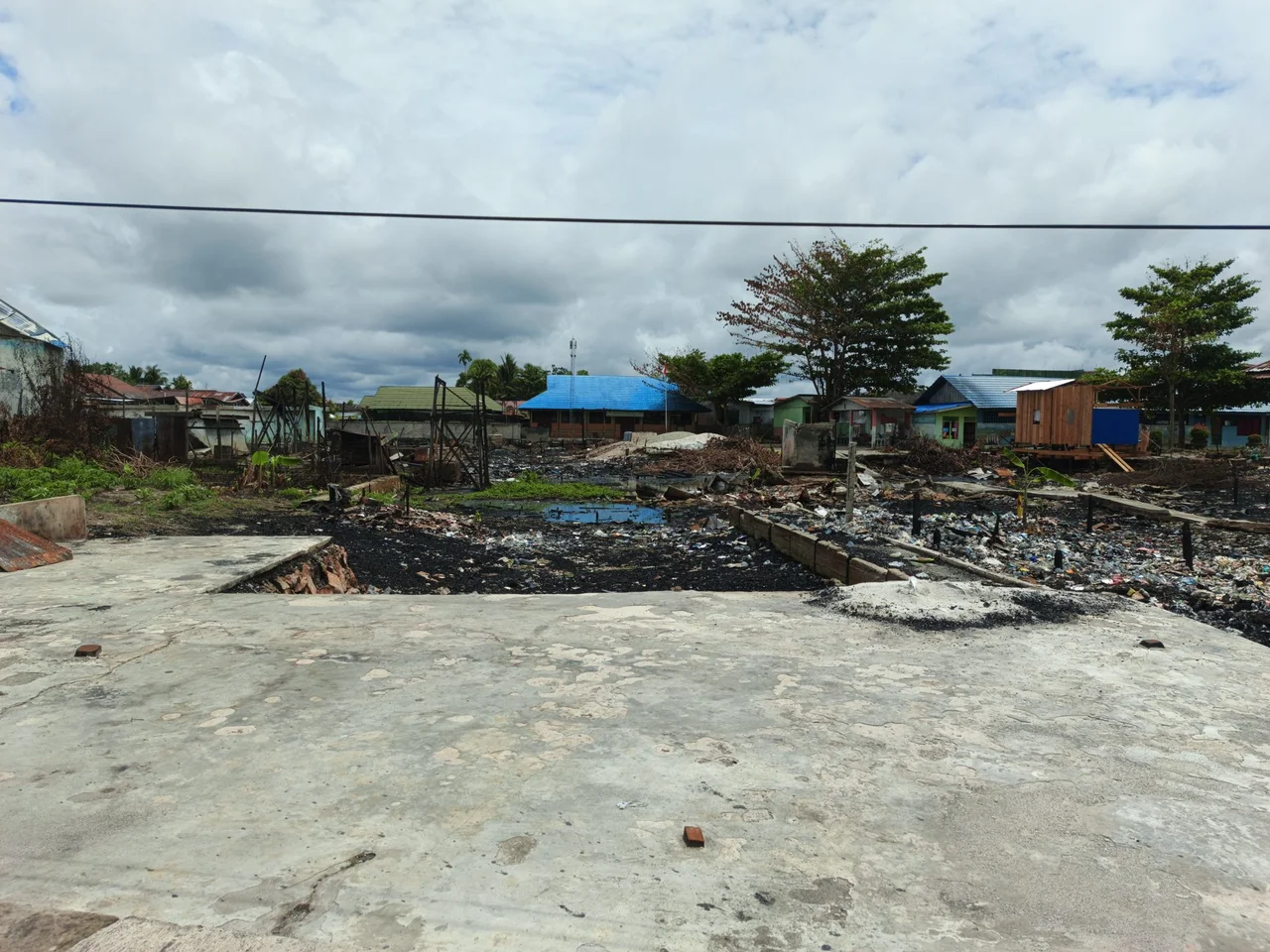
It started behind a food stall. On the evening of January 25, 2026, somewhere in the narrow lanes behind Jalan Bungai in Kasongan Lama village, an electrical short circuit -- at least, that is what investigators would later suspect -- sparked a fire that found exactly the conditions it needed to become a catastrophe. The Kasongan Market complex in Katingan Regency, Central Kalimantan, was a dense weave of timber-framed houses, kiosks, and shop-houses built close enough to share walls, close enough to share flames. By the time the fire was out, seven hours later, at least 17 buildings had been destroyed, two schools had been gutted, and 374 people had lost their homes, their livelihoods, or both.
Timber, Wind, and Seven Hours
The Kasongan Market area sits where commerce and community overlap entirely. Like many traditional trading hubs across Kalimantan, its buildings are constructed primarily from timber and semi-permanent materials -- practical, affordable, and catastrophically flammable. Structures crowd together, separated by alleys rather than firebreaks. When the fire ignited at approximately 9:00 PM Western Indonesia Time, strong winds pushed the flames from building to building faster than anyone could respond. The blaze was first reported between 9:00 and 10:21 PM. Within minutes, the fire had jumped from the food stall to neighboring kiosks and residences. Firefighting crews from the Katingan Regency Fire Department arrived first, but the intensity of the blaze quickly exceeded local capacity. Reinforcements came from Palangka Raya, the provincial capital, along with teams from the Central Kalimantan Provincial Forestry Service and the regional disaster management agency. Volunteers and private fire brigades joined the effort. Together, deploying water tankers carrying up to 5,000 liters and portable firefighting equipment, they fought to contain the fire until it was brought under control around 1:00 AM on January 26.
What the Fire Took
The damage extended far beyond market stalls. Among the 15 to 17 buildings destroyed were residential homes where families had lived for years, shop-houses where merchants stored their entire inventory, and two educational institutions: Al Badar State Islamic Primary School and Al Badar Islamic Junior High School. The schools' destruction rippled outward immediately -- 301 students suddenly had nowhere to learn. No one died. No serious injuries were reported. That fact, given the fire's intensity and the density of the neighborhood, feels less like luck than like the desperate effectiveness of people who know how to run. But survival is not the same as escaping unscathed. The 374 people displaced by the fire lost possessions, shelter, and the daily routines that held their lives together. Material losses were described as substantial, though precise figures were still being calculated in the days that followed.
The Morning After
By Monday morning, the Katingan Regency disaster management agency had erected emergency tents and relief posts near the burn site. Government officials began the grim administrative work of cataloging who had lost what. Some displaced families moved in with relatives or friends; others had no such option and stayed in the temporary shelters. The smoldering debris was not finished. On Monday night, hotspots reignited from smoldering wreckage, and firefighters returned for additional cooling operations. The persistence of hidden embers in timber structures is a well-known hazard -- fires in traditional markets across Indonesia routinely reignite days after the visible flames are gone. For the students of the two Al Badar schools, the disruption was immediate and concrete. Local authorities, school administrators, and the educational foundation coordinated to set up temporary classrooms in nearby public facilities and other schools in Kasongan, ensuring that learning could resume even as the rubble was still being cleared.
Investigating the Ashes
The Katingan Regional Police cordoned off the site and opened a formal investigation. Preliminary assessments pointed to an electrical short circuit as the likely cause -- a familiar culprit in Indonesian market fires, where aging wiring runs through timber-framed buildings without modern circuit protection. To confirm the origin and exact cause, the Indonesian National Police Forensic Laboratory Center from Banjarmasin deployed investigators to examine electrical wiring remains, electricity meters, and structural debris. The investigation represented a larger pattern. Indonesia's traditional markets are vital community institutions -- centers of commerce, social life, and cultural identity -- but many operate in physical infrastructure that has not kept pace with electrical demand. The Kasongan fire drew coverage beyond Indonesia's borders; a global disaster monitoring account on the social media platform X posted footage of the blaze that attracted significant international attention. For the people of Kasongan Lama, however, the fire was not a viral moment. It was the night they watched their neighborhood disappear.
From the Air
Coordinates: 1.91S, 113.39E, in the lowland interior of Central Kalimantan along the Katingan River. The market area sits in the small town of Kasongan, the regency capital. Nearest significant airport: Tjilik Riwut Airport, Palangka Raya (WRBI/PKY), approximately 130 km to the east. The surrounding terrain is flat riverine lowland with extensive peat swamp forest. From altitude, look for the Katingan River's winding course through the landscape -- the town sits on its banks.
Nearby Stories
- The Great Dayak River 11 km away
- Borneo's Dayak Heartland 16 km away
- The Vanishing Green Heart of Borneo 20 km away
- Borneo Orangutan Survival 49 km away
- Kyai Gede Mosque 162 km away
- Oil, Empire, and the Fight for Borneo 176 km away
- Fort Alice 350 km away
- Kapuas River 375 km away