
The Butterfly Kingdom of Sulawesi
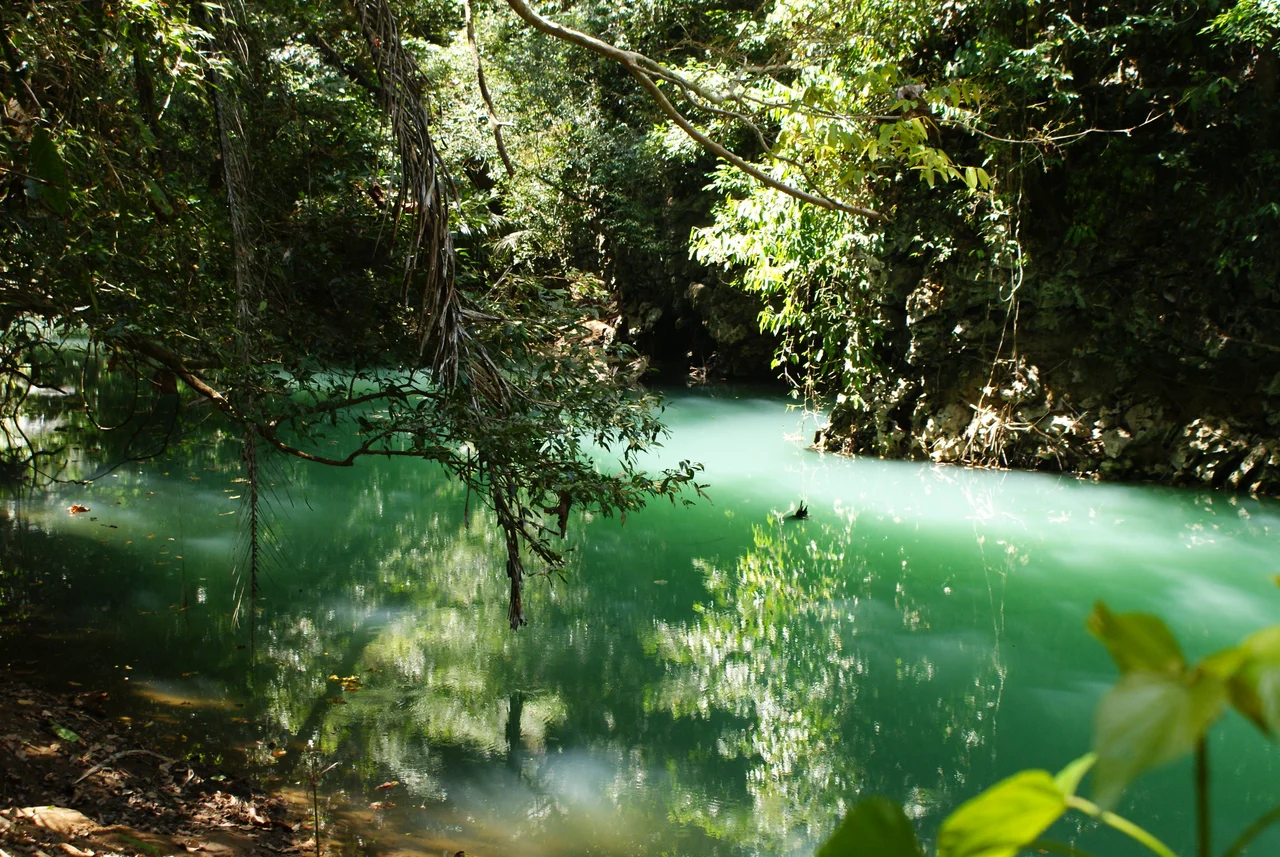
Alfred Russel Wallace arrived in Bantimurung in July 1857 and found himself in what he would later call a butterfly kingdom. Clouds of swallowtails and birdwings drifted through the humid air above a river that plunged over limestone ledges into deep green pools. The karst towers rose nearly vertical on both sides, their walls pocked with caves that held paintings older than any civilization. Wallace spent three months here, cataloging 256 butterfly species and filling crates with specimens that would help him develop the theory of evolution by natural selection -- independently of Darwin, and an ocean away from Victorian England.
Towers of Dissolved Time
The Maros-Pangkep karst system that forms the backbone of Bantimurung-Bulusaraung National Park is the second largest in the world, trailing only the karst formations of southeastern China. Across 43,750 hectares, limestone towers rise at near-vertical angles from rice paddies and jungle, their surfaces sculpted by millions of years of tropical rainfall dissolving calcium carbonate grain by grain. Within these towers lie 286 documented caves. Thirty-three of them are prehistoric, their walls bearing hand stencils and paintings left by people who sheltered here tens of thousands of years before the first Austronesian farmers arrived by sea. Two caves flanking the park's famous waterfall have earned their own names: the Dream Cave, a kilometer-long passage of dripping stalactites, and the Stone Cave on the opposite bank. Children ride inflated inner tubes through the pools below, their laughter echoing off walls that predate human memory.
Wallace's Laboratory
When Wallace published The Malay Archipelago in 1869, he drew the world's attention to this corner of Sulawesi. Researchers followed, and by the late twentieth century the conservation significance of the karst was undeniable. In 1993, the International Union of Speleology Congress recommended Maros-Pangkep Karst for world heritage status. IUCN and UNESCO weighed in during a 2001 forum in Sarawak, Malaysia, pressing the Indonesian government to act. Three years later, in 2004, the Ministry of Forestry consolidated wildlife sanctuaries, nature parks, and production forests into a single protected area: Bantimurung-Bulusaraung National Park. The designation brought together landscapes that had been managed piecemeal since the 1970s -- the nature parks of Bantimurung and Gua Pattunuang, and the wildlife sanctuaries of Bantimurung, Karaenta, and Bulusaraung -- into one contiguous conservation zone just fifty kilometers north of Makassar.
Creatures Between Two Worlds
Sulawesi sits in the biogeographic transition zone between Asia and Australia, a position that has blessed Bantimurung-Bulusaraung with an astonishing roster of endemic species. The dark-furred Sulawesi moor macaque moves through the canopy in troops, while the red-knobbed hornbill announces itself with a resonant call that carries across the karst valleys. Cuscus -- marsupials more commonly associated with New Guinea -- cling to branches in the upper story. The Sulawesi palm civet, one of the rarest carnivores in Southeast Asia, hunts the forest floor at night. In 2008, park staff documented the elusive Tarsius fuscus, a tiny primate with enormous amber eyes, and located its nest deep within the reserve. Perhaps the strangest resident is Cancrocaeca xenomorpha, a blind freshwater crab found nowhere on Earth except the subterranean streams of the Maros karst caves -- a creature so alien that its species name borrows from science fiction.
Wings Under Pressure
Wallace counted 256 butterfly species during his three months at Bantimurung. A 1977 survey by the researcher Mattimu found 103 species within the park boundaries, including endemics such as Papilio blumei, with its electric-green wing patches, and Graphium androcles, the largest swordtail butterfly in the world. The golden birdwing Troides helena and the iridescent Troides haliphron still drift near the waterfall, but their numbers tell a story of decline. Since the 1970s, Bantimurung has been a commercial source of butterflies, with specimens sold as framed souvenirs, key chains, and loose specimens to both domestic and international buyers. By 2010, 600,000 tourists visited annually, mostly Indonesian families drawn by the waterfall and the spectacle of the butterflies themselves. Park management shifted the conservatory's mission from extraction to preservation, but enforcement remains difficult. Sellers still catch butterflies inside the park and sell them to local dealers rather than breeding them. Several species have been listed as conservation priorities in the Indonesian government's National Species Conservation Strategic Directions.
Above the Karst
From the air, the karst towers of Bantimurung-Bulusaraung appear as a dense, dark-green labyrinth interrupting the orderly geometry of lowland rice paddies. The park lies just twenty kilometers from Sultan Hasanuddin International Airport, making the transition from modern Makassar to primeval limestone almost absurdly quick. The towers cast long shadows in the low equatorial light, and on clear mornings the waterfall's mist catches the sun in brief rainbows visible even from altitude. Mount Bulusaraung, the park's highest point, rises above the canopy to the east. What Wallace saw from the jungle floor -- butterflies threading between towers older than any dynasty -- remains visible today, though the kingdom is smaller than it was, and its subjects fewer.
From the Air
Coordinates: 4.90S, 119.75E. The park lies 20 km from Sultan Hasanuddin International Airport (WAAA/UPG), Makassar. Karst towers are visible from 5,000-10,000 ft as a dramatic dark-green labyrinth contrasting with surrounding rice paddies. Bantimurung waterfall may be visible as a white streak on the limestone face in clear conditions. Mount Bulusaraung rises to approximately 1,353 m (4,439 ft) to the east of the karst field.
Nearby Stories
- The Three Summits Pact 11 km away
- The Village That Said No to the Modern World 29 km away
- Kingdom of Tallo: Two Kings, One People 30 km away
- The Script That Grew on Palm Leaves 33 km away
- The Ninety Minutes of MV Marina Baru 2B 127 km away
- The Five Minutes That Swallowed the Teratai Prima 132 km away
- Two Minutes of Distraction 172 km away
- Isuzu: The Cruiser That Refused to Sink 304 km away