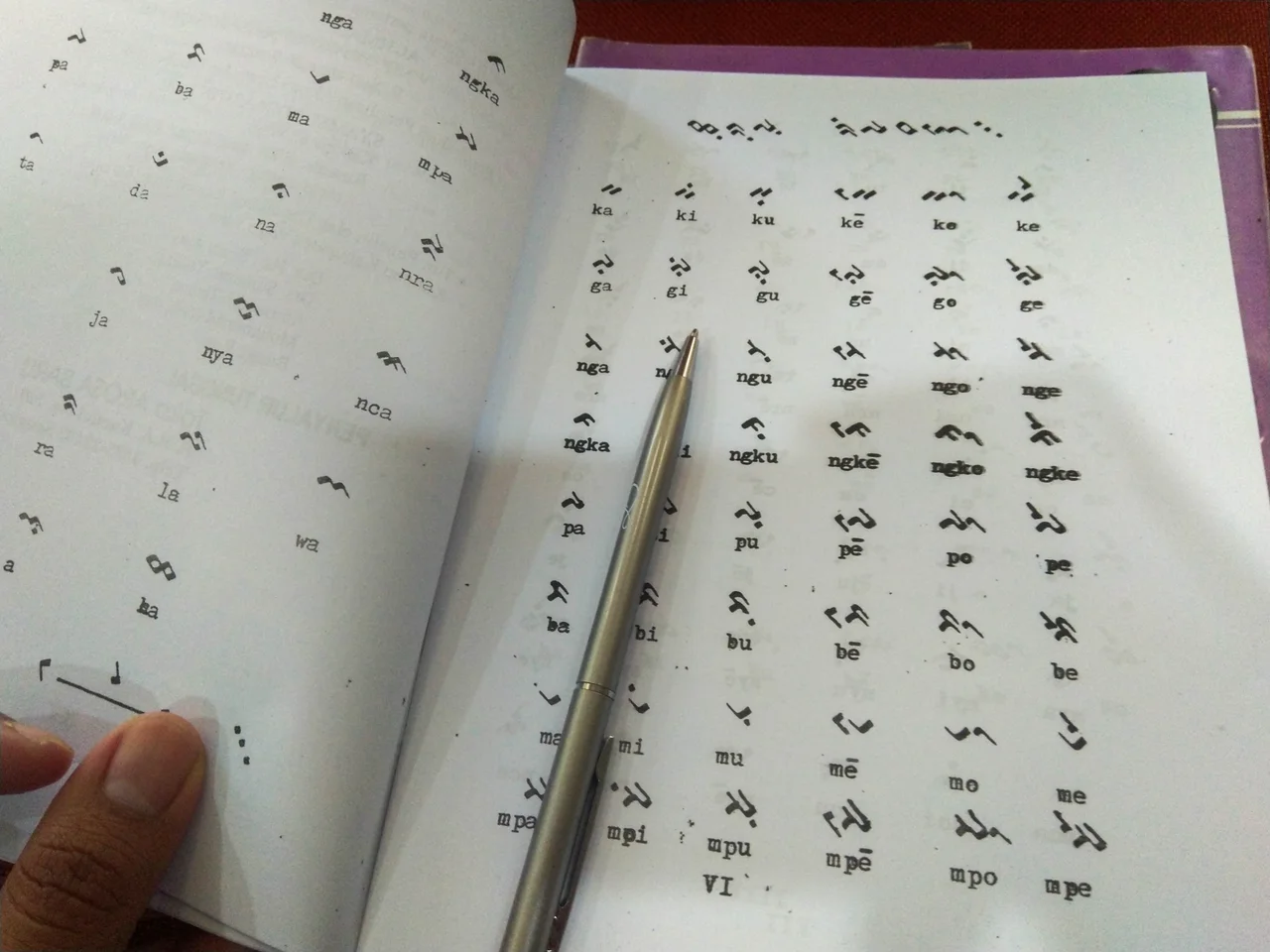

The Script That Grew on Palm Leaves
The Sureq Galigo runs to roughly 6,000 pages. Written in the curving Lontara script of the Bugis people, this epic creation myth is among the longest literary works ever composed -- rivaling the Mahabharata in sheer volume. Yet for centuries, its language remained almost entirely unknown to the outside world. Buginese, spoken today by some four million people across South Sulawesi and scattered diaspora communities from Java to the Philippines, carries within its grammar and glyphs the history of kingdoms, sea voyages, and a civilization that Europeans did not encounter until the 19th century.
Ink on Palmyra Leaves
The Buginese writing system takes its name from an unlikely source: a tree. Lontara derives from the Malay word for the palmyra palm, whose broad, durable leaves served as the traditional writing surface across South and Southeast Asia. The script belongs to the Brahmic family, sharing distant ancestry with the writing systems of India, but the Buginese version developed its own distinctive character. Unlike most Brahmic scripts, it traditionally lacked any way to suppress the inherent vowel built into each consonant, making it impossible to write consonant clusters or final consonants cleanly. Writers worked within these constraints for centuries, producing historical chronicles that historians of Indonesia have described as remarkably "sober" and "factual" -- their authors even inserting disclaimers before stating anything they could not personally verify. In an era of mythologized royal histories across Maritime Southeast Asia, the Bugis preference for unembellished truth stands out.
Kingdoms and Crosswinds
The Bugis people have never been content to stay in one place. Their homeland lies in South Sulawesi, centered around the old kingdoms of Bone, Wajo, Soppeng, and Sidenreng -- political entities that shaped the language into distinct dialects still recognizable today. Linguists have identified eleven major dialects, most with two or more sub-dialects, mapping closely onto these precolonial boundaries. But from the 17th century onward, continuous warfare and political upheaval drove waves of Bugis outward across the archipelago. Small Buginese-speaking communities took root on Java, in eastern Sumatra, in the Malaysian state of Sabah, on the Malay Peninsula, and in the southern Philippines. This diaspora carried the language far beyond Sulawesi's shores, turning Buginese into a thread connecting port cities and fishing villages across thousands of kilometers of open water.
A Missionary's Dictionary
Before the Dutch colonial administration arrived in force in the early 20th century, a Scottish missionary named B. F. Matthews accomplished something no European had managed before: he learned Buginese. Matthews went further, translating the Bible into the language and compiling dictionaries and grammar books that remain foundational references to this day. He also mastered the closely related Makassarese language, and the folklore texts and literature he published opened a window into Bugis culture for the wider world. His work was not merely academic. By documenting a language that had existed primarily in oral tradition and palm-leaf manuscripts, Matthews created a bridge between two ways of knowing -- the Lontara chronicles kept by Bugis scribes for their own purposes, and the Latin-script scholarship that would eventually become the dominant medium for writing Buginese itself.
Six Vowels and a Glottal Stop
Buginese is an Austronesian language belonging to the South Sulawesi subgroup, most closely related to Campalagian and the Tamanic languages of West Kalimantan. Its phonology features six vowels, including a central vowel, and a system of consonants that includes prenasalized stops -- sounds where a nasal consonant blends into the following stop, producing combinations that can be difficult for non-native speakers to distinguish. The glottal stop plays a quiet but important role, often represented in Latin script by an apostrophe, as in ana' for "child." Today, most Buginese is written in Latin letters following standard Indonesian spelling conventions, though the Lontara script survives in cultural and ceremonial contexts. A Buginese poem even adorns a wall in Leiden, Netherlands, near the Royal Netherlands Institute of Southeast Asian and Caribbean Studies -- a fragment of Sulawesi inscribed on European brick, thousands of miles from the palm groves where the script was born.
From the Air
Coordinates: 4.47S, 119.98E, in the heart of South Sulawesi, Indonesia. From cruising altitude, the southwestern peninsula of Sulawesi is visible with its distinctive shape. The modern capital Watampone (the old Bone kingdom center) lies along the coast to the east. Nearest major airport is Sultan Hasanuddin International Airport (WAAA) in Makassar, approximately 130 km to the southwest. The terrain below is a mix of lowland rice paddies and forested hills, with the Makassar Strait visible to the west.
Nearby Stories
- The Forest People Who Vanished 14 km away
- Kingdom of Tallo: Two Kings, One People 43 km away
- The Ninety Minutes of MV Marina Baru 2B 51 km away
- South Sulawesi: Where Kingdoms Built Ships and Honor Demanded Blood 53 km away
- Where a Soccer Field Became a Cathedral of Faith 73 km away
- The Five Minutes That Swallowed the Teratai Prima 119 km away
- Sulawesi's Hidden Wetland: Rawa Aopa Watumohai 155 km away
- Coral Over the Sands 224 km away