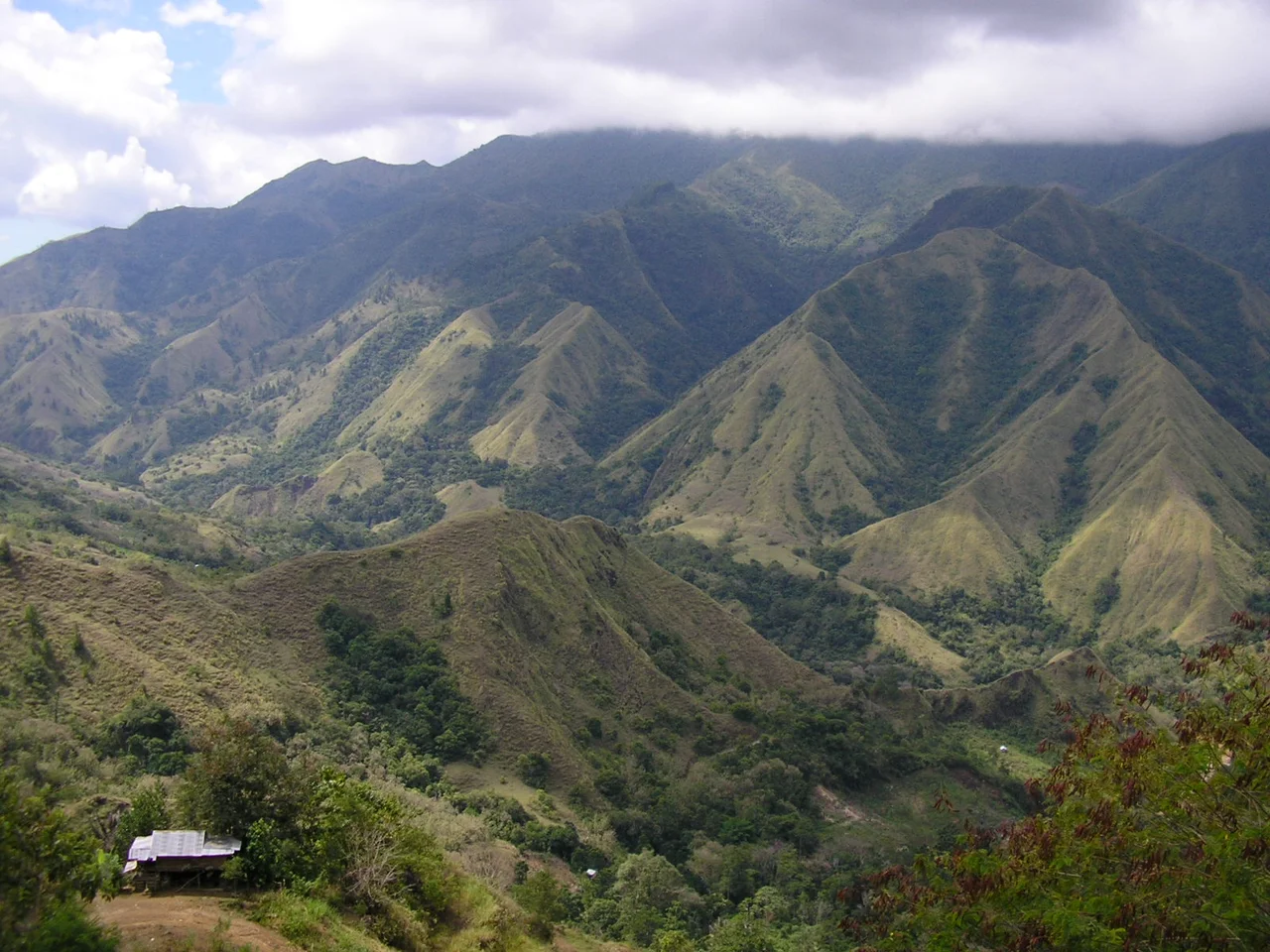

South Sulawesi: Where Kingdoms Built Ships and Honor Demanded Blood
The Bugis would rather die than live without siri'. That single word, which translates loosely as honor, shame, and self-respect rolled into one, has shaped South Sulawesi more than any colonial treaty or administrative boundary ever could. This province at the southern tip of Sulawesi island is home to nearly 9.5 million people spread across a peninsula where cave paintings date back 40,000 years, where rival kingdoms once fought for control of the spice trade, and where wooden sailing ships called pinisi still carry cargo between islands just as they have for centuries. The capital, Makassar, sits on the western coast facing the strait that bears its name, but the real story of South Sulawesi unfolds in the tension between its peoples -- Buginese, Makassarese, and Torajan -- whose distinct cultures have clashed and intertwined across a landscape of rice paddies, limestone caves, and open sea.
Handprints in the Limestone
Some 30 kilometers northeast of Makassar, the limestone hills around Maros hide one of humanity's oldest artistic achievements. Inside the Pettakere cave, handprint paintings estimated at 35,000 to 40,000 years old mark the walls -- among the earliest known examples of figurative art anywhere on Earth. In the river terraces of the Walanae valley, between Soppeng and Sengkang, stone tools lie scattered among the fossilized bones of giant pigs and elephants that once roamed the peninsula. These earliest inhabitants left only traces, but their successors built civilizations. By the 14th century, rising demand for South Sulawesi's rice drove agricultural expansion from shifting cultivation to intensive wet-rice farming. Population density climbed. Forests fell. And from the cleared interior, new political powers emerged: the Bugis chiefdoms of Bone and Wajoq in the east, and the Makassar kingdom of Gowa in the west.
The Spice Gate Wars
The contest between these kingdoms would define South Sulawesi for centuries. By the early 1500s, Bone dominated the eastern peninsula while the twin kingdoms of Gowa and Talloq expanded westward. Their collision came in the 1560s. In 1582, three Bugis states -- Bone, Soppeng, and Wajoq -- signed the Treaty of Timurung, a mutual defense pact called the Tellumpocco, or "Three Peaks." They repelled Gowa's campaigns in 1582, 1585, and 1588. But by the early 1600s, Gowa and Talloq had embraced Islam and international commerce, and their power became irresistible. Soppeng fell in 1609, Wajoq in 1610, Bone in 1611. When the Dutch East India Company arrived, they saw Gowa as the obstacle standing between them and control of the spice routes to the Maluku Islands. The VOC allied with the exiled Bugis prince Arung Palakka, and together they broke Gowa's power. Sultan Hasanuddin signed the humiliating Treaty of Bungaya, and Palakka became South Sulawesi's new ruler -- under Dutch supervision.
The Ships That Still Sail
Walk along certain waterfronts in South Sulawesi and you might think the centuries have reversed themselves. The pinisi -- a two-masted wooden sailing ship built primarily by the Konjo people, a sub-ethnic group of the Makassarese -- still plies the waters of the Indonesian archipelago. These vessels stretch 20 to 35 meters long and can displace up to 350 tons. Their hulls resemble dhows, but the rigging follows its own logic: the mainsail reefs toward the mast like a curtain rather than lowering with the gaff, which doubles as a deck crane in harbor. The lower mast often takes the form of a tripod. Buginese and Makassarese sailors use pinisi for cargo runs, fishing, and inter-island transport -- a living tradition in an age of container ships and GPS navigation. The sight of one under full sail, cutting across the Makassar Strait with masts rising 30 meters above the deck, connects the present to the centuries when South Sulawesi's maritime culture rivaled any in Southeast Asia.
Siri' Na Pacce: The Code That Cuts Both Ways
The Bugis-Makassar cultural philosophy of siri' na pacce governs far more than personal conduct. Siri' encompasses honor, dignity, and shame; pacce means shared suffering and solidarity. Together they form a moral framework so central that to live without siri' is considered worse than being an animal. If someone's honor is violated -- a state called siri' nipakasiri -- that person or their family must act to restore it, or be considered mate siri': dead in status and dignity. The Bugis-Makassar would traditionally rather die than accept such a fate. Yet siri' also drives achievement. Siri' masiri is the aspiration to maintain and improve one's standing through honest effort and hard work. This duality -- honor as both a burden and a spur -- runs through South Sulawesi's history of fierce resistance to colonial rule, which persisted until 1905, and through its present-day culture, where the badik, a distinctive asymmetric knife, is still worn daily as a symbol of identity.
A Province of Many Tongues
South Sulawesi's diversity announces itself in sound. Buginese, spoken by around 5 million people, dominates a wide band from Pinrang in the northwest to Bulukumba in the southeast, making it one of Sulawesi's most widely spoken languages. Makassarese claims 2.1 million speakers in the southwestern coastal areas. In the highlands, the Toraja language serves over 800,000 speakers in a region so culturally distinct that Indonesia designated Tana Toraja its second-most-important tourist destination after Bali in 1984. The Torajan people, numbering roughly one million, are famous for their elaborate funeral ceremonies -- multi-day social events attended by hundreds -- and their tongkonan houses, whose soaring saddleback roofs evoke the shape of boats. In original Toraja society, only nobles had the right to build tongkonan; commoners lived in simpler homes called banua. Today, rice paddies, traditional dances, and the aroma of Sulawesi's catch -- milkfish, grouper, shrimp, and crab -- tie these communities together across their linguistic borders.
From the Air
Centered at approximately 3.75°S, 120.0°E. The province occupies the southern peninsula of Sulawesi island. Makassar (Sultan Hasanuddin International Airport, ICAO: WAAA) is the main gateway on the western coast. Approaching from the west over Makassar Strait, the peninsula's distinctive shape is unmistakable. The limestone karst formations near Maros are visible northeast of the city. Inland, the terrain rises toward the Toraja highlands in the north. The Gulf of Bone separates the peninsula's eastern coast from Southeast Sulawesi. Best viewed at 15,000-25,000 feet for provincial scale, or lower over the Maros karst towers.
Nearby Stories
- The Ninety Minutes of MV Marina Baru 2B 7.2 km away
- The Shortcut That Wasn't 9.5 km away
- The Script That Grew on Palm Leaves 48 km away
- The Drum of God 64 km away
- The Five Minutes That Swallowed the Teratai Prima 91 km away
- Kingdom of Tallo: Two Kings, One People 120 km away
- Wallace's Dreampond: Lake Towuti and Its Living Archive 134 km away
- Sulawesi's Hidden Wetland: Rawa Aopa Watumohai 160 km away