
Where a Soccer Field Became a Cathedral of Faith
The land where 10,000 worshipers now gather for Friday prayers was, not so long ago, a soccer field. The Exelsior Makassar pitch -- 13,912 square meters of colonial-era sporting ground -- was handed over for a purpose that had nothing to do with goals and everything to do with independence. In 1947, as Indonesia fought to solidify the sovereignty it had declared two years earlier, a scholar from Bone Regency named K.H. Ahmad Bone looked at that empty field in the heart of Makassar and saw something else entirely: the foundation for the main mosque of South Sulawesi.
Born from Independence
K.H. Ahmad Bone appointed K.H. Muchtar Lutfi to chair the construction committee, and architect Muhammad Soebardjo won the design competition that would shape the building's first incarnation. Construction began on May 25, 1949, just four years after Indonesia proclaimed independence from the Dutch. The total cost came to 1.2 million rupiah -- a modest sum that reflected both the young nation's limited resources and the community's determination to build something meaningful. The mosque rose on Bulusaraung Street, drawing roughly 80 percent of its building materials from local sources. It was not merely a place of worship. In a city still shaking off centuries of colonial rule, the mosque became a declaration: Makassar would define itself on its own terms.
Presidents at Prayer
The Grand Mosque quickly became a landmark that drew national attention. In 1955, it hosted the first-ever Musabaqah Tilawatil Quran festival -- a Quran recitation competition that would grow into one of Indonesia's most cherished cultural events. Two years later, Sukarno, the nation's founding president, stopped in Makassar and performed Friday prayers at the mosque. A decade after that, in 1967, President Soeharto followed suit. These were not merely ceremonial visits. In a sprawling archipelago of more than 17,000 islands, a president choosing your mosque for Friday prayers signaled that your city mattered, that your community had weight in the national story. The mosque became, as Makassarese often describe it, a source of civic pride -- a building that represented not just faith but the city's stature.
The Great Transformation
By the late 1990s, the original structure -- functional but modest -- no longer matched the ambitions of a city that had grown into one of eastern Indonesia's most important urban centers. Vice President Jusuf Kalla, a native of Makassar, championed a massive renovation that would reinvent the mosque from the ground up. Not everyone embraced the idea. Concerns arose that a nearby plaza development might turn the sacred site into a commercial venture, swallowing the mosque's identity in a wave of retail construction. Those fears eased as the renovation took shape. Governor Zainal Basri Palaguna broke ground on October 9, 1999, and the overhaul stretched until 2005 -- six years of construction that transformed the building's character entirely.
Twin Minarets Over the Strait
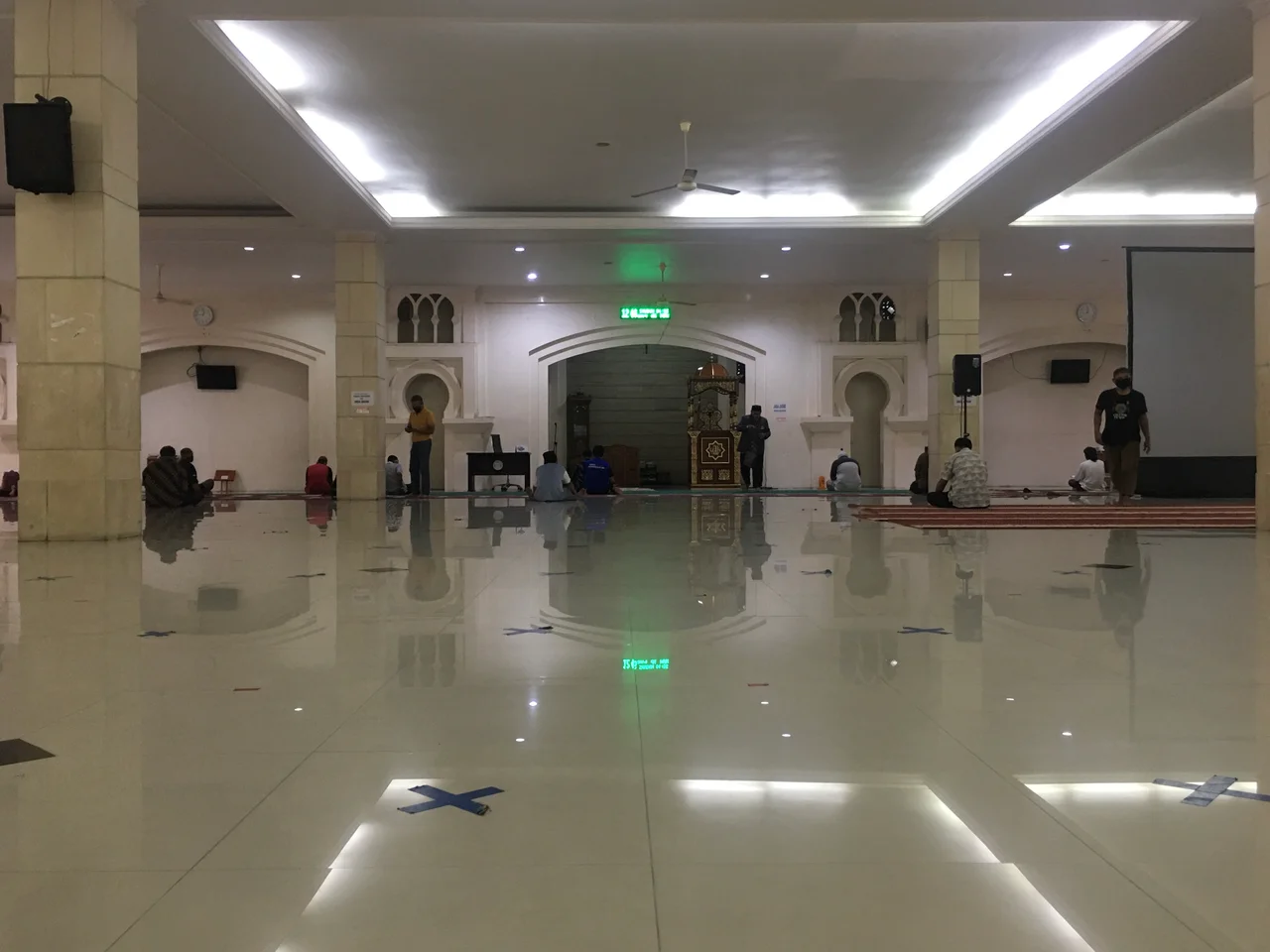
The renovated mosque is a different building from the one Soebardjo designed in 1949. Two minarets now rise 66.66 meters above Bulusaraung Street, their height a deliberate echo of Islamic numerology. The design shifted from its original Indonesian vernacular toward a style that blends Middle Eastern mosque architecture with Mediterranean touches -- arches, domes, and a scale that announces the building from a considerable distance. Inside, the two-story prayer hall accommodates up to 10,000 worshipers, making it one of the largest mosques in Southeast Asia. Adjacent facilities include a library and the South Sulawesi chapter office of the Indonesian Ulema Council. Among the mosque's most distinctive features is a giant handwritten Quran, measuring 1 by 1.5 meters and weighing 584 kilograms, crafted by KH Ahmad Faqih from Wonosobo in Central Java.
A City's Anchor
Makassar is a port city that has reinvented itself repeatedly -- from the seat of the Gowa Sultanate to a Dutch colonial outpost, from a Japanese-occupied staging ground to the capital of modern South Sulawesi. Through each transformation, the Grand Mosque has served as a fixed point, an institution older than the Indonesian republic's own settled governance. The soccer field is long gone, but the impulse that built over it endures. Every Friday, the call to prayer from those 66-meter minarets carries across the rooftops of a city of nearly two million, reaching toward the Makassar Strait. The mosque remains what K.H. Ahmad Bone envisioned when he looked at an empty pitch in 1947: not just a building, but a statement about what a community values enough to build first.
From the Air
Located at 5.13S, 119.42E in central Makassar, South Sulawesi. The twin 66.66-meter minarets are visible landmarks from the air. Sultan Hasanuddin International Airport (WAAA) lies approximately 20 km to the southeast. The mosque sits near the waterfront, roughly 7 km south of Makassar's main port. Best viewed at 3,000-5,000 feet on approach from the Makassar Strait to the west. The city's grid layout makes the mosque's prominent minarets easy to spot against the surrounding low-rise neighborhoods.
Nearby Stories
- The Forest People Who Vanished 18 km away
- The Morning After the Strongman 24 km away
- Four Sails in the Selayar Strait 40 km away
- The Oldest Paintings on Earth 43 km away
- The Bird Letters of Sulawesi 57 km away
- Two Minutes of Distraction 157 km away
- The Five Minutes That Swallowed the Teratai Prima 193 km away
- Isuzu: The Cruiser That Refused to Sink 254 km away