.jpg)
Four Sails in the Selayar Strait
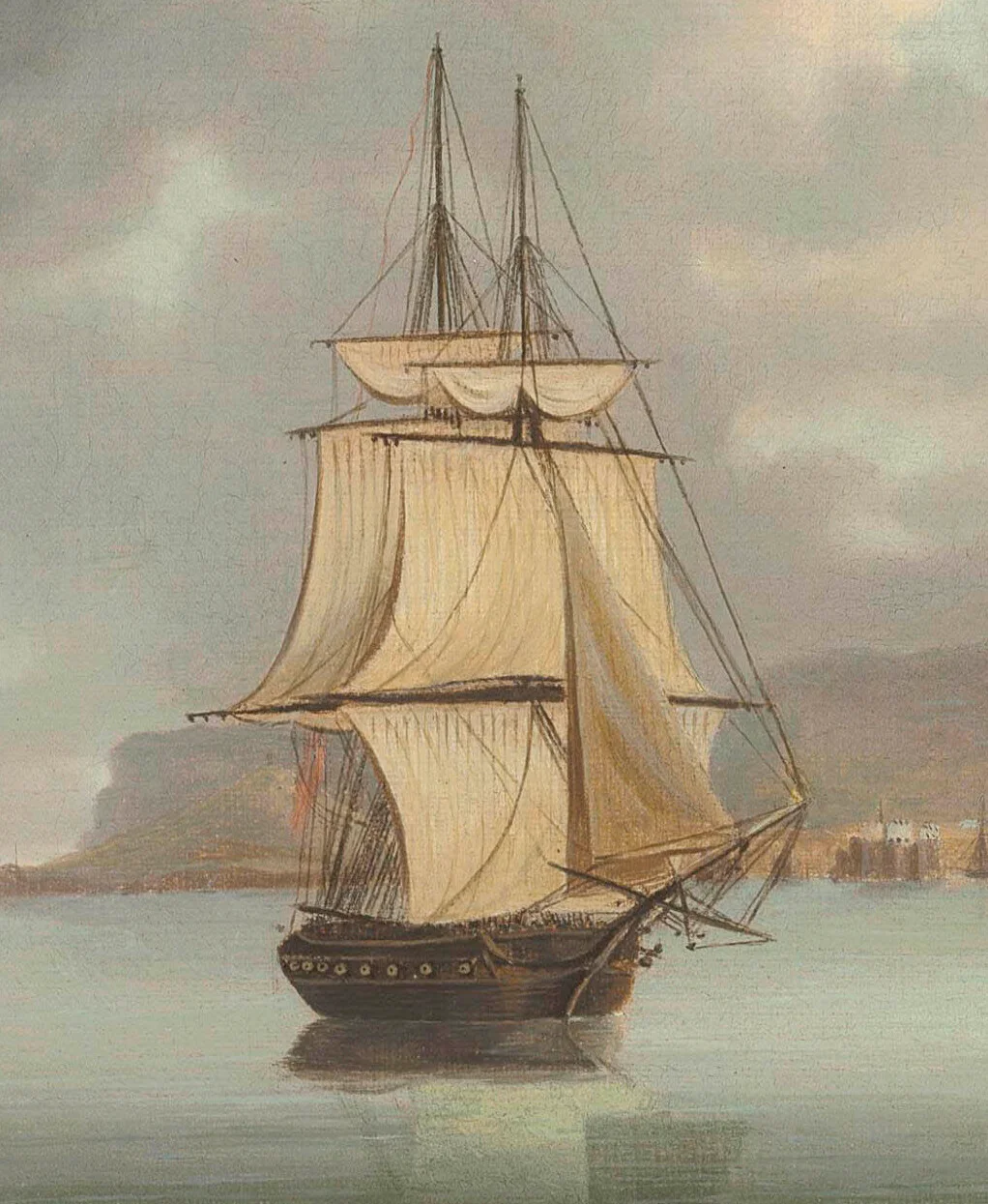
On the evening of 25 July 1806, lookouts aboard HMS Greyhound spotted four sails threading through the Selayar Strait, that narrow passage between Selayar Island and the southern tip of Celebes where currents run deep and dangerous. Captain Edward Elphinstone counted the silhouettes against the fading light and hesitated. One of the vessels looked enormous -- a ship of the line, perhaps, far too powerful for his 32-gun frigate and the little 18-gun brig-sloop Harrier sailing alongside. He was wrong. The ship was Victoria, a Dutch East Indiaman whose bulk mimicked a warship's profile in the tropical dusk. By dawn, Elphinstone would realize his mistake. By breakfast, he would own most of the convoy.
A Spice Islands Chessboard
The engagement did not erupt from nothing. It was the first move in a careful campaign. Since 1803, when the Peace of Amiens collapsed and war resumed between Britain and Napoleonic France, the Dutch East Indies had been a thorn in the side of British maritime trade. The Kingdom of Holland, ruled by Napoleon's brother Louis Bonaparte, maintained a naval squadron in the archipelago whose primary mission was suppressing piracy but whose presence menaced the lucrative shipping lanes through the Malacca Strait to China. In 1804, a French squadron under Rear-Admiral Charles Linois had used Batavia on Java as a base to attack the British China Fleet, an effort that failed at the Battle of Pulo Aura. By early 1806, with Linois gone and the Cape of Good Hope freshly seized, Rear-Admiral Sir Edward Pellew finally had enough ships to turn his attention east. He sent frigates ahead to scout the Dutch positions. Greyhound, under Elphinstone, was the first to arrive in the Java Sea.
The Chase at Dawn
Elphinstone and Commander Edward Troubridge in Harrier had already been busy. In June they had destroyed the Dutch brig Christian Elizabeth at Manado and captured the ship Belgica at Tidore. When the four sails appeared in the Selayar Strait on 25 July, Elphinstone gave chase immediately, but the mistaken identification of Victoria kept him cautious through the night. The Dutch convoy commander, Captain Nicolaas Sebastiaan Aalbers aboard the 36-gun frigate Pallas, used the darkness to form his ships into a line of battle -- Pallas and the 24-gun corvette William escorting the merchantmen Victoria and Batavier -- and hugged the Celebes coast near the Dutch-held ports of Bonthain and Balacomba. By morning, closer observation revealed that the threatening silhouette was merely a fat merchant vessel. Elphinstone committed to the attack.
Raking Fire and Struck Colors
The tactical execution was sharp and swift. At five in the morning, Elphinstone raised French colors in a ruse de guerre, trying to close the distance before the Dutch could react. Aalbers was not fooled, but it bought minutes. At 05:30, Greyhound opened fire on Pallas at close range and the frigate answered immediately. Elphinstone then pulled off a textbook maneuver: he passed across Pallas's bow and raked her, pouring shot down the length of the ship where the Dutch could barely reply. Throwing his sails back, he held Greyhound fixed across the bow, pounding the frigate from a position of near-impunity. By 06:10, Dutch fire had ceased. The flag came down. Forty of Pallas's 250-man crew were casualties, including Aalbers himself, who would later die of his wounds along with five other wounded men. British losses were strikingly light: one killed and eight wounded on Greyhound, three wounded on Harrier.
The Merchantmen Fall
While Elphinstone dismantled Pallas, Troubridge in Harrier had been absorbing ineffectual fire from Victoria and Batavier, biding his time. The moment the Dutch flagship struck her colors, Troubridge turned on the merchantmen. Victoria surrendered at 06:30. Captain William De Val in Batavier saw both the frigate and the brig-sloop closing on his isolated ship and struck his own flag ten minutes later. Of the four Dutch vessels, only William escaped, the corvette under Captain Feteris having taken no part in the fighting at all. The Royal Navy took Pallas into service and renamed her HMS Celebes, though she would be sold in just a year. The captured prizes were sent to India and auctioned.
Victory's Shadow
Elphinstone's success opened the door for the larger campaign Pellew had planned. In October, Captain Peter Rainier in HMS Caroline captured the Dutch frigate Maria Riggersbergen. In November, Pellew attacked Batavia itself. Within a year, the last Dutch warships in the East Indies were eliminated at Griessie. The Java campaign was a strategic triumph. But for Elphinstone, the triumph was brief. Ordered home to Britain in early 1807, he took passage aboard HMS Blenheim, flagship of Rear-Admiral Sir Thomas Troubridge -- Edward Troubridge's father. On or around 1 February 1807, Blenheim and her consort Java vanished in a hurricane southeast of Madagascar. The ship that last saw them reported distress signals flying from their masts. No trace of either vessel was ever found. Roughly 870 men perished, among them the captain who had won the first battle of the Java campaign just seven months before.
From the Air
Coordinates: 5.67S, 120.17E, in the Flores Sea off the southern coast of Sulawesi, Indonesia, near the Selayar Strait. The strait separates Selayar Island from the Sulawesi mainland. Sultan Hasanuddin International Airport (WAAA) at Makassar lies roughly 150 km to the northwest. The waters here are deep, with strong currents. From altitude, the distinctive coastline of southern Sulawesi and the chain of islands stretching toward Flores are visible in clear conditions.
Nearby Stories
- Katangka Mosque: Where Spears Guard the Pulpit 30 km away
- The Village That Said No to the Modern World 35 km away
- The Forgotten Citadel of Makassar 60 km away
- Coral Over the Sands 100 km away
- The Bluff That Worked and the Storm That Didn't Care 166 km away
- The Ninety Minutes of MV Marina Baru 2B 187 km away
- Isuzu: The Cruiser That Refused to Sink 239 km away
- The Month the World Didn't Know 276 km away