
The Sea Turtle Fort
From above, Fort Rotterdam looks like a sea turtle crawling toward the Makassar Strait. The Indonesians noticed this too -- they call it Benteng Penyu, the sea-turtle fort -- and the resemblance is no accident of erosion or urban encroachment. Dutch military engineers gave it that shape deliberately in the 1670s, when they rebuilt a conquered Makassarese fortress into the centerpiece of colonial power on Sulawesi. The turtle has outlasted every regime that occupied it. Four centuries after the first walls went up, the fort sits in the heart of modern Makassar, its seven-meter ramparts enclosing museums, a music conservatory, and the ghosts of a Javanese prince who spent the last 25 years of his life imprisoned within its bastions.
Before the Dutch Arrived
The original fortification on this site was not Dutch at all. Around 1634, the rulers of the Sultanate of Gowa built a fortress called Jum Pandan, named for the pandanus trees growing nearby, as part of a defensive program against Dutch East India Company aggression. The fort gave its name to the entire settlement -- Ujung Pandang -- which became an alternate name for the city of Makassar itself. For three decades, Jum Pandan anchored Makassarese resistance against VOC expansion in eastern Indonesia. That resistance ended in 1667, when the Sultanate of Gowa fell in the Makassar War and Sultan Hasanuddin signed the Treaty of Bongaya. Among the treaty's concessions: the fort at Ujung Pandang, handed over to the victors.
Speelman's Turtle
Dutch admiral Cornelis Speelman, the architect of Gowa's defeat, ordered the captured fort entirely rebuilt. Between 1673 and 1679, engineers constructed five bastions and reshaped the walls into the distinctive turtle outline that endures today. Speelman renamed it Fort Rotterdam after his birthplace in the Netherlands, though he himself never lived in the governor's residence that later bore his nickname. The construction drew materials from across Sulawesi: limestone hauled from the Selayar Islands, stone quarried from the karst mountains of Maros, timber felled in Tanete and Bantaeng. Each bastion received a name borrowed from territories under VOC influence -- Bonie, Boeton, Batjang, Mandassar, Amboina -- as if the fort were a map of Dutch ambition pressed into stone. A seven-meter rampart encircled the complex, fronted by a two-meter moat. Fort Rotterdam became the administrative and military headquarters for the entire region.
The Prince in the Bastion
Fort Rotterdam's most famous prisoner arrived in 1833. Prince Diponegoro, a Javanese national hero who had led a five-year revolt against Dutch colonial rule in the Java War of 1825-1830, was captured through deception during peace negotiations in 1830 and exiled first to Manado, then transferred to Fort Rotterdam in July 1833. The Dutch confined him within the southwestern bastion -- Bastion Bacan -- where he would remain for the rest of his life. He died there in 1855, having spent 22 years as a prisoner inside the turtle-shaped walls. Today Diponegoro is honored as one of Indonesia's national heroes, and his imprisonment at Fort Rotterdam is among the most resonant chapters of Indonesian resistance to colonial rule. The bastion that held him still stands, a stone cell that has outlived both the prisoner and the empire that held him.
What the Walls Still Hold
Thirteen buildings stand within Fort Rotterdam's perimeter, eleven of them original 17th-century structures. The oldest date to 1686 and line the northern curtain wall: the governor's residence, quarters for the senior merchant and captain, the predikant's house, and weapons storage. The so-called Speelman's House at the northwest corner now holds part of the La Galigo Museum, which displays prehistoric megaliths from Watampone alongside ancient weapons, coins, and utensils. Along the south curtain, former storage buildings house exhibits on local silk weaving, agriculture, and boatbuilding, with scale models of indigenous vessels. The eastern barracks contain a small library of Dutch books that once belonged to a 19th-century missionary named Reverend Mates, along with ships' logs of VOC captains and ancient lontar palm-leaf manuscripts. In the southeast corner, the former VOC administrative building houses an archaeology department; its ground floor was once a prison. Two additional buildings were added during the Japanese occupation of World War II, when the fort served briefly as a research station for linguistics and agriculture.
A Fort That Learned to Dance
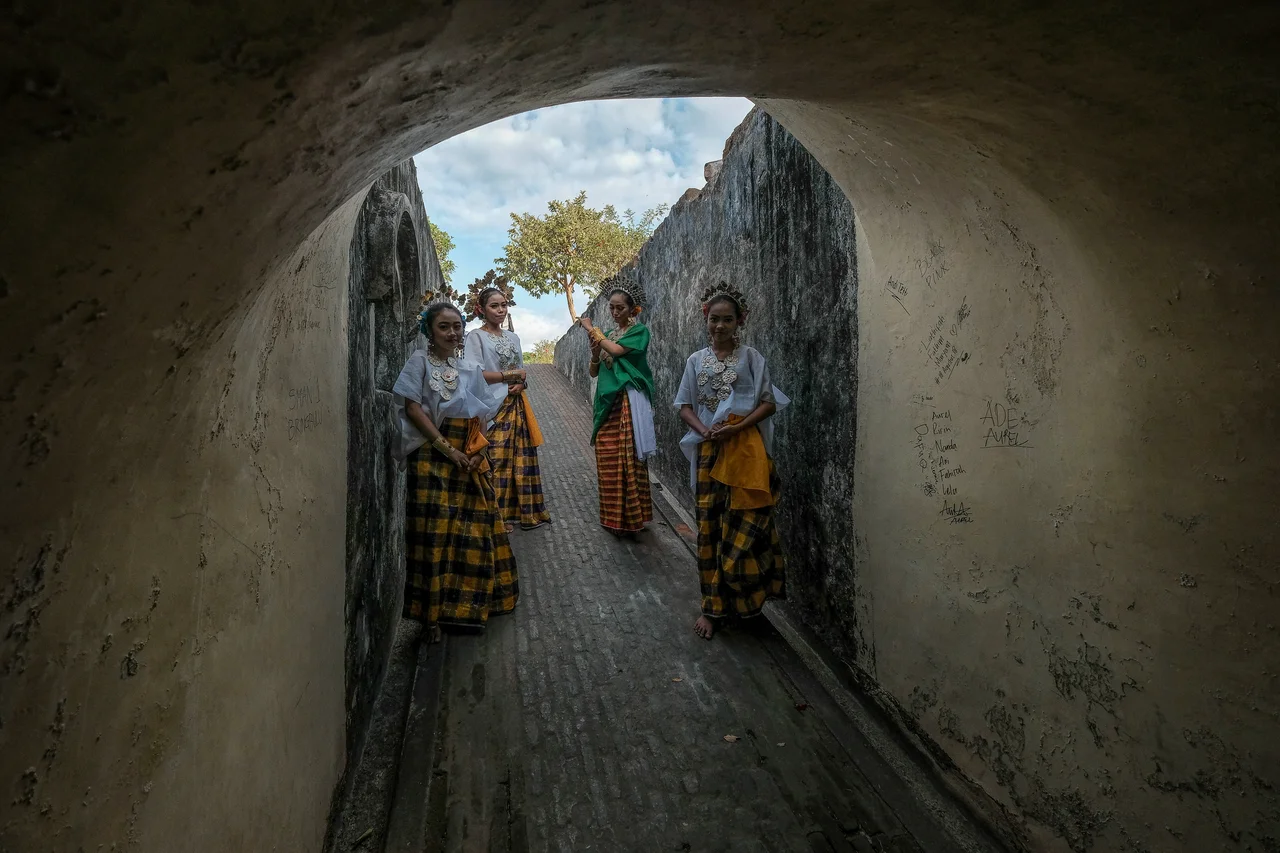
Fort Rotterdam ceased functioning as a military installation after 1937, and the Japanese occupation left it in disrepair. A major restoration in the 1970s gave the complex a second life as a cultural center. Today the fort houses a conservatory for music and dance, the city archive, and a historical and archaeological institute. Events fill the courtyard where soldiers once drilled -- concerts, dance performances, exhibitions. Visitors walk the ramparts where sentries once watched the strait, peering over walls built to repel the very people whose descendants now stroll through on weekends. Only the southwestern section of the original moat remains visible, and the ravelin has vanished entirely, but the five bastions still stand with their cannons. The turtle keeps its shape. It has simply changed what it guards: no longer Dutch trade routes and colonial order, but the layered memory of everyone who built it, conquered it, suffered within it, and ultimately reclaimed it.
From the Air
Fort Rotterdam is located at 5.13S, 119.41E on the waterfront of central Makassar, South Sulawesi. From the air, look for the distinctive turtle-shaped pentagonal fortification near the coast, surrounded by dense urban development. The fort is close to the Makassar Strait shoreline and the city's port facilities. Sultan Hasanuddin International Airport (WAAA) is approximately 20 km northeast. Best viewed at 2,000-4,000 feet to appreciate the turtle-shaped layout. The seven-meter walls and bastions are visible at lower altitudes.
Nearby Stories
- The Forest People Who Vanished 18 km away
- The Morning After the Strongman 24 km away
- Four Sails in the Selayar Strait 40 km away
- The Oldest Paintings on Earth 43 km away
- The Bird Letters of Sulawesi 57 km away
- Two Minutes of Distraction 157 km away
- The Five Minutes That Swallowed the Teratai Prima 193 km away
- Isuzu: The Cruiser That Refused to Sink 254 km away