.jpg)
Temple Newsam
Henry Stuart, Lord Darnley, was born here in 1545. Twenty years later he would marry Mary, Queen of Scots, father the boy who became James I of England, and be murdered at Kirk o' Field in Edinburgh in a plot that has been argued over by historians for four hundred and fifty years. Most of the great country houses of England can claim a king, a battle, or a love affair. Temple Newsam can claim the bloodline. From this Tudor manor east of Leeds, in a single generation, came the man who linked the Scottish and English crowns and put a Stuart on the throne of both kingdoms.
The Templars to the Darnleys
The Domesday Book of 1086 calls the manor Neuhusam, meaning new houses, held before the Norman Conquest by two Anglo-Saxon thanes named Dunstan and Glunier. After 1066 it passed to Ilbert de Lacy. By the early 13th century it belonged to the Knights Templar, who farmed the estate efficiently with 1,100 head of livestock, and whose name stayed on it long after the order was suppressed in 1307. Between 1500 and 1520 a Tudor manor house was built on the site. Henry VIII granted the estate to Margaret Tudor, who passed it to her son Matthew Stewart, 4th Earl of Lennox, after whose wife Lady Margaret Douglas it became the birthplace of their son Henry, Lord Darnley, in 1545. When Darnley married Mary, Queen of Scots in 1565, Elizabeth I seized the estate. Their son, the future James I, would inherit both his father's claim and his uncle's English throne, uniting the kingdoms under a single crown.
The Ingrams' House
In 1609 James I granted the estate to his Franco-Scottish second cousin Ludovic Stewart, 2nd Duke of Lennox, who promptly ran out of money and began selling it in 1622 to Sir Arthur Ingram, a Yorkshire-born London merchant and arms dealer. Ingram paid £12,000 for the property in two instalments, the last in 1624. His son rebuilt the house in the half-H plan it largely holds today, demolishing the east wing to leave the front open in what was then the fashionable shape. Round the top of the building, in stone letters Ingram had cut into the balustrade, runs this declaration: All Glory And Praise Be Given To God The Father The Son And Holy Ghost On High Peace On Earth Good Will Towards Men Honour And True Allegiance To Our Gracious King Loving Affection Amongst His Subjects Health And Plenty Be Within This House. It is one of the most elaborate inscriptions on any English house. Six months after Charles I was beheaded in 1649, the younger Arthur Ingram was declared a delinquent for his Royalist loyalties, paid his composition, and retired to Temple Newsam. The Ingrams, later Viscounts of Irvine, kept the house for nearly two hundred years.
Brown's Landscape and the Coal Beneath
In the 1760s, Charles Ingram, 9th Viscount of Irvine, hired Capability Brown to redesign the park. Brown's contoured landscape of clumped trees, sweeping vistas, and ornamental water still defines the estate, though the great lake he planned near the house was never dug. Brown's serpentine pasture and Reptonian distances also disguised something less polite: coal. Estate records show coal pits in and around the park from the seventeenth century, and bell pits had been worked in Bell Wood south of the house for decades. In 1815, William Fenton, one of Yorkshire's so-called Coal Kings, sank a mine shaft on the estate at Thorpe Stapleton and named the colliery Waterloo to commemorate the battle of that year. A village grew up around it. The Lancashire and England cricketer Albert Ward was born in the colliery village in 1865. Today no trace of the workings remains; the parkland was relandscaped over the pit. In 2019 the house ran a temporary exhibition called Blot on the Landscape, examining the coal that had paid for the elegance.
Hampton Court of the North
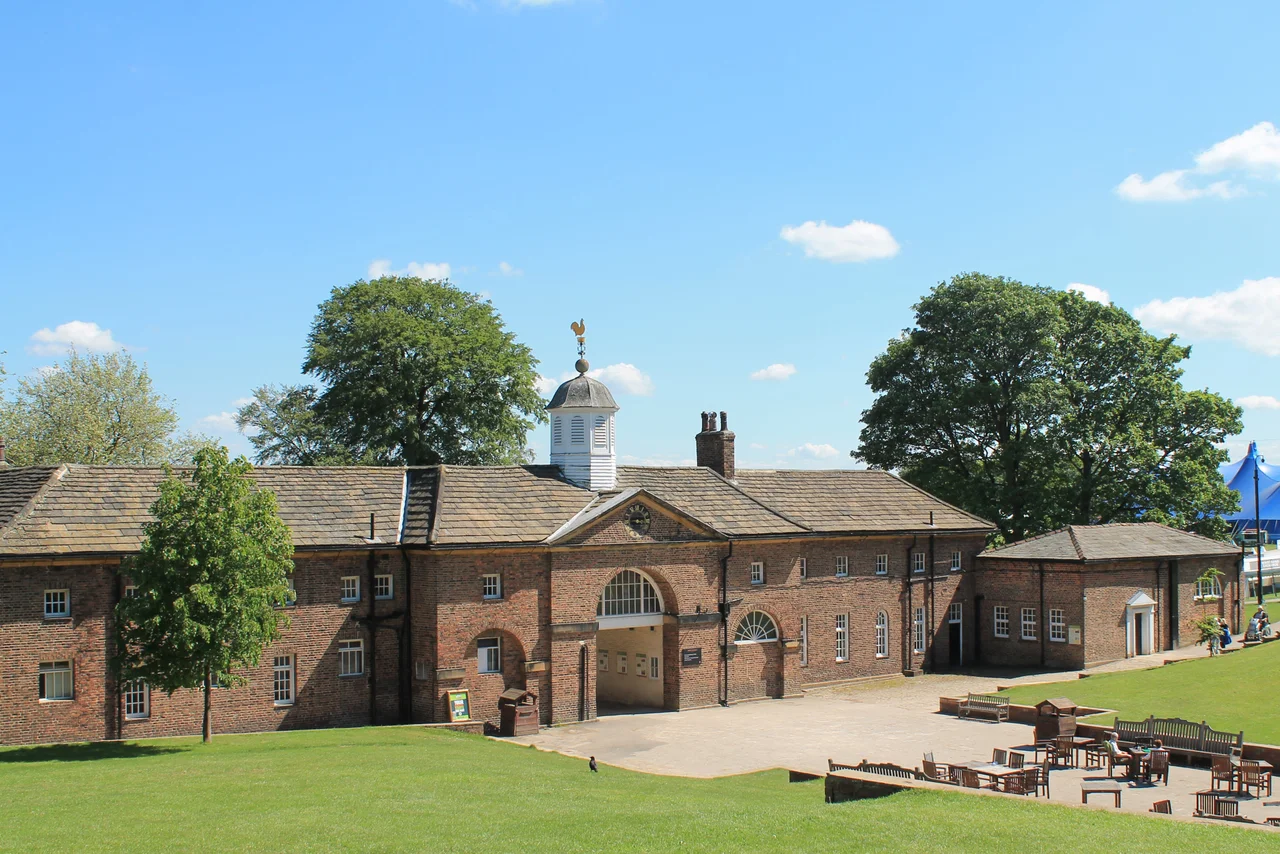
When Edward Wood sold the house and park to Leeds Corporation in 1922 for a nominal sum, with covenants ensuring preservation, the Derby Daily Telegraph compared it to Hampton Court Palace. It opened to the public on 19 October 1923. The collections inside, fine and decorative art designated by DCMS as nationally significant, made it a museum as much as a house. Former culture minister Mark Fisher once placed Temple Newsam in his top three non-national museums in Britain, alongside Birmingham's Barber Institute and Dulwich Picture Gallery. The Picture Gallery is an important example of early English Rococo style. The Home Farm, with a barn built in 1694, is the largest working rare breeds farm in Europe, one of only sixteen approved by the Rare Breeds Survival Trust. The wider estate forms the second largest part of the Forest of Leeds. There are six National Plant Collections, including rare Michaelmas daisies and primula auricula. Pegasus Wood, planted to the south of the house, commemorates the veterans who took Pegasus Bridge during the Normandy landings in 1944. The grounds have hosted Party in the Park, the V Festival, the Leeds Festival, and a weekly Parkrun. The house was built to declare allegiance to a Stuart king. The grounds now belong to Leeds.
From the Air
Temple Newsam sits at 53.78N, 1.46W in the east of Leeds, just south of Halton and Whitkirk and north of the M1 motorway. The Tudor-Jacobean half-H house is centered in a Capability Brown landscape of rolling parkland. Leeds Bradford Airport (EGNM) is 6 nautical miles northwest. From altitude, look for the distinctive E-shaped house plan at the center of an oval of parkland, just east of the A6120 ring road and north of the M1 corridor.
Nearby Stories
- Stockport Air Disaster 4.5 km away
- Hillsborough Disaster 6.1 km away
- Murder of Sophie Lancaster 6.3 km away
- Battle of Stamford Bridge 9.8 km away
- Wressle Castle 12 km away
- Gordale Scar 12 km away
- Gainsborough Old Hall 19 km away